WorldPath AIWORLDPATH•AI
Europe

France Passport

Ranked #4 Globally

In 2026 the France passport sits in joint fourth place worldwide, tied with Germany and Italy. Its holders can enter 185 destinations either without a visa or with a quick visa-on-arrival. A French citizen carries something most travel documents cannot match: the right to live, work, study, and retire in any of the 27 (European Union) member states, with no permit and no sponsor. French nationals also cross the whole (the borderless travel zone covering most of Europe) without checks, enter the United States under its visa-waiver scheme, and reach mainland China visa-free for 30-day stays through 31 December 2026. The passport is issued only to French nationals by the Ministry of the Interior, through (the National Agency for Secure Documents). France does not sell citizenship; the standard route is five years of legal residence followed by naturalisation.

4th
Global Ranking
185
Destinations
92.52
Mobility Score
France Passport - Passport Power 3rd | worldpath.ai WRI

France Passport Global Mobility Context

France is a founding member of the European Union, a permanent member of the United Nations Security Council, a (Group of Seven major industrial democracies) economy, and a (North Atlantic Treaty Organization, the Western military alliance) ally. That standing is read at every border desk, and it is why a French passport rarely draws a second question.

France runs one of the largest diplomatic networks on earth — over 160 embassies and around 90 consulates — second only to a small handful of states. A French traveller in trouble almost anywhere can reach a French mission, and that broad reach is one reason the document opens 185 destinations with little friction.

The single biggest advantage is not on the list of visa-free countries at all: it is (European Union) citizenship. A French passport lets the holder settle in Lisbon, take a job in Berlin, or open a shop in Dublin with no visa and no work permit — a right no Asian or North American passport can offer.

France issued (International Civil Aviation Organization) 9303-compliant electronic passports from April 2006 and added fingerprints to the chip in 2009. The contactless chip stores the holder's photo and biographic details so e-gates can read it in seconds at airports across Europe, Asia, and the Gulf.
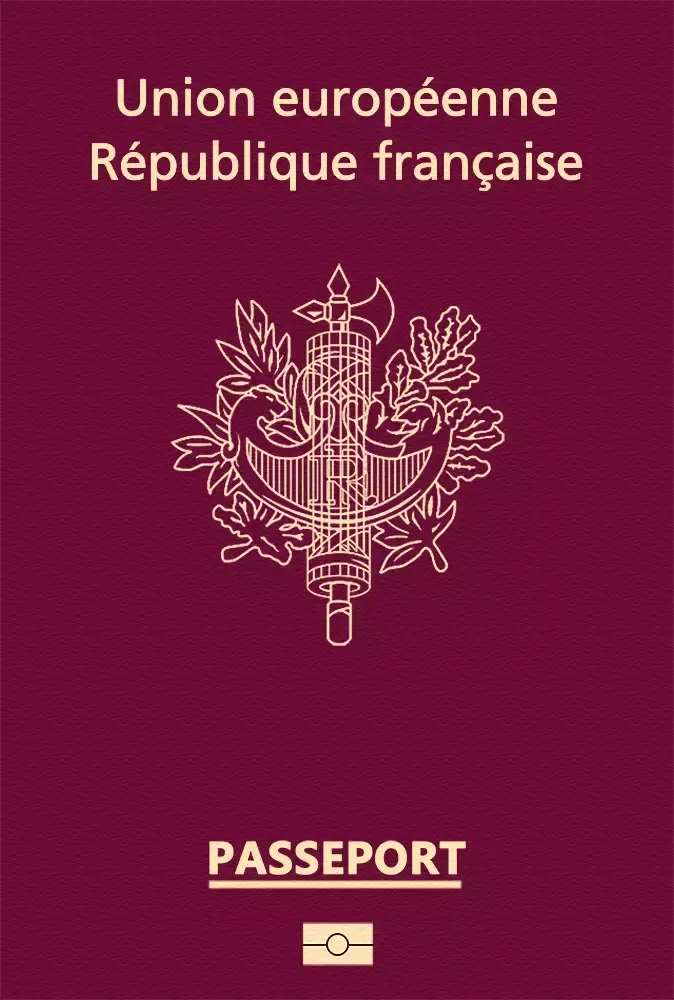
The passport is an official travel document. It also serves to prove the identity and the French nationality of its holder, in the same way as the national identity card.

France Passport at a Glance

Global rank (2026)

#4 worldwide, tied with Germany and Italy at 185 visa-free destinations on the leading mobility indices. Spain sits one place ahead at #3 (186); Singapore leads at #1 (192).

Visa-free destinations

185 destinations, including the full , the United Kingdom, Japan, the United States, every (Group of Seven) economy, and mainland China for 30-day stays through 31 December 2026.

Document type

Biometric ePassport with a contactless chip built to the international (International Civil Aviation Organization) 9303 standard. France issued its first electronic passport in April 2006 and added fingerprints to the chip in 2009.

Page count

32 pages in the standard passport. Frequent travellers who fill it with stamps and visas can request the 48-page 'grand voyageur' (frequent-traveller) edition for the same fee.

Languages

The personal-data page is printed in French and English, with the field labels repeated in the other official European Union languages further inside the booklet.

Adult validity

10 years for adults aged 18 and over. A minor who turns 18 while holding a child passport may keep using it until it expires rather than reapply early.

Child validity (under 16)

5 years for applicants under 18, so families with young children renew roughly twice as often as adults do.

Dual citizenship

Allowed without limit. France has accepted multiple nationalities since 1973 and does not ask new citizens to give up their original passport, though some other countries still do.

Issuing authority

The Ministry of the Interior, which produces every French passport through (the National Agency for Secure Documents). Town halls take applications inside France; consulates handle them abroad under the Ministry for Europe and Foreign Affairs.

History

France has issued passports since the 18th century. The first electronic passport appeared in April 2006, fingerprints joined the chip in 2009, and the current burgundy cover design was refreshed in 2022.

France Passport Visa-Free Destinations by Region

Regional Mobility

Economic Mobility Score: 92.52%Country GDP: 3.6%
Visa Exceptions
Europe shows 100% because a French citizen can not only travel but live and work in all 27 European Union states. China is counted as open under the unilateral 30-day visa-free arrangement running through 31 December 2026. A few destinations need a quick online authorisation (ESTA, eTA, eVisitor, NZeTA, or an e-visa) before arrival.

The destinations French travellers ask about most are the United States (entered with an — Electronic System for Travel Authorization, a quick online pre-screening, not a visa), the United Kingdom (an (Electronic Travel Authorisation) since 2 April 2025), the whole with no checks at all, Japan and South Korea for 90 days each, and mainland China for 30 days under a Beijing arrangement that runs through 31 December 2026. The deepest benefit, though, is closer to home: any of the 27 (European Union) states is open to a French citizen not just to visit but to live and work in.

Americas

France reaches almost the entire Western Hemisphere without a prior visa. The United States admits French citizens under its Visa Waiver Program once they buy an ESTA (Electronic System for Travel Authorization) online for USD 21, valid two years. Canada uses its own online eTA (Electronic Travel Authorization), approved within minutes for flights. Mexico grants 180 days, Brazil 90, and the rest of Latin America — Argentina, Chile, Peru, Colombia, Uruguay, Ecuador, plus every Central American republic — waves French visitors through for short tourism stays. France's own overseas territories in the Caribbean and South America, such as Guadeloupe, Martinique, and French Guiana, are part of France itself, so a French passport needs nothing extra to land there.

Europe

Europe is where the French passport is strongest, and the reason is legal rather than touristic. As an EU (European Union) citizen, a French national may live, work, study, and retire in any of the other 26 member states with no visa and no permit — move to Amsterdam on Monday and start a job on Tuesday. Travel inside the Schengen Area (the passport-free zone covering most of Europe) involves no border check whatsoever, so France, Germany, Spain, Italy, the Nordic countries, and newer members Croatia, Bulgaria, and Romania blur into one space. The non-EU Balkans — Serbia, Albania, Bosnia and Herzegovina, Montenegro, North Macedonia, and Moldova — also admit French visitors freely. Because France is itself an EU and Schengen state, the (Entry/Exit System — the European Union's automated record of non-EU arrivals, live since 10 April 2026) and the upcoming (European Travel Information and Authorisation System) pre-screening do not apply to French citizens; they are systems for visitors coming the other way.

Asia-Pacific

Asia-Pacific opened up sharply for French travellers in recent years. Mainland China dropped its visa for ordinary French passport holders under a unilateral Beijing scheme; the arrangement was extended on 5 November 2025 to run through 31 December 2026, allowing 30-day stays for tourism, business, family visits, and transit. Japan and South Korea each give 90 days visa-free, Taiwan 90, Thailand 60, Vietnam 45, and Malaysia, Singapore, and Indonesia between 30 and 90 days. Australia and New Zealand are reached through quick online forms — the eVisitor for Australia and the (New Zealand Electronic Travel Authority). Across the Pacific, island nations from Fiji to Samoa to Palau admit French citizens without paperwork, and France's own Pacific collectivities — New Caledonia, French Polynesia, and Wallis and Futuna — require nothing beyond the passport itself.

Middle East

The Gulf is straightforward for French passengers, many of whom pass through Doha or Dubai on long-haul routes. The United Arab Emirates and Qatar grant 30 days visa-free, Oman issues a short visa-on-arrival or e-visa, and Saudi Arabia sells a 90-day tourist e-visa online in minutes. Israel asks French visitors to obtain an (Electronic Travel Authorisation Israel) online before arrival, while Jordan, Bahrain, and Kuwait offer visa-on-arrival or e-visas. The exceptions are political rather than bureaucratic: France's foreign ministry advises against non-essential travel to several states in the region on security grounds, regardless of the visa rule on paper.

Africa

African access is a mix of open doors and advance paperwork. Morocco, Tunisia, Senegal, Mauritius, Botswana, and South Africa admit French citizens visa-free for stays of up to 90 days, reflecting deep historical and economic ties between France and parts of the continent. Kenya now requires a short online travel authorisation, and Egypt, Tanzania, Rwanda, Ethiopia, Madagascar, and Uganda issue e-visas or visa-on-arrival for tourists. A band of states still asks for a full embassy visa arranged in advance — among them several in the Sahel and Central Africa — and many of these overlap with destinations France's foreign ministry already flags for security reasons.

Offshore Jurisdictions

The offshore and financial-centre territories that matter to globally mobile French holders are open with no visa. The Cayman Islands and Bermuda allow stays of up to six months for tourism. The British Virgin Islands and the Bahamas each admit French visitors for 90 days, handy on the long routes from Paris that connect through Miami. The Channel Islands of Jersey and Guernsey, the Isle of Man, and Gibraltar are reached freely as British dependencies. Hong Kong gives French passport holders a generous 90 days, longer than many passports receive there.

Where a Visa Is Still Required

  • Russia: full e-visa required, and France's foreign ministry advises against non-essential travel.
  • India: e-visa applied for online before departure.
  • Australia: not a visa as such, but an eVisitor authorisation must be obtained online before flying.
  • Saudi Arabia: a tourist e-visa is needed, though it is issued online within minutes.
  • Several Sahel and Central African states: full embassy visa required, with much of the region under French travel warnings.

How to Get a France Passport

1

Get a Long-Stay Residence Permit

There is no investor passport in France, no donation route, and no fast lane for the wealthy. The journey to a French passport begins with legal residence, which for non- (European Union) applicants means a long-stay visa followed by a residence permit. EU citizens already have the right to live in France and skip this step.

The most common skilled route is the Passeport Talent (Talent Passport), a multi-year permit for qualified workers, company founders, investors, and researchers. The qualified-employee category set its minimum gross salary at $46,000 (€39,582) a year from August 2025; the path for highly skilled hires sits higher, at $69,000 (€59,373). The permit is issued for up to four years at a time and is renewable, and it lets the holder's spouse and children live and work in France too.

Other paths to residence include a standard employee permit tied to a job, a student visa that can convert to a work permit after graduation, and a family permit for the spouse of a French citizen. Each issues a residence card (titre de séjour) that the holder renews while building toward permanent settlement.

Applications start on the France-Visas portal for the visa, then move to the online platform run by the Ministry of the Interior for the residence card itself. Most non-EU applicants now also face an integration contract and language commitments early in their stay, well before any citizenship application.

2

Build Five Years of Residence

Naturalisation by decree — the main route for someone with no French parent or spouse — requires five years of habitual residence in France. The clock counts continuous, legal presence; long absences abroad can break it and reset the count. Certain people qualify after only two years, including graduates of French higher education, but five years is the standard baseline.

Residence alone is not enough. France looks for genuine integration: stable income drawn mainly from French sources, payment of French taxes, no serious criminal record, and real ties to the country. A 2025 government instruction pushed prefectures to refuse files where most income comes from abroad, even when the applicant lives in France full-time, so the source of earnings now matters as much as the amount.

Language sits at the centre of the test. From 1 January 2026 the required level rose from to on the European language scale — roughly the level of someone who can follow a meeting and write a clear letter in French. Applicants prove it with an approved test or a French diploma. The bar for a long-term resident card stays lower at B1, but full citizenship now demands B2.

Also from 1 January 2026, most applicants must pass a new civic exam: 40 multiple-choice questions in 45 minutes on French history, institutions, and republican values, with a pass mark of 80%. The exam sits alongside the long-standing signed charter of rights and duties and the in-person interview at the prefecture.

3

Apply for French Citizenship

The citizenship file is submitted online through the nationality portal, then assessed by the prefecture and forwarded to the (the sub-directorate for access to French nationality) in Rezé, near Nantes, which handles naturalisation for the whole country. The applicant attends an interview that tests both French and knowledge of the country.

The dossier is substantial: proof of five years' residence, tax returns for recent years, pay slips or business accounts showing stable French-source income, the language certificate, the civic-exam result, a criminal-record check, and full civil-status documents such as birth and marriage certificates, translated by a sworn translator. Missing or inconsistent paperwork is the most common reason a file stalls.

France does not require new citizens to give up their original nationality, so most applicants keep their first passport alongside the French one. The applicant signs the charter of the rights and duties of the French citizen, a formal statement of the values they are agreeing to uphold.

Processing is slow and should be planned for: most decrees of naturalisation in 2026 take roughly 18 to 24 months from a complete filing to publication. Approval is confirmed when the applicant's name appears in a naturalisation decree printed in the Journal Officiel, the official government gazette. There is no government fee for the naturalisation decision itself.

4

Apply for the Passport

Once the naturalisation decree is published in the Journal Officiel, the new citizen is French and can apply for a passport straight away. There is no waiting period after the decree. The applicant first secures proof of nationality — usually the decree reference or a Certificat de Nationalité Française (Certificate of French Nationality) — which underpins the passport application.

Passport applications are made through (the National Agency for Secure Documents) and finished in person at any town hall fitted with a biometric registration station, where fingerprints and a photo are captured. French citizens living abroad apply instead at their consulate. The required items are proof of identity and nationality, a compliant photo, and the fee.

The standard adult passport costs EUR 86 in mainland France (about USD 95 at May 2026 exchange rates) and is valid for 10 years. Someone who travels constantly can ask for the 48-page 'grand voyageur' (frequent-traveller) booklet at the same price instead of the 32-page standard one. There is no extra charge for the biometric chip.

The passport issued is the biometric ePassport with a contactless (International Civil Aviation Organization) 9303 chip holding the holder's photo and fingerprints. Once it is in hand, the new citizen has the same rights as any other French national, including the right to live and work anywhere in the European Union.

Alternative Route: French Nationality by Descent and by Birth in France

France passes nationality down by blood, so many people are French without ever having applied. Under the Civil Code, a child is French at birth if at least one parent is French at that moment, whether the child is born in France or abroad. Someone who can document a French parent at their birth is therefore usually French already and simply needs to prove it, not acquire it.

The proof is a Certificat de Nationalité Française (Certificate of French Nationality), issued by a court registry. The applicant shows an unbroken chain of civil-status records — their own birth certificate, the French parent's birth certificate, and evidence the parent held French nationality when the applicant was born, such as a passport or consular registration. With the certificate in hand, the person can request a French identity card and passport directly. Unlike some European descent routes, the French line does not stretch indefinitely back through great-grandparents; it works cleanly through a parent and becomes harder to prove the further back the French ancestor sits.

France also grants nationality through birth on French soil in specific cases, a principle known as double droit du sol (double right of soil). A child born in France to a parent who was themselves born in France is French automatically. Separately, a child born in France to foreign parents can claim French nationality as a young adult if they have lived in France for several years during adolescence — a route that rewards growing up in the country rather than ancestry.

There is no heritage or ancestry programme for distant descendants of French emigrants comparable to the descent laws of Italy or Ireland. For people whose French ancestor is several generations back and whose civil-status chain is broken, the realistic path is ordinary residence and naturalisation rather than a claim by blood.

Comparison of France Passport With Other Top Passports

Passport

Rank

Visa-free

Key edge

Singapore Passport

#1

192

Top-ranked passport; raw mobility leader

Germany/Italy/Spain Passports

#4

185

EU peers — live and work in 27 states

United Kingdom Passport

#6

184

Common-law peer; English-speaking financial hub

United States Passport

#10

179

Worldwide-tax contrast on a similar mobility tier

How the France passport compares depends on the yardstick: raw visa-free count, the right to settle somewhere, or exposure to tax. France's defining edge is European Union citizenship, so the picks below are framed around what a French holder gains or gives up against each peer.

France vs the top-ranked passport. Singapore leads the 2026 index at #1 with 192 destinations, against France's 185 at joint #4. But the comparison flips on settlement rights: a French citizen can move to and work in 27 (European Union) countries, while a Singapore passport grants no such right anywhere. For anyone who wants to live abroad rather than only visit, France is the stronger document despite the lower rank.

France vs its EU neighbours. Germany, Italy, and Spain are France's closest peers, clustered at the top with 185 to 186 destinations and identical EU living-and-working rights. The travel gaps between them are tiny and shift month to month. The real choice is rarely about mobility; it comes down to which country's tax system, language, and naturalisation timeline fit a person's life.

France vs the United States. The United States sits lower at #10 with 179 destinations, but the sharper contrast is tax. America taxes its citizens on worldwide income for life through the (Internal Revenue Service) wherever they live, enforced abroad through (the Foreign Account Tax Compliance Act). France taxes by residence: a French citizen living outside France generally pays no French tax on foreign income — a difference that can matter more than a few visa-free countries.

Pros and Cons of the France Passport

Pros7 strengths
Cons7 frictions
  • 01Rights
    Live and Work Across All 27 EU States
    A French passport carries citizenship of the European Union (EU), the 27-nation bloc, so the holder can settle and take a job in any other member state with no visa or work permit. This settlement right is something no Asian or North American passport offers.
    EU rights
  • 02Mobility
    Visa-Free Entry to 185 Destinations
    The passport opens 185 destinations with little friction, including the full Schengen travel zone, Japan, the United States, and mainland China for 30-day stays through the end of 2026. That places France joint 4th on the leading 2026 mobility rankings.
    185 places
  • 03Standing
    Backed by Top-Tier Diplomatic Weight
    France is a permanent member of the United Nations (UN) Security Council and a G7 (Group of Seven major economies) state, a standing read at every border. It also runs one of the largest mission networks on earth, so a citizen in trouble almost anywhere can reach French help.
    G7 standing
  • 04Rights
    Keep Your Original Nationality
    France has accepted multiple nationalities since 1973 and never asks new citizens to surrender their first passport. Most people who naturalise simply hold the French document alongside the one they already had.
    Dual OK
  • 05Tax
    Taxed on Residence, Not Citizenship
    France ties tax to where you actually reside. A French citizen who lives outside the country generally pays nothing on income earned overseas, unlike an American, whose passport carries a lifelong worldwide tax bill no matter where they settle.
    Residence tax
  • 06Eligibility
    A Clear Skilled-Worker Route to Residence
    The Talent Passport is a multi-year permit for qualified employees, founders, and researchers that also lets a spouse and children live and work in France. It is the most common skilled path toward eventual settlement and citizenship.
    Talent visa
  • 07Document
    Fast-Reading Biometric Chip Since 2006
    France began issuing electronic passports in 2006 and added fingerprints to the chip in 2009. Because the booklet meets the international aviation standard for travel documents, e-gates from Europe to the Gulf clear the holder in seconds.
    Biometric
  • 01Eligibility
    Citizenship Now Demands B2-Level French
    From 1 January 2026 the language bar for naturalisation rose from B1 to B2 on the European scale, roughly the level needed to follow a meeting and write a clear letter. Applicants prove it with an approved test or a French diploma.
    B2 French
  • 02Eligibility
    A New Civic Exam You Must Pass
    Also from January 2026, most applicants face a new civic test: 40 multiple-choice questions in 45 minutes on French history, institutions, and republican values, with a steep 80 percent pass mark required to qualify.
    Civic exam
  • 03Eligibility
    Naturalisation Decisions Take 18 to 24 Months
    Most naturalisation decrees in 2026 take roughly 18 to 24 months from a complete filing to publication in the official gazette. Missing or inconsistent paperwork is the most common reason a file stalls even longer.
    18-24 mo
  • 04Eligibility
    Five Years of Continuous Residence Needed
    The main naturalisation route requires five years of habitual, legal residence, and long absences abroad can break the count and reset it. Only certain people, such as graduates of French universities, qualify after two years.
    5-yr wait
  • 05Eligibility
    Income Must Come Mainly From France
    A 2025 government instruction pushed officials to refuse files where most income comes from abroad, even for applicants living in France full-time. The source of earnings now matters as much as the amount.
    French pay
  • 06Eligibility
    No Investor or Donation Shortcut
    France has no investor passport, no donation route, and no fast lane for the wealthy. Every applicant without a French parent or spouse must build up years of qualifying residence the ordinary way.
    No buy-in
  • 07Validity
    Children's Passports Expire in Five Years
    While an adult book lasts 10 years, a passport for an applicant under 18 is valid for only 5. Families with young children therefore renew the document roughly twice as often as adults do.
    Kids 5 yrs

Dual Citizenship — the Operational Rules

France is one of the most relaxed countries in the world on dual nationality. It has allowed its citizens to hold other passports since 1973, and it does not ask people who naturalise as French to renounce the nationality they were born with.

What France itself requires. Nothing. A person can hold French nationality alongside two, three, or more others as far as French law is concerned. France keeps no cap and imposes no reporting duty for simply holding a second passport. The only limits come from the other country: some states, such as India, still force their citizens to give up that nationality on becoming French, so the practical outcome depends on the rules at the other end.

The border rule entering France. A dual national who also holds a French passport should enter and leave France on the French document. Inside the European Union this matters less because French citizens are not stamped, but presenting the French passport at the French border is the clean choice and avoids questions about residence or visa status that a foreign passport can trigger.

The rule abroad. Outside France, the holder presents whichever passport works best for the destination — the French one to glide through Schengen and to claim (European Union) rights, the other where it gives easier entry. A dual national should avoid mixing documents on a single trip, entering a country on one passport and leaving on another, which can confuse border records.

The tax point to watch. Holding two passports does not by itself create a tax bill. France taxes on residence, not nationality, so a French citizen living abroad is generally outside French income tax on foreign earnings. The exception is a second nationality that taxes by citizenship — chiefly the United States — in which case the American obligation follows the person regardless of where they live, on top of French rules while resident in France.

Bottom Line on the France Passport

The France passport is one of the strongest in the world by any measure, ranked joint #4 in 2026 with 185 visa-free destinations and backed by France's seat on the United Nations Security Council, its (Group of Seven) membership, and one of the largest diplomatic networks anywhere. At a border it carries weight that few documents match.

Its defining feature is not the visa-free list but the right behind it: EU (European Union) citizenship. A French passport lets the holder live, work, study, and retire across 27 countries with no permit — a freedom no passport from Asia, the Americas, or the Gulf can offer. Paired with France's residence-based tax system, under which citizens abroad usually owe no French tax on foreign income, the document suits the globally mobile unusually well.

The cost is time and integration rather than money. Naturalisation needs five years of residence, stable French-source income, and — from 1 January 2026 — -level French plus a 40-question civic exam scored at 80%. Decrees in 2026 take roughly 18 to 24 months to publish after a complete file. There is no investor shortcut and no way to buy in; the price of entry is genuinely building a life in France.

For someone willing to invest those years, the rewards are large: visa-free or easy access to 185 destinations, the freedom of an entire continent to settle in, generous dual-citizenship rules that let the original passport stay, and a 10-year travel document read smoothly at e-gates worldwide. The France passport rewards commitment to the country with one of the widest sets of rights any nationality confers.

France Passport FAQ

What is the French passport ranking in 2026?

As of April 2026, the French passport ranks 4th on global passport rankings (Q1 2026), tied with eleven other European countries including Germany, Italy, and Spain, with visa-free or visa-on-arrival access to 185 destinations. On the Passport Index 2026, France also sits in the top tier (5th, tied with multiple European nations). France has consistently ranked among the top five passports globally for over a decade, a reflection of its P5 Security Council status, EU membership, and extensive bilateral visa waiver agreements.

How many countries can French passport holders visit visa-free?

French passport holders have visa-free or visa-on-arrival access to 185 destinations as of Q1 2026, including all 26 Schengen states, the United States (ESTA), Canada (eTA), the United Kingdom (ETA), Australia (ETA), Japan, South Korea, Singapore, Brazil, Argentina, Chile, and virtually all of Latin America. French citizens additionally hold the right to live and work permanently in any EU member state — a mobility benefit that goes beyond what any visa-free stamp can offer.

Can I get French citizenship without living in France?

Yes — through citizenship by descent. If at least one of your parents was a French citizen at the time of your birth, you can claim French nationality regardless of your country of birth or residence. No French language test, no residency, and no interview are required. This pathway is completely unchanged by France's January 2026 naturalization reforms, which only affect naturalization-by-residency applications. Grandparent-based claims are also possible but are subject to the 50-year désuétude bar under Article 30-3 of the French Civil Code.

How long does it take to get French citizenship by naturalization?

French citizenship by naturalization typically takes 12 to 24 months from a complete application submission to decree issuance, following a minimum 5-year continuous lawful residency in France (or 2 years for French university graduates). As of January 1, 2026, applicants must also pass a formal B2-level French language exam and a civic knowledge test covering French history, values, and institutions before submitting their naturalization dossier.

Does France allow dual citizenship?

Yes. France has permitted dual and multiple citizenship without restriction since 1973. French nationals who acquire another nationality do not lose French citizenship. Foreign nationals who become French — by descent, naturalization, or marriage — are not required to renounce any existing passport. The most important practical check is the home country's rules: while most Western countries permit dual citizenship with France, some countries (notably China, Saudi Arabia, and Singapore) restrict or prohibit dual nationality for their citizens.

How does the French passport compare to Caribbean CBI passports?

The French passport (185 visa-free destinations, full EU establishment rights, P5 diplomatic status) is categorically superior to every Caribbean citizenship-by-investment passport on mobility outcomes. For reference: St. Kitts and Nevis reaches 156 destinations; Grenada, 147; Dominica, 145. However, the French passport cannot be purchased — there is no citizenship-by-investment program in France. For investors specifically targeting EU access and a European passport through investment, the remaining EU golden visa routes (Austria, Luxembourg, Bulgaria's investor program) are the only functional pathways. The French passport is the destination, not the mechanism.

What are the new French naturalization requirements in 2026?

As of January 1, 2026, France has significantly tightened naturalization requirements. Key changes include: the French language requirement raised from B1 to B2 level (complex material, nuanced communication); a new mandatory civic exam covering French history, geography, culture, values, and republican institutions; income must come primarily from French sources (professional integration requirement); and any prior irregular immigration status, even decades ago, results in permanent ineligibility. These changes do not affect citizenship by descent or citizenship by marriage procedures, which remain governed by unchanged rules.

Is the French passport worth it for investors?

For eligible applicants — particularly those with French ancestry — the French passport delivers the highest-value mobility outcome available, with 185 visa-free destinations and permanent EU residence rights for the holder and all direct descendants. For investors without French ancestry, France offers no direct investment-to-citizenship pathway. Those seeking a European passport through investment should consider alternative EU programs (Austria, Luxembourg, Malta was terminated in April 2025), and plan for a 7 to 10-year pathway to citizenship, which may eventually include French naturalization if they establish substantial ties to France during that period.

Related Information

Verified by

Sarah Mitchell
Senior Immigration Advisor
at WorldPath AI