WorldPath AIWORLDPATH•AI
Abstraction background for New Business Domicile
Europe

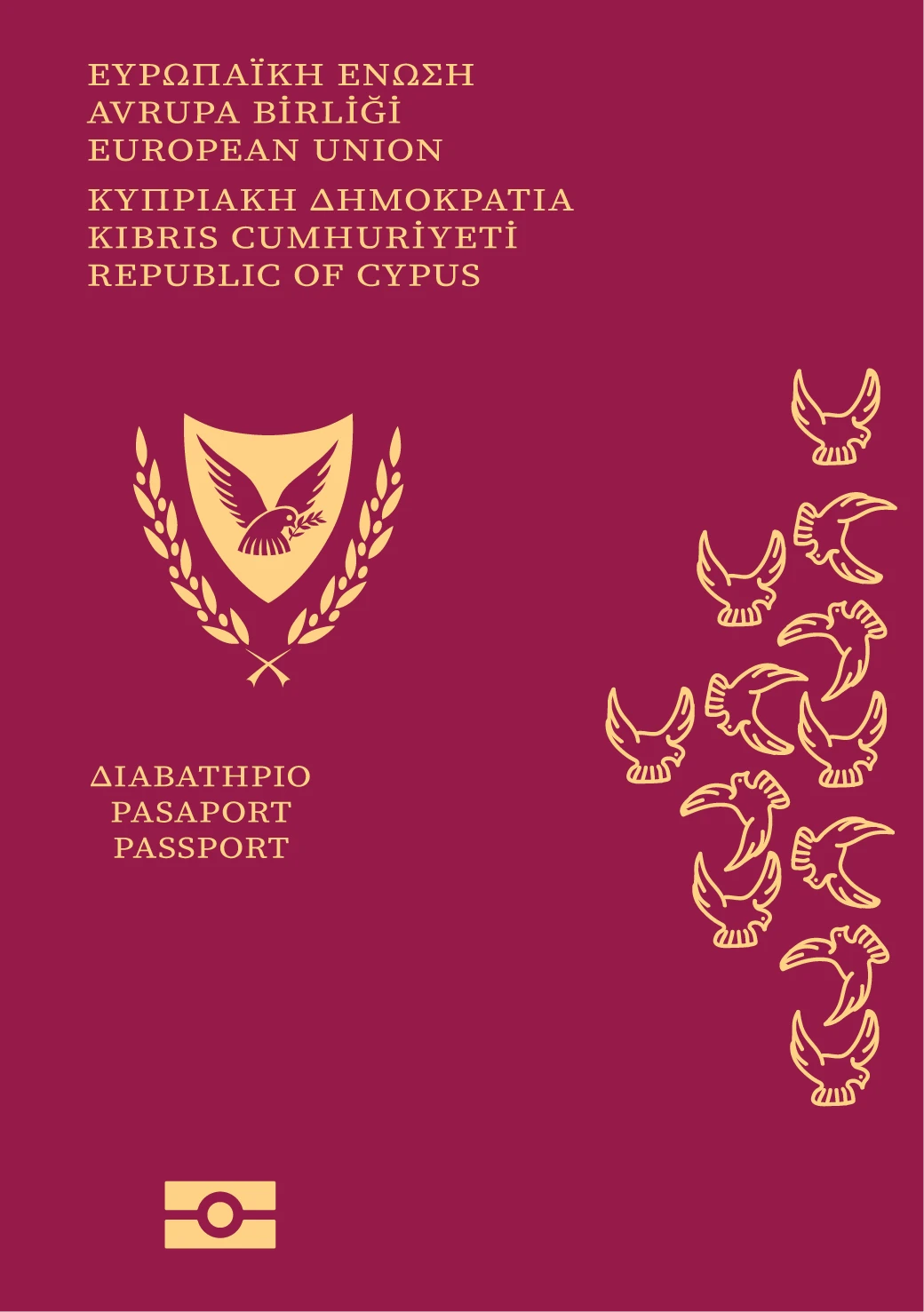
Cyprus Passport

Ranked #14 Globally

The Cyprus passport is the travel document of the Republic of Cyprus, an island nation in the eastern Mediterranean and a member of the European Union ( — the political and economic union of 27 European countries). In 2026 it ranks #14 in the world for travel freedom, letting holders reach 174 destinations without a visa beforehand or with a quick visa on arrival. Its biggest perk is not on any travel chart: a Cyprus passport makes you an EU citizen, so you can live, work, study, and retire in any of the other 26 EU countries with no permit. The Civil Registry and Migration Department, part of the Ministry of the Interior, issues the document. One thing surprises newcomers: Cyprus once sold citizenship to investors, but that route closed on 1 November 2020, so today the main path is years of residence on the island.

14th
Global Ranking
174
Destinations
62.88
Mobility Score
Cyprus Passport - Passport Power 12th | worldpath.ai WRI

Cyprus Passport Global Mobility Context

The Cyprus passport is strong for one reason above all: it carries citizenship of the (European Union — the union of 27 countries that share open internal borders). A holder can move to Berlin, Paris, or Amsterdam tomorrow and start working, with no visa and no permit. Only the 27 EU passports unlock that right.

On travel reach, Cyprus sits at #14 worldwide in 2026 with 174 destinations open visa-free or by visa on arrival. The list covers the whole EU and wider (the European zone with one shared external border and no checks between members), the United Kingdom, Japan, South Korea, Singapore, Canada, and most of South America.

The document is built to a high security bar. Cyprus has issued the biometric ePassport — a booklet with a chip storing your photo and, for ages 12 and up, two fingerprints — since December 2010. The chip meets the (International Civil Aviation Organization) 9303 standard airports use at e-gates.

Cyprus also offers a tax draw: the non-domiciled regime. A new resident not born in Cyprus can register as non-domiciled and pay zero Special Defence Contribution (the local tax on investment income) on dividends and interest for 17 years. With EU citizenship and an English-speaking, common-law system, the passport appeals to entrepreneurs.

Any person born in Cyprus on or after 16th August 1960 is a citizen of the Republic of Cyprus, provided that one of his parents was a citizen of the Republic, or would have been entitled to become a citizen of the Republic.

Cyprus Passport at a Glance

Global rank (2026)

Ranked #14 worldwide for travel freedom in 2026, holding steady from 2025. Reaches 174 destinations visa-free or with a visa on arrival.

Visa-free destinations

174 countries and territories you can enter without arranging a visa first, or with a fast visa stamped on arrival. Includes the whole , the UK, Japan, and Canada.

Document type

Biometric ePassport with a tiny chip holding your photo and fingerprints. Follows the global 9303 rulebook so airport e-gates worldwide can read it.

Page count

The standard adult booklet has 32 pages. Most go to visa and entry stamps, which matters less now that most travel is digital and stamp-free in the .

Languages

Printed in Greek, Turkish, and English, the official languages of the Republic, with the data page also labelled in other languages for border officers.

Adult validity

An adult Cyprus passport is valid for 10 years, the maximum the global rulebook allows. Renew it before it drops under six months of validity.

Child validity (under 16)

Passports for minors are valid for five years, not ten, because a child's face changes fast and the photo and chip must stay a good match.

Dual citizenship

Fully allowed with no limit on how many other nationalities you hold. You never have to give up another passport to keep your Cyprus one.

Issuing authority

The Civil Registry and Migration Department, part of the Ministry of the Interior, issues passports and runs the citizenship and naturalisation process.

History

Cyprus gained independence from Britain in 1960 and joined the in 2004. It rolled out the fingerprint biometric ePassport in December 2010.

Cyprus Passport Visa-Free Destinations by Region

Regional Mobility

Economic Mobility Score: 62.88%Country GDP: 0.036%
Visa Exceptions
Europe shows 100% regional mobility — as an EU citizen, a Cyprus holder can live, work, and settle in every other EU state, not only visit. The clearest gap is the United States, which still requires Cypriots to hold a full visa. Russia, India, and a few other destinations need an e-visa or short online pre-authorisation before arrival.

A Cyprus passport reaches 174 destinations without a visa arranged in advance, or with a visa stamped on arrival, placing it #14 in the world for 2026. The headline draw is the (European Union — the bloc of 27 countries with open internal borders): a Cyprus holder is an EU citizen and can settle anywhere in it. Beyond Europe, the document opens the United Kingdom, Canada, Japan, South Korea, Singapore, and most of Latin America. The clearest gap is the United States, which still requires Cypriots to apply for a visa.

Europe

Europe is where the Cyprus passport is at its strongest, and the reason is deeper than tourism. As an EU citizen, a Cyprus holder does not merely visit the other 26 EU states — they can live, work, study, and retire in any of them without a permit, using just a passport or national ID card. Cyprus is not yet inside the (the zone where European countries drop border checks between each other), so a passport is still scanned at the gate, but entry is automatic. Outside the EU, the Western Balkans are open: Albania, Serbia, Montenegro, Bosnia, and North Macedonia all admit Cypriots visa-free. Ukraine and Georgia allow long visa-free stays, and the United Kingdom welcomes Cyprus holders for six months without paperwork.

Americas

The Americas are mostly open, with one large exception. Canada admits Cyprus holders once they get an (electronic Travel Authorisation — a quick online pre-screen, not a visa) costing a few dollars and valid for years. Across South America the door is wide: Argentina, Brazil, Chile, Colombia, Peru, and Uruguay all grant visa-free stays of up to 90 days, and Mexico and Panama do the same in Central America. The exception is the United States. Cyprus is not in the US Visa Waiver Program, so Cypriots cannot use the simple online (Electronic System for Travel Authorization) that many Europeans use. They must instead apply for a full B-category visitor visa at a US embassy, attend an interview, and pay the fee — a step the Cyprus and US governments were still negotiating to remove in 2026.

Asia-Pacific

Asia and the Pacific are broadly friendly to the Cyprus passport. Japan and South Korea both grant 90 days visa-free, two of the most sought-after stamps for any traveller. Singapore, Malaysia, Thailand, and the Philippines admit Cypriots without a visa for stays of 30 to 90 days. China is open on a temporary visa-free trial running through December 2026, giving 30 days on arrival. Australia asks for an eVisitor authorisation and New Zealand for an (New Zealand Electronic Travel Authority), both cheap online forms rather than embassy visas. A handful of destinations such as India sit outside the visa-free list and need an e-visa applied for online before the trip.

Middle East

The Middle East mixes visa-free entry with quick electronic permits, and Cyprus's location off the Levantine coast makes the region a frequent short hop. Israel is visa-free for short stays, a natural connection given the two countries sit barely 300 kilometres apart. The United Arab Emirates grants Cyprus holders visa-free entry, useful for the Dubai business and transit traffic. Qatar admits them visa-free as well, while Saudi Arabia, Bahrain, and Oman issue an e-visa or a visa on arrival within minutes. Jordan offers a visa on arrival. The pattern across the Gulf is fast access, with most formalities handled online or at the airport desk.

Africa

Africa is the region where a Cyprus holder most often needs a small extra step, but the popular destinations stay reachable. Morocco and Tunisia in the north are visa-free for short tourist stays. In East Africa, Kenya, Tanzania, Rwanda, and Mauritius admit Cypriots either visa-free or through a simple electronic permit bought online. Seychelles issues a tourist registration on arrival, and South Africa grants visa-free entry for up to 90 days. Across much of the rest of the continent the rule is an e-visa or a visa on arrival rather than open entry, so a Cyprus traveller heading somewhere off the tourist track should check the entry rule a week or two ahead.

Offshore Jurisdictions

Cyprus is itself a well-known financial and shipping centre, so its passport naturally reaches the world's offshore and island jurisdictions used by globally mobile people. The British Overseas Territories in the Caribbean — the Cayman Islands, the British Virgin Islands, and Bermuda — admit Cyprus holders without a visa for stays of up to several months. Hong Kong grants 90 days visa-free, a help for finance and trade work in Asia. The Channel Islands and the Isle of Man, tied to the United Kingdom, are open to Cypriots as the UK itself is. For a holder running cross-border business or banking, these add up to smooth access to the jurisdictions where that work tends to happen.

Where a Visa Is Still Required

  • United States — Cyprus is not in the Visa Waiver Program, so a full B-category visitor visa and an embassy interview are required; the online ESTA is not available to Cypriots as of 2026.
  • Russia — entry needs an e-visa applied for online; the simple visa-free door is closed.
  • India — requires an e-visa arranged online before travel, valid for short tourist or business stays.
  • Much of sub-Saharan and Central Africa — typically an e-visa or visa on arrival rather than fully open entry.
  • A few Gulf and Central Asian states — short electronic permits or on-arrival visas apply rather than visa-free access.

How to Get a Cyprus Passport

1

Get a Residence Permit

Cyprus has no investor passport and no donation route to citizenship — that door closed on 1 November 2020. The only path for most people is to live in Cyprus legally for years, then naturalise. The first step is to get the legal right to reside on the island.

How you get that right depends on where you are from. Citizens of the (European Union — the bloc Cyprus belongs to) need no permit at all; they simply register after arriving and can live and work freely. Everyone else applies for a residence permit tied to a reason: a job, self-employment, study, family, or financial independence.

A common route for people of means is the residence-by-investment permit, sometimes called the golden visa. A property purchase of at least 300,000 euros (about 325,000 US dollars) plus proof of outside income grants permanent residence. Note clearly: this gives the right to live in Cyprus, not a passport. It is the start of the residence clock, not a shortcut around it.

Whatever the category, the goal of this step is the same — hold a valid, renewable legal status that lets the years of residence begin counting toward citizenship.

2

Build Your Residency Years

Citizenship by naturalisation in Cyprus rests on time actually spent living on the island. The standard rule asks for seven years of legal residence within the ten years before you apply, and the final twelve months must be continuous — you must be physically present in Cyprus for that last year without long gaps.

There is a faster track for skilled workers. People employed by approved companies in Cyprus can apply after four years of residence if they reach the higher Greek-language level, or five years at the lower level. A small number of highly skilled staff at registered firms can qualify in as little as three years. These shorter windows are the exception; seven years is the normal path.

During these years you keep renewing your residence permit, file taxes if you are tax-resident, and avoid long absences that could break the count. Many residents use this stretch to register as non-domiciled for tax and to learn Greek, both of which pay off at the citizenship stage and after.

Keep clean records of every entry and exit, your address history, and your tax filings. The citizenship office checks the residence math closely, and gaps you cannot document can reset the clock.

3

Apply for Citizenship

Once the residence years are complete, you apply for citizenship by naturalisation to the Civil Registry and Migration Department using the official form for residence-based applications. You submit proof of your years on the island, a clean criminal record, and evidence that you can support yourself.

Two tests stand between you and approval. The first is Greek language: you must show ability at level or on the common European scale, roughly meaning you can handle everyday conversation and simple written tasks. The level required depends on which residence track you used. The second is a knowledge test on the basics of Cyprus's political and social life, which you must pass with a score of at least 60 percent.

You also confirm good character and lawful conduct during your residence. Because Cyprus allows dual citizenship, you do not have to give up any nationality you already hold — your existing passport stays valid alongside the Cypriot one you are seeking.

Processing is not quick. As of 2026 the authorities estimate two to three years for a residence-based citizenship decision, so plan for a wait after filing and keep your residence status valid throughout.

4

Apply for the Passport

Citizenship and the passport are two separate things. Approval of naturalisation makes you a Cypriot citizen and is recorded in the civil registry, but the passport is a travel document you request afterwards. You first register as a citizen and obtain a Cypriot identity card, then apply for the passport.

You apply in person, because the biometric ePassport needs your fingerprints and a digital photo captured on the spot. Inside Cyprus you go to a Civil Registry and Migration Department office; from abroad you use a Cypriot embassy or high commission. Children under 12 give only a photo, not fingerprints.

The adult passport is valid for ten years and has 32 pages. A passport for a child under 16 is valid for five years. Fees are modest by international standards, and faster processing is available for an extra charge if you need the booklet quickly.

Once issued, the passport is your proof of citizenship as well as Cypriot nationality. From the day you hold it you can live and work in any EU country and use the travel access that comes with the document.

Many people get a Cyprus passport without ever doing the seven-year residence track, because they qualify by blood or by marriage. These routes are faster and, for those with the right family link, far simpler.

Citizenship by descent is the broadest shortcut. A child born to a Cypriot parent is a citizen automatically, wherever in the world the birth happens. The right reaches back further too: people with a Cypriot parent or, in many cases, a Cypriot grandparent can register as citizens by descent. This matters for the large Cypriot diaspora in the United Kingdom, Greece, Australia, and South Africa, whose children and grandchildren can often claim a Cyprus passport — and therefore (European Union) citizenship — on the strength of family records.

Marriage is the other common route. The spouse of a Cypriot citizen can apply for naturalisation after three years of marriage, with at least two of those years lived in Cyprus, and a lighter set of conditions than the standard residence path. The marriage must be genuine and ongoing, and the authorities check that.

There is one route Cyprus no longer offers. From 2013 to 2020 the country ran a citizenship-by-investment programme, informally the golden passport, that granted nationality in exchange for a large property or business investment. After a 2020 investigation found widespread abuse — an official inquiry later concluded that more than half of the passports issued had been granted unlawfully — the government shut the programme down on 1 November 2020 and began revoking improperly issued passports. No investor route to a Cyprus passport exists today; descent, marriage, and long residence are the only ways in.

Comparison of Cyprus Passport With Other Top Passports

Passport

Rank

Visa-free

Key edge

Singapore Passport

#1

192

World's strongest passport; about 192 destinations vs Cyprus's 174

France/Italy/Spain Passports

#4

185

Fellow EU members — the right to live and work in all 27 states

Greece Passport

#5

184

Greece — eastern-Mediterranean EU neighbour with a near-identical story

Portugal Passport

#5

184

Portugal — ended its golden-visa property route in 2023, like Cyprus's 2020 exit

United States Passport

#10

179

Largest economy, but taxes citizens worldwide and needs a visa from Cypriots

The Cyprus passport sits at #14 for 2026. To see what that rank buys, line Cyprus up against the strongest passport, its fellow (European Union) members, a near-identical neighbour, and the one large country that still keeps Cypriots out without a visa.

Against the world's strongest passport. The top-ranked passport reaches about 192 destinations versus Cyprus's 174. The gap sits mostly in places a typical traveller rarely visits. Across Europe, the Americas, and developed Asia, the two feel much the same.

Against fellow EU members. Some EU passports rank a few places higher on raw destination count. But the right that matters most is identical: every EU passport grants freedom to live and work in all 27 member states. On that, Cyprus is a full peer.

Against its closest neighbour. Cyprus's nearest match is the other eastern-Mediterranean EU state a short flight away, ranked a little higher. Both are warm-weather relocation magnets that once sold residence or citizenship to investors. Cyprus closed its investor-citizenship route in 2020; the neighbour kept a residence option.

Against a former golden-passport peer. One western-European EU country ended its golden-visa property route in 2023, three years after Cyprus shut its citizenship version. Both now route newcomers through residence rather than a cheque.

Against the United States. The US passport is strong but taxes its holders on worldwide income wherever they live. And the border runs one way: a US passport enters Cyprus visa-free, while a Cyprus passport needs a full visa for the United States.

Pros and Cons of the Cyprus Passport

Pros7 strengths
Cons7 frictions
  • 01Rights
    Full European Union Citizenship and Freedom of Movement
    A Cyprus passport makes you an EU citizen. You can live, work, study, and retire in any of the 27 EU countries with no visa and no permit — the single most valuable right the document carries.
    EU citizen
  • 02Mobility
    Visa-Free or Visa-on-Arrival Access to 174 Destinations
    Ranked #14 worldwide in 2026, reaching 174 destinations without a visa arranged first. The list covers the whole EU, the UK, Japan, South Korea, Singapore, Canada, and most of South America.
    174 dest.
  • 03Tax
    Seventeen-Year Non-Domiciled Tax Status
    A new resident not born in Cyprus can register as non-domiciled and pay zero Special Defence Contribution on dividends and interest for 17 years, a draw for entrepreneurs and investors.
    Non-dom 17y
  • 04Standing
    English Widely Used and a Common-Law Legal System
    Cyprus inherited an English-language, common-law legal system from British rule. English is widely spoken in business and government, easing relocation for English-speaking newcomers.
    English use
  • 05Rights
    Dual Citizenship Fully Allowed With No Limit
    Cyprus law places no cap on extra nationalities. You never have to renounce another passport to gain or keep your Cyprus one, under the Civil Registry Law of 2002.
    Dual OK
  • 06Descent
    Broad Citizenship by Descent for the Diaspora
    A child or, in many cases, a grandchild of a Cypriot can register as a citizen by descent. The large diaspora in the UK, Greece, and Australia can often claim an EU passport this way.
    By descent
  • 07Validity
    Adult Passport Valid for a Full Ten Years
    The adult booklet runs for 10 years, the maximum the global ICAO 9303 rulebook allows, so renewals are infrequent. The biometric chip clears e-gates at airports quickly.
    10-year
  • 01Mobility
    United States Still Requires a Full Visa
    Cyprus is not in the US Visa Waiver Program. Cypriots cannot use the online ESTA and must apply for a B-category visa and attend an embassy interview, often abroad. Talks to change this were ongoing in 2026.
    No US ESTA
  • 02Eligibility
    Investor Citizenship Route Closed Since 2020
    The citizenship-by-investment golden passport ended on 1 November 2020 after an inquiry found most issued passports were granted unlawfully. There is no way to buy a Cyprus passport today.
    No investor
  • 03Eligibility
    Seven Years of Residence to Naturalise
    The standard route needs seven years of legal residence within the past ten, plus a continuous final year. A skilled-worker fast track can cut this to three to five years for some applicants.
    7-yr resid.
  • 04Eligibility
    Greek Language and Civics Tests Required
    Naturalisation requires Greek at level A2 or B1 and a pass of at least 60 percent on a test about Cyprus's political and social life — a real study commitment for non-Greek speakers.
    Greek test
  • 05Support
    Citizenship Decisions Take Two to Three Years
    As of 2026 the authorities estimate two to three years to decide a residence-based citizenship application after filing, on top of the years of residence already served.
    2-3 yr wait
  • 06Mobility
    Not Yet Inside the Schengen Area
    Cyprus is an EU member but has not joined the Schengen open-border zone, so its passport is still scanned at European gates rather than waved through with no check.
    Not Schengen
  • 07Standing
    Northern Third Outside Government Control Since 1974
    The island has been divided since 1974, with the northern third under Turkish control. The Republic of Cyprus passport is the EU document; the breakaway north is recognised only by Turkey.
    Divided isle

Dual Citizenship and the Cyprus Passport

Cyprus places no limit on dual or multiple citizenship. The right is grounded in the Civil Registry Law of 2002 and the founding Treaty of Establishment of 1960, neither of which forces a citizen to choose one nationality. You can gain a Cyprus passport without surrendering another, and a Cypriot who later naturalises elsewhere keeps their Cyprus status.

What this means in practice. A naturalised citizen keeps every passport they already hold. Someone claiming citizenship by descent adds Cyprus to their existing nationality rather than swapping. The only limit comes from the other country: if your other nationality forbids dual citizenship, that is its rule, not a Cyprus rule.

The border rule for dual nationals. Inside Cyprus and the rest of the (European Union), always travel on the Cyprus passport — it is your proof of the right to live and work there, and it spares you entry formalities. When entering a third country, present whichever of your passports gives the easier entry. A Cyprus-and-US dual national, for instance, would enter the United States on the US passport to skip the visa that a Cyprus passport alone would need.

A note on tax. Holding two passports does not by itself create a tax bill, but one pairing needs care. The United States taxes its citizens on worldwide income wherever they live, so a Cyprus-and-US dual national must keep filing US returns even while resident in Cyprus. Cyprus itself taxes on residence, not citizenship, so a Cypriot living abroad owes no Cyprus tax on foreign income.

Final Assessment

The Cyprus passport earns its #14 rank on travel reach alone, but the rank undersells it. The document's real value is European Union citizenship: the right to live, work, and settle across 27 countries, which only an EU passport delivers. Add a 17-year non-domiciled tax status, an English-friendly common-law system, and full acceptance of dual citizenship, and Cyprus becomes one of the more attractive EU passports for an internationally mobile person to hold.

The trade-offs are clear and worth weighing. There is no longer any way to buy in — the investor-citizenship route closed in 2020 — so the realistic path is seven years of residence, a Greek-language test, and a civics exam, then a two-to-three-year wait for the decision. Descent and marriage offer faster routes for those who qualify. And the United States still demands a full visa, the one conspicuous hole in an otherwise wide-reaching document. For someone willing to put down roots on the island, or who has Cypriot family, the payoff is an EU passport with a strong global footprint.

Cyprus Passport FAQ

How strong is the Cyprus passport in 2026?

The Cyprus passport ranks 14th globally on global passport rankings (January 2026), granting visa-free or visa-on-arrival access to 174 destinations. It's one of the strongest EU passports, offering full freedom of movement across all 27 EU member states and 4 EFTA countries. Imminent Schengen accession and US Visa Waiver Program admission are expected to further boost its ranking in 2026.

How many countries can you visit visa-free with a Cyprus passport?

Cyprus passport holders can access 174 countries visa-free or with visa-on-arrival as of January 2026. This includes the entire EU/Schengen Area, the UK (visa-free up to 6 months), China (30 days, added October 2024), and most of Latin America. The US currently requires a B-1/B-2 visa, though VWP admission is expected before mid-2026.

Can I still get Cyprus citizenship by investment?

No. Cyprus terminated its Citizenship by Investment Program on November 1, 2020, following a major scandal. No replacement program exists. Today, citizenship requires genuine residence: 7–8 years via standard naturalization, 4–5 years via fast-track for highly skilled professionals, or 3–5 years through marriage to a Cypriot citizen. A Golden Visa (€300,000 property investment) can lead to citizenship after 8+ years of residence.

How much does it cost to get a Cyprus passport through naturalization?

The standard naturalization route costs approximately €3,500–€8,000 all-in (government fees ~€1,017 + legal fees €2,000–€5,000), excluding living expenses. The fast-track route for highly skilled professionals costs €9,000–€13,000, including the €5,000 premium processing fee. The Golden Visa + naturalization path totals €343,000–€370,000+ over 10–12 years, driven mainly by the €300,000 property investment.

Does Cyprus allow dual citizenship?

Yes, fully and without restrictions. Cyprus permits dual and multiple citizenship under Civil Registry Law 141(I)/2002. You are not required to renounce your existing passport, and there are no reporting obligations. US, UK, and EU nationals can hold Cypriot citizenship alongside their current passports. Note: citizens of India, China, Japan, and Austria should verify their home country's rules, as those countries may not recognize dual nationality.

Is the Cyprus passport worth it compared to Malta or Portugal?

It depends on your priorities. Malta offers an EU passport in 1–3 years but costs €690,000–€1.1 million. Portugal (5 years, ~€250,000–€500,000) is faster with minimal physical presence. Cyprus is the most tax-advantaged option — with a non-domicile regime, 0% inheritance tax, and a 60-day residency rule — but requires 10–12 years commitment. Ideal for entrepreneurs and HNWIs prioritizing long-term EU tax optimization over speed.

How long does it take to get a Cyprus citizenship?

  • Standard naturalization: 10–11 years (8 years residence + 2–3 years processing)
  • Fast-track for skilled professionals: 5–6 years (4–5 years residence + ~8 months processing)
  • Marriage to Cypriot citizen: 4–5 years
  • Citizenship by descent: 3–12 months (if eligible)
  • Golden Visa + naturalization: 10–12 years total

Can I travel to the US with a Cyprus passport without a visa?

Not yet. Cyprus is one of three EU member states (alongside Bulgaria and Romania) not in the US Visa Waiver Program. Cypriot citizens currently need a B-1/B-2 visa for the US. However, Cyprus's visa refusal rate dropped below the critical 3% threshold in FY2025, and VWP admission is widely expected before mid-2026, which would make the Cyprus passport significantly more valuable.