
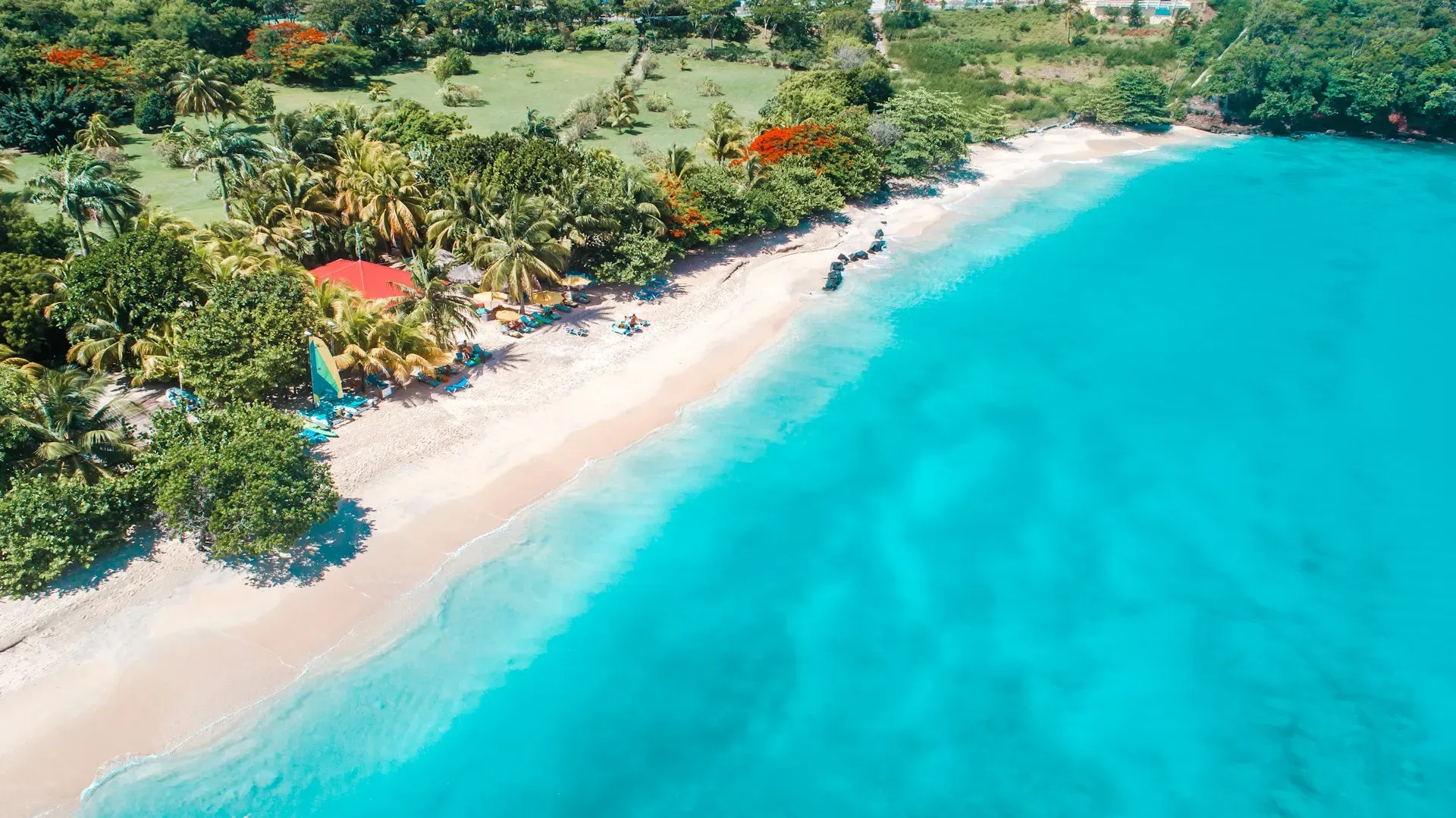
Grenada Overview
Grenada is a Caribbean tri-island state of 344 km² consisting of the main island plus Carriacou and Petite Martinique, lying north of Trinidad and Tobago at the southern end of the Windward Islands. A constitutional monarchy under King Charles III with a parliamentary democracy, with Prime Minister Dickon Mitchell (National Democratic Congress) in office since June 2022. The legal system runs on English common law with appeals to the Caribbean Court of Justice. Grenada is a member of the Commonwealth, the Caribbean Community (), the Organization of Eastern Caribbean States (), the Eastern Caribbean Currency Union (), the United Nations, and the World Trade Organization. The East Caribbean Dollar () is the legal currency, pegged at 2.7 XCD = $1 USD since 1976 through the Eastern Caribbean Central Bank. English is the official language; Grenadian Creole is the everyday vernacular.
On This Page
- 1.Grenada Overview
- 1.1How Does Grenada Compare?
- 1.2Who does Grenada fit?
- 1.3Pros and Cons of Relocating to Grenada
- 1.4Grenada leads on Citizenship — WRI 90.0 / 100
- 1.5Grenada leads on Residency — WRI 90.0 / 100
- 1.6Residence
- 1.7Taxes on Personal Income
- 1.8Cost of Living
- 1.9Healthcare System
- 1.10Education System
- 1.11Banking & Finance
- 1.12Cryptocurrency Regulation
- 1.13Real Estate Market
- 2.Frequently Asked Questions
Quick Facts
- Passport Rank: 29
- Visa-Free Destinations: 147
- Capital: St. George's
- Population: 117,200 (World Bank 2024)
- Area: 344 km² (Grenada + Carriacou + Petite Martinique)
- Currency: East Caribbean Dollar (XCD); pegged 2.7 XCD = $1 USD since 1976
- Official languages: English (official), Grenadian Creole
- Religions: Protestant ~49%, Catholic ~36%, other Christian + Rastafarian ~10%, none/other ~5%
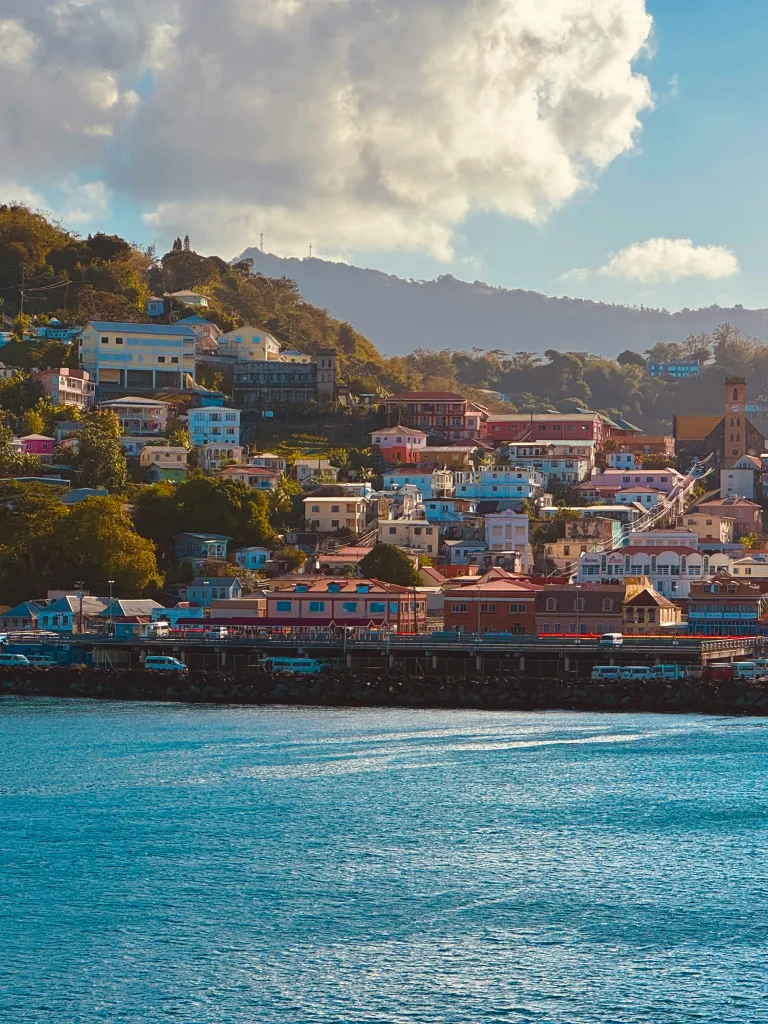
Key Indicators
- GDP (Nominal): $1.3 billion (World Bank 2024)
- Unemployment Rate: 11.1% (ILO model 2023)
- Human Development Index: 0.791 (High, HDR 2024)
- GDP per Capita: $11,705 (World Bank 2024)
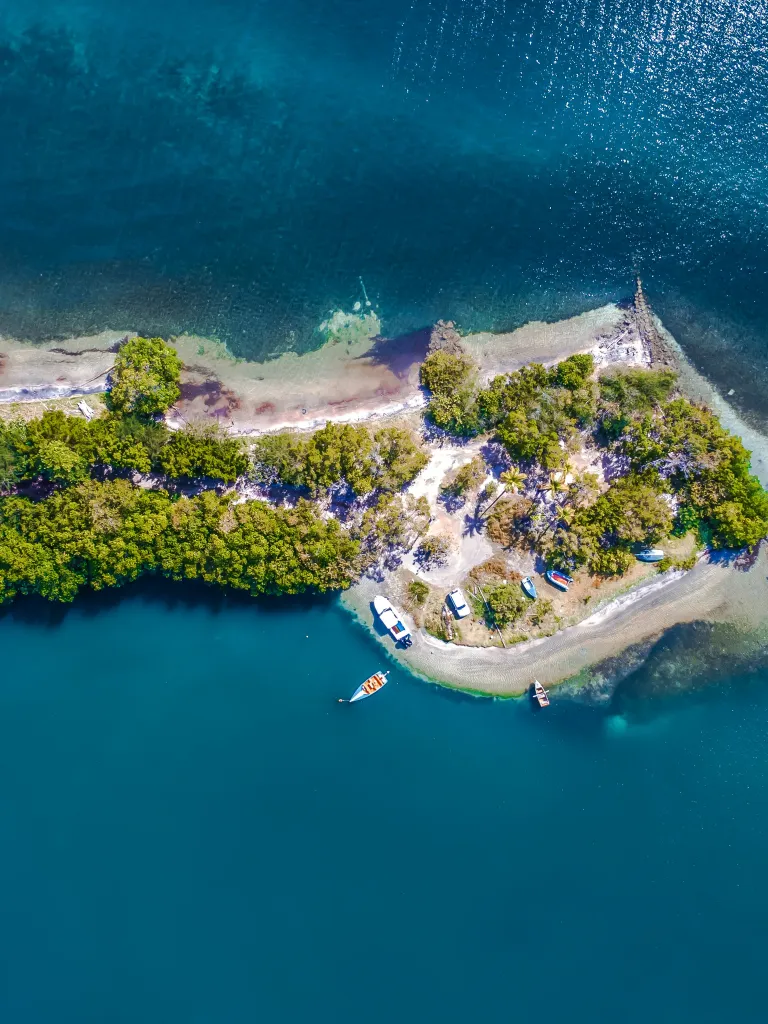
Safety & Governance
- Global Peace Index (IEP): 2.047 (GPI 2024)
- Press Freedom Index (RSF): 71.22 (Rank: 45, RSF 2025)
- Corruption Perception (TI): 56/100 (Rank: 46, CPI 2025)
- Gini Coefficient (WB): 43.8 (World Bank, most recent)
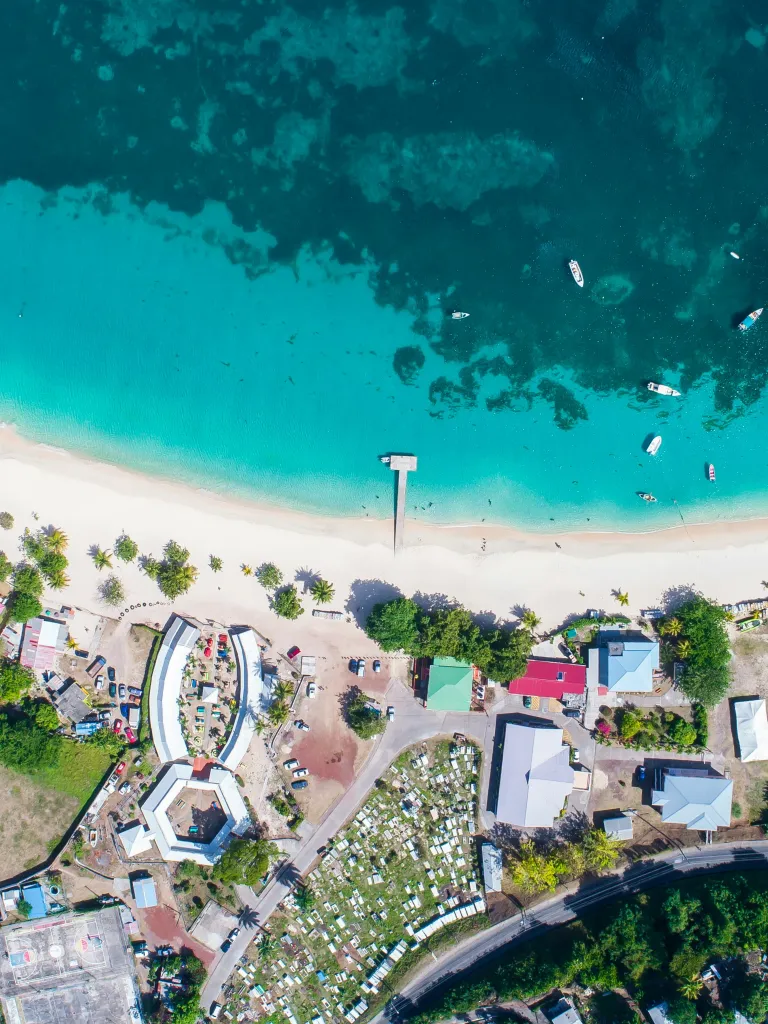
Health & Environment
- PM2.5 Air Pollution: 21 µg/m³ (WHO 2024, Sahara-dust influenced)
- Air Quality Category: Fair
- ND-GAIN Adaptation Index: 52.5 (Rank: 47, ND-GAIN 2023)
- Life Expectancy: 75.2 years (WHO 2024)
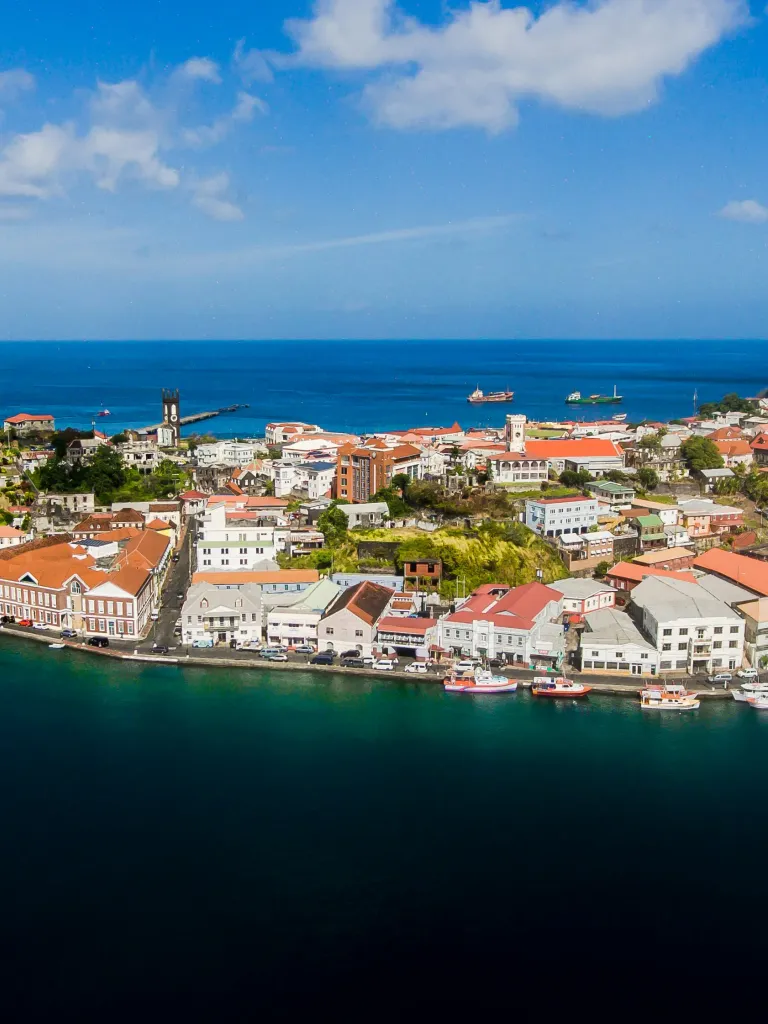
The proposition for an investor or relocator is unusually clean: a Citizenship-by-Investment programme administered by the Investment Migration Agency (IMA) Grenada from $235,000 in non-refundable contribution to the National Transformation Fund, the only Caribbean passport that grants eligibility for the US E-2 Investor Visa (treaty in force since 1989), territorial taxation that exempts all foreign-source income, and no capital gains, inheritance, or wealth tax. The cost is also clean: a population of 117,200 and consequent small-island infrastructure thinness, Hurricane Beryl devastation of Carriacou and Petite Martinique in July 2024 with $218 million in damage on Grenada's smaller islands, and a Safety score that sits in the middle of the top-five WRI peer group. Grenada does not try to be for everyone — it is clear from the start who it is for.
How Does Grenada Compare?
Summary
In the World Relocation Index (WRI) 2026, Grenada ranks 7th globally with a score of 79.8, positioned between Australia (79.9) and New Zealand (79.6). Within this comparison group, the Netherlands leads with a score of 80.0, while Turkey follows at 77.2. Grenada stands out for its exceptional performance in Citizenship, Residency, and Retirement, where it achieves the highest scores among all countries shown. While it trails some peers in Business and Investment, Grenada offers a distinctive combination of investment migration opportunities, tax efficiency, lifestyle appeal, and access to the U.S. E-2 Treaty Investor Visa.
How Grenada stacks up against its closest peers on the WRI 2026:
Where Grenada wins: Grenada leads this peer group in several of the categories most relevant to globally mobile investors and retirees. Its Citizenship score of 90 is the highest in the comparison, exceeding Turkey (85), Australia (78), New Zealand (78), and the Netherlands (60). Grenada also ranks first for Residency with a score of 90, ahead of Turkey (85), New Zealand (70), the Netherlands (65), and Australia (60). In Retirement, Grenada's score of 85 outperforms every peer country shown, reflecting its attractive tax environment, favourable climate, relaxed lifestyle, and strong appeal as a long-term relocation destination.
Where Grenada lags: Grenada's primary weaknesses relative to this comparison group are Business and Investment. Its Business score of 70 trails the Netherlands (90), Australia (82), Turkey (82), and New Zealand (76), reflecting the country's smaller domestic economy and more limited corporate ecosystem. On Investment, Grenada scores 75, below the Netherlands (88) and Australia (82), although it matches New Zealand and exceeds Turkey. Grenada also scores 82 in Education, remaining competitive but falling short of Australia's 92 and the Netherlands' 88, while matching New Zealand and outperforming Turkey.
Who does Grenada fit?
Summary
Grenada fits HNW investors using the CBI for a 3-4 month passport with US E-2 Treaty access, foreign retirees on Pensionado-equivalent visas under territorial taxation, Caribbean lifestyle relocators seeking the only top-5 WRI Caribbean jurisdiction, and US-business operators using the E-2 onward route from $100,000. It does not fit deep-financial-services operators requiring Luxembourg or Singapore infrastructure, applicants needing a top-tier passport for primary mobility (Grenada's 147 visa-free destinations are good but not Schengen--tier), or anyone requiring climate-risk certainty given Hurricane Beryl's 2024 demonstration of Caribbean exposure.
Right fit:
- HNW investors using the Grenada CBI — The Investment Migration Agency (IMA) Grenada currently administers two qualifying investment routes under the Citizenship by Investment Programme. Applicants may either make a non-refundable contribution to the National Transformation Fund () starting from USD 235,000 or invest in a government-approved real estate project from USD 270,000. While approved real estate investments may be structured through different ownership models and investment thresholds, these are treated as variations of the same real estate route rather than separate citizenship pathways.
- US-business operators pursuing an E-2 onward route — Grenada is the only Caribbean CBI state with an active US E-2 Investor Visa Treaty (since 1989); naturalized-by-investment applicants must satisfy a 3-year domicile requirement (Public Law 117-263 since December 2022) before E-2 eligibility, but the route remains uniquely accessible from $100,000-300,000 in qualifying US business investment.
- Foreign retirees on territorial taxation — Grenada exempts all foreign-source income from local tax, with no capital gains tax, no inheritance tax, and no wealth tax; the standard retirement visa is administered through the Immigration Department under the Royal Grenada Police Force, with the CBI route providing immediate full citizenship rights including freehold property purchase.
- Caribbean lifestyle relocators seeking jurisdictional substance — Grenada is the only Caribbean state in the top 5 of the WRI 2026 by overall score, combining the CBI, US E-2 Treaty, territorial taxation, and full Commonwealth + CARICOM + OECS access; tropical climate; English-language common-law jurisdiction; St. George's University Medical School draws an established medical-school expat community.
Wrong fit:
- Deep financial-services operators — Grenada's $1.3 billion GDP cannot support the institutional depth that Luxembourg, Singapore, or even the United Kingdom offer; capital markets are limited to the Eastern Caribbean Securities Exchange (ECSE) with shallow liquidity; deep private banking infrastructure does not exist locally.
- Applicants requiring a top-tier passport for primary mobility— the Grenadian passport sits at rank 29 globally with 147 visa-free or visa-on-arrival destinations — strong for a Caribbean small state and the unique gateway to the US E-2, but materially weaker than Luxembourg, Singapore, or UK passports for global business mobility outside the E-2 corridor.
- Anyone requiring climate-risk certainty — Hurricane Beryl Category 4-5 landfall on Carriacou July 1, 2024, destroyed 99% of buildings on Carriacou and 70% on Petite Martinique with $218 million total damage; while St. George's was spared, Atlantic hurricane season exposure is material for outer-island relocators and real-estate investors.
- High-volume tertiary education families — outside St. George's University Medical School (a regionally significant institution), Grenada's tertiary infrastructure is thin; secondary students bound for European, US, or UK universities typically transition abroad.
- Investors seeking a deep technology ecosystem — Grenada has emerging fintech and DCash CBDC infrastructure, but the country is not a Web3 or AI hub on the order of Singapore or even regional Caribbean peers like the Cayman Islands or the BVI.
Pros and Cons of Relocating to Grenada
- 01CitizenshipCitizenship in 3-4 months from $235,000 NTFInvestment Migration Agency (IMA) Grenada CBI under Citizenship by Investment Act 2013: $235,000 NTF non-refundable contribution single applicant (family tiered), or $270,000 real estate (5-year hold); 3-4 months processing; no pre/post-residency requirement; dual citizenship permitted.CBI from $235k NTF
- 02CitizenshipOnly Caribbean CBI with active US E-2 TreatyGrenada is the only Caribbean CBI state with an active US E-2 Investor Visa Treaty (in force since 1989); naturalised citizens access E-2 from $100,000-300,000 qualifying US business investment subject to 3-year domicile requirement (Public Law 117-263, Dec 2022 amendment to INA §101(a)(15)(E)).US E-2 Treaty unique
- 03TaxationNo capital gains, inheritance, or wealth taxTerritorial taxation: only Grenada-sourced income taxed (0/30% threshold above XCD 36k); all foreign pensions, dividends, capital gains, royalties exempt regardless of residence; no capital gains tax in any form; no inheritance tax; no wealth tax; no gift tax; 15% VAT standard.Territorial tax, 0% CGT
- 04MobilityGrenadian passport rank 29, 147 visa-freeGrenadian passport at rank 29 globally with 147 visa-free or visa-on-arrival destinations; covers Schengen Area, UK, China, Russia, Hong Kong, Singapore; uniquely accesses US E-2 onward via the 1989 treaty; CARICOM and OECS free movement.Passport rank 29, 147 VF
- 05CurrencyXCD pegged 2.7:1 to USD since 1976East Caribbean Dollar (XCD) pegged at 2.7 XCD = $1 USD since 1976 through the Eastern Caribbean Central Bank; eliminates currency-conversion friction for North American capital; full capital mobility; FATCA and CRS in force; structural exchange-rate stability across ECCU 8-member union.XCD-USD peg 2.7:1 stable
- 06HealthcareSt. George's University medical-school ecosystemSt. George's University (SGU) founded 1976 has trained 22,000+ medical doctors with strong US/Canadian residency placement; SGU Hospital and broader expat-tier private sector deliver regionally above-average specialist density; complex acuity routes to US/Trinidad via medical evacuation.SGU medical hub access
- 07LifestyleOnly Caribbean state in WRI 2026 top 5Grenada is rank 5 of 27 in the worldpath.ai WRI 2026 — the only Caribbean state in the top five globally — combining CBI, US E-2 Treaty access, territorial taxation, and full Commonwealth + CARICOM + OECS bloc access; tropical climate; English-language common-law jurisdiction.Top-5 WRI Caribbean
- 01StabilityCarriacou + Petite Martinique devastated July 2024Hurricane Beryl Category 4-5 landfall July 1, 2024 destroyed 99% of buildings on Carriacou and 70% on Petite Martinique with $218 million total damage; St. George's main island spared; recovery 80%+ complete early 2025; material climate-risk for outer-island real-estate investors and CBI real-estate route applicants.Hurricane Beryl 2024
- 02StabilityGDP $1.3B limits institutional depthGrenada GDP $1.3 billion (World Bank 2024) cannot support deep financial-services, capital-markets, or specialist-services infrastructure; Eastern Caribbean Securities Exchange (ECSE) shallow liquidity; 11.1% unemployment rate; population 117,200 limits operational scale; reliance on tourism + CBI revenue.Small economy, $1.3B GDP
- 03Citizenship3-year domicile required for E-2 post-CBIPublic Law 117-263 (Dec 2022) amended INA §101(a)(15)(E) adding 3-year domicile requirement for naturalised-by-investment treaty applicants; CBI applicants pursuing E-2 onward must establish 3 years of continuous treaty-country domicile before applying — material timeline cost for the US-business-access use case.3-yr E-2 domicile rule
- 04BusinessBusiness 70 trails Singapore 97, Lux 92Business dimension 70 — small economy cannot deliver the institutional depth of Singapore (97), Luxembourg (92), UK or Turkey (82); professional services, capital markets, and specialist-services infrastructure are thinner; operational logistics through St. George's add real cost; deep technology and Web3 ecosystems are limited.Business depth 70 vs 97
- 05HealthcareComplex specialist care via medical evacuationPublic General Hospital + private SGU Hospital deliver primary/secondary care; complex specialist procedures (cardiac, oncology, neurosurgery, advanced trauma) route to Trinidad, Barbados, US, or Canada via medical evacuation insurance; mandatory private health insurance with evacuation coverage $2,800-6,500/yr couple.Healthcare medevac
- 06Real EstateAlien Landholding License 10% on non-citizen purchasesForeigners require Alien Landholding License (ALHL) for residential and commercial property purchases — 10% one-off fee on purchase price plus 4-5% additional acquisition costs (1% stamp duty, 1-2% legal, 1% registry); CBI real-estate route applicants bypass ALHL for IMA-approved projects; total non-CBI acquisition cost 13-15%.ALHL 10% non-citizen fee
- 07StabilityAtlantic hurricane exposure June-NovemberAtlantic hurricane season June-November brings annual climate-risk exposure; Beryl 2024 was the strongest recorded landfall on Grenada (Carriacou) since records began; climate-risk insurance premiums materially elevated post-2024; outer-island properties and CBI real-estate developments require specific climate-resilience underwriting.Hurricane season exposure
Grenada leads on Citizenship — WRI 90.0 / 100
Grenada posts the highest Citizenship score in the WRI 2026 peer group at 90, decisively ahead of Luxembourg at 74, the United Kingdom at 55, Singapore at 48, and matching Turkey at 85 with two additional differentiators. The driver is the Grenada Citizenship by Investment Programme, administered by the Investment Migration Agency (IMA) Grenada (imagrenada.gd, formerly the CBI Unit before the March 2024 rebrand) under the Grenada Citizenship by Investment Act 2013. Two qualifying routes are available: a $235,000 non-refundable contribution to the National Transformation Fund for a single applicant (with family-tiered minimums for spouses and dependants), and a $270,000 government-approved real estate investment with a 5-year hold requirement. Processing runs 3-4 months from submission through to passport issuance, with no prior or post-residency requirement at any stage. Dual citizenship is permitted. The Grenadian passport opens 147 destinations visa-free or visa-on-arrival, including the , the United Kingdom, China, Russia, Hong Kong, and Singapore. The decisive differentiator: Grenada is the only Caribbean CBI state with an active US E-2 Investor Visa Treaty (in force since 1989), granting naturalised citizens onward business-mobility access to the United States from $100,000-300,000 in qualifying US business investment — subject to the 3-year domicile requirement for naturalised-by-investment applicants under Public Law 117-263 (December 2022 amendment to §101(a)(15)(E)).
Grenada leads on Residency — WRI 90.0 / 100
Grenada posts a Residency score of 90, tied with the country's Citizenship dimension and decisively ahead of Luxembourg at 78, Singapore at 62, the United Kingdom at 60, and matching Turkey at 85 within the WRI 2026 peer group. The driver is the same Investment Migration Agency (IMA) Grenada CBI architecture that powers the Citizenship score, combined with the territorial taxation regime that converts a Grenadian residence permit into a meaningful tax-residence option for foreign-income earners. The Immigration Department under the Royal Grenada Police Force (rgpf.gd) administers standard residence permits for non-CBI applicants on annual, renewable terms covering work, study, retirement, and dependent categories; tax residency triggers on 183 or more days of physical presence in a calendar year. Permanent residence is available after 5 years of legal residence; standard naturalization runs 7-15 years depending on category, but the CBI route bypasses this entirely. The Eastern Caribbean Currency Union peg of 2.7 XCD per USD removes currency-conversion friction for North American capital, and the OECS bloc grants Grenadian citizens free movement across the six OECS member states. The territorial tax regime exempts all foreign-source income from Grenadian tax — material for residence-permit holders maintaining global income streams.
Residence
Grenada applies territorial taxation to both residents and non-residents — only Grenada-sourced income is taxed, while all foreign-source income (foreign pensions, dividends from foreign companies, capital gains on foreign-located assets, royalties on foreign-registered intellectual property) is exempt regardless of residence status. Tax residency triggers on 183 or more days of physical presence in the calendar year, or having Grenada as the centre of habitual residence and economic interests. There is no Controlled Foreign Company (CFC) regime in domestic application. Residence permits are administered by the Immigration Department under the Royal Grenada Police Force (rgpf.gd), with the Inland Revenue Division (ird.gd) issuing tax-resident certificates. Standard residence permits run on one-year renewable terms covering employment, business, student, retirement, and dependent categories. Permanent residence is available after 5 years of continuous lawful residence; standard naturalization runs 7-15 years depending on category. The Investment Migration Agency (IMA) Grenada CBI route at imagrenada.gd bypasses standard timelines, granting full citizenship, including freehold property rights, within 3-4 months from $235,000. Dual citizenship is permitted.
Safety sits at 72 in the WRI 2026, in the middle of Grenada's peer group. The Global Peace Index 2024 places Grenada in the upper-middle peace tier among Caribbean states (score 2.047, IEP-categorised "very peaceful"), and the Corruption Perceptions Index 2025 (released February 2026) places Grenada at rank 46 of 182 globally with a score of 56/100 — comparable to several member states. Reporters Without Borders Press Freedom Index 2025 places Grenada at rank 45 with a score of 71.22. Violent crime is materially below Caribbean regional averages; petty theft and tourist-zone crime are the predominant operational concerns. The trade-off is the Atlantic hurricane exposure, dramatically demonstrated by Hurricane Beryl on 1 July 2024, when a Category 4-5 storm destroyed 99% of buildings on Carriacou and 70% on Petite Martinique with $218 million total damage; St. George's was spared. Climate-risk insurance is operationally material for outer-island property holders and CBI real-estate investors targeting Carriacou or Petite Martinique developments.
Taxes on Personal Income
Grenada applies territorial personal income taxation administered by the Inland Revenue Division (ird.gd) of the Ministry of Finance. Residents and non-residents are taxed only on Grenada-sourced income at a flat progressive structure: 0% on the first XCD 36,000 of annual income (approximately $13,300 USD), and 30% on income above that threshold. All foreign-source income, including foreign pensions, dividends from foreign companies, capital gains on foreign-located assets, royalties on foreign-registered intellectual property, and foreign employment income for short-stay residents, is fully exempt regardless of residence status. There is no capital gains tax in any form. There is no inheritance tax, no wealth tax, and no gift tax. Dividends from Grenadian companies are subject to a 15% withholding tax for non-resident shareholders; intra-CARICOM dividends are exempt under bilateral treaty arrangements. VAT (Goods and Services Tax) runs at 15% on most goods and services, with 20% on telecommunications and mobile-operator services and 10% on hotel and diving-tour services. Corporate income tax is 28% for residents on worldwide income; non-resident companies are taxed only on Grenada-sourced income. The effective tax rate on a foreign-pension retiree resident in Grenada is 0% federally — combined with no capital gains, inheritance, or wealth tax, this is structurally one of the most favourable retirement tax positions globally.
Cost of Living
Grenada has a moderate Caribbean cost-of-living profile with significant St. George's versus outer-island spread. A single professional in central St. George's, Lance aux Epines, or Grand Anse budgets $1,800-2,800 a month for a one-bedroom apartment at $450-900, utilities including air conditioning, transit, and basic groceries; the same lifestyle in Westerhall, Calivigny, or rural parishes runs $1,300-1,900. A family of three in central St. George's budgets $3,500-5,500 a month, including a two- or three-bedroom rental at $1,200-2,500, transit, groceries, and international school fees at the Westmorland School or St. George's University-affiliated school ($8,000-15,000 per year); the same family in Westerhall or Lance aux Epines runs $2,800-4,200. Inexpensive restaurant meals average $12-22 per person; bus fare runs $1-2 per ride. Imported goods, including electronics, processed foods, and vehicles, carry significant import duties — operationally meaningful for an expat budget. Private health insurance for non-citizen residents with international evacuation coverage runs $2,800-6,500 per year per couple. A mid-range second-hand vehicle imported from North America runs $14,000-25,000 and is the default transit mode outside central St. George's. The XCD-USD peg at 2.7:1 removes currency-conversion friction for North American capital.
Healthcare System
Grenada runs a public-private split with the Ministry of Health and Social Security operating the General Hospital in St. George's and district health facilities across the three islands, complemented by a meaningful private hospital and clinic network. The flagship private institution is St. George's University Hospital and the broader St. George's University (SGU) medical-school ecosystem, which has trained more than 22,000 medical doctors since 1976 with strong US and Canadian residency placement — and this gives Grenada an unusual depth of available medical expertise for a small Caribbean state. Standard primary and secondary care is generally adequate in St. George's; complex specialist care (cardiac surgery, oncology, neurosurgery, advanced trauma) routes to Trinidad and Tobago, Barbados, the United States, or Canada via medical evacuation insurance. A specialist private consultation runs $60-150, a private hospital day $300-900, and a typical outpatient procedure $500-2,000. Mandatory private health insurance for non-citizen residents with international evacuation coverage runs $2,800-6,500 per year per couple; plans with US hospital coverage run $5,000-12,000. Life expectancy is 75.2 years (WHO 2024), in the upper-middle range for Caribbean states and the upper-middle range globally for upper-middle-income countries. Medical tourism is small but growing, with US and Canadian patients accessing dental and cosmetic procedures at 40-60% discounts to North American pricing.
Education System
Grenada runs an English-language public education system through the Ministry of Education, with a literacy rate of 98.6% across primary and secondary levels — among the highest in the Caribbean. Public schools deliver a British-modelled curriculum through Common Entrance examinations and the Caribbean Secondary Education Certificate (CSEC); free primary and secondary education is provided to citizens and permanent residents. The international school market is concentrated in St. George's and Lance aux Epines: the Westmorland School (British curriculum + IGCSE, $8,000-15,000 per year), St. George's School (American curriculum), and a handful of smaller institutions serving the St. George's University expat community. Secondary students bound for European, US, or Canadian universities typically transition abroad for the final two or three years or complete CXC Cape examinations locally before international university applications. At the tertiary level, St. George's University (SGU) is the flagship institution — founded in 1976 as a US-style medical school, it now offers undergraduate, graduate, and professional programmes serving more than 5,000 students predominantly from the United States and Canada; SGU's School of Medicine is accredited for US residency and licensing. The T.A. Marryshow Community College and the University of the West Indies Open Campus deliver complementary undergraduate-tier programmes. Public schools accept any registered resident with no separate fees; the medium of instruction is English throughout.
Banking & Finance
Grenada's banking system operates within the Eastern Caribbean Currency Union (ECCU) under the supervision of the Eastern Caribbean Central Bank (ECCB), which serves the eight OECS member territories collectively. The system houses approximately 5 commercial banks: Grenada Co-operative Bank (the only locally-owned bank), Republic Bank (Trinidad-headquartered), RBC Royal Bank, ScotiaBank, and the Bank of Nova Scotia. The East Caribbean Dollar (XCD) has been pegged at 2.7 XCD per USD since 1976, eliminating currency-conversion risk for North American capital and providing structural exchange-rate stability across the eight ECCU member states. Account opening for non-citizen residents requires a Tax Identification Number (TIN) from the Inland Revenue Division, a valid residence permit or temporary visa, proof of address, and source-of-funds documentation under AML standards. Standard account-opening times run 1-3 weeks. Foreign credit history does not transfer; expats build local credit from zero. Mortgages for non-citizen residents are available through Grenada Co-operative Bank and Republic Bank at 6-8.5% fixed rates over 15-25 year maturities with 30-40% minimum down for non-residents. Capital mobility is fully unrestricted; and are in force. The ECCB launched DCash — the Eastern Caribbean Central Bank digital currency — in March 2021 as the first central bank digital currency from a currency-union central bank, though the pilot was scaled back in 2024 with permanent regulatory frameworks under development.
Cryptocurrency Regulation
Grenada's cryptocurrency regulatory framework operates at the ECCU level through the Eastern Caribbean Central Bank, which launched DCash in March 2021 as the first sovereign central bank digital currency from a currency union — pioneering CBDC implementation across the eight ECCU member territories, including Grenada. The DCash pilot was scaled down in 2024 with formal regulatory frameworks under ongoing development. Bitcoin and other crypto-assets occupy a tolerated rather than legally recognized position in Grenada: they are not legal tender, but personal ownership and trading through international exchanges are permitted without specific licensing requirements. Capital gains on crypto-asset disposals by residents are not taxed under the territorial regime if assets are held offshore (no capital gains tax in any form applies under Grenadian domestic law), making Grenada structurally favourable for crypto investors seeking long-term hold strategies. Crypto-as-payment for goods and services follows standard 15% VAT on the underlying transaction. The Eastern Caribbean Securities Regulatory Commission has not issued comprehensive crypto-asset service provider licensing under a Grenada-specific framework; cross-border crypto-exchange operations are typically licensed in Cayman, BVI, or the Bahamas, with Grenada serving as a tax-favourable residency for principals. Grenada is not a Web3 hub on the order of the BVI or the Cayman Islands, but combined with the territorial tax regime and CBI passport access, it offers a credible operational base for crypto-focused HNW relocators.
Real Estate Market
Grenada allows foreigners to buy residential and commercial property freely under an Alien Landholding License (ALHL) system administered by the Ministry of Legal Affairs and the Inland Revenue Division (ird.gd). The ALHL requires a 10% one-off fee on the purchase price for non-citizen buyers, with processing typically completed within 4-8 weeks. Acquisition costs total approximately 13-15% of the transaction value, including the 10% ALHL fee, 1% stamp duty, 1-2% legal-fee allocation, and 1% registry/notary fees. Annual property tax (Property Tax Act) runs 0.1-0.5% of assessed market value on residential properties, structured by property category and use. CBI applicants under the real-estate route bypass the ALHL fee for IMA-approved projects and qualify for citizenship from $270,000 minimum (5-year hold). Prime Lance aux Epines, Westerhall, Grand Anse, and Calivigny coastal properties run $2,200-4,500 per square metre; central St. George's apartments run $1,500-3,000 per square metre; outer-island Carriacou (post-Beryl rebuild) and Petite Martinique offer beachfront opportunities at $800-2,500 per square metre. CBI-approved developments at hotels and resort villas typically run $300,000-600,000 entry points and bundle the citizenship application with the property purchase. Gross rental yields run 6-10% on long-term St. George's apartment lets and 8-14% on short-term Grand Anse and Lance aux Epines vacation rentals during the December-April peak season. Mortgage rates for non-resident foreign buyers run 6-8.5% fixed at 15-25 year maturity with 30-40% minimum down. Transactions typically close in 60-120 days from offer acceptance, including ALHL processing time.


