
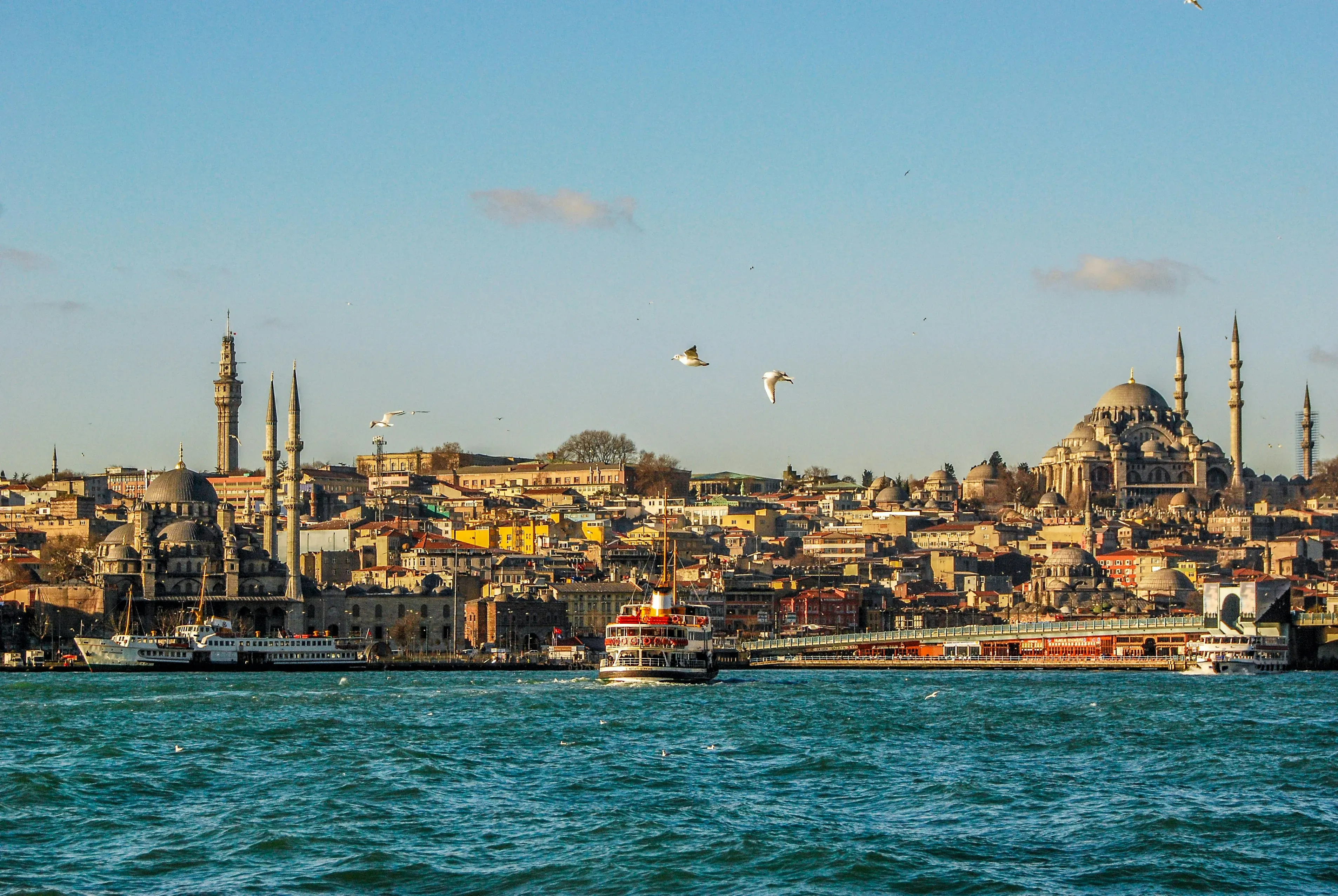
Turkey Overview
Turkey occupies 783,356 km² spanning two continents, with 97% of its territory in Anatolia and 3% in Eastern Thrace, and it runs the only Citizenship-by-Investment programme inside the . The country has been a member since 1952, has held candidate status since 1999, sits inside the EU customs union for industrial goods, and is a founding member of the , the Council of Europe, and the G20. A unitary republic since 1923 under a French-influenced civil-law system, Turkey controls the Bosphorus and Dardanelles, shares land borders with eight countries from Greece and Bulgaria in the west to Iran and Iraq in the east, and runs from Istanbul one of the world's busiest dual-continent commercial hubs.
On This Page
- 1.Turkey Overview
- 1.1How Does Turkey Compare?
- 1.2Who does Turkey fit?
- 1.3Pros and Cons of Relocating to Turkey
- 1.4Turkey leads on Citizenship — WRI 85.0 / 100
- 1.5Turkey leads on Residency — WRI 85.0 / 100
- 1.6Residence
- 1.7Taxes on Personal Income
- 1.8Cost of Living
- 1.9Healthcare System
- 1.10Education System
- 1.11Banking & Finance
- 1.12Cryptocurrency Regulation
- 1.13Real Estate Market
- 2.Frequently Asked Questions
Quick Facts
- Passport Rank: 45
- Visa-Free Destinations: 116
- Capital: Ankara
- Population: 85.4 million
- Area: 783,356 km²
- Currency: Turkish Lira (TRY)
- Official languages: Turkish
- Religions: Islam ~99% (Sunni majority, Alevi ~15-20%); Christianity, Judaism, Other <1%

Key Indicators
- GDP (Nominal): $1.36 trillion
- Unemployment Rate: 8.8%
- Human Development Index: 0.855 (Very High)
- GDP per Capita: $15,892

Safety & Governance
- Global Peace Index (IEP): 2.80 (Rank: 146, GPI 2024)
- Press Freedom Index (RSF): 31.6 (Rank: 158, RSF 2024)
- Corruption Perception (TI): 34/100 (Rank: 107, CPI 2024)
- Gini Coefficient (WB): 44.5
Health & Environment
- PM2.5 Air Pollution: 20.3 µg/m³
- Air Quality Category: Moderate
- ND-GAIN Adaptation Index: 56.0 (Rank: 56, ND-GAIN 2024)
- Life Expectancy: 77.2 years
The proposition for an investor or relocator is unusually clean: a route from $400,000 in real estate, a passport opening 116 destinations, 90+ double-taxation treaties, and a banking system compliant with OECD reporting. The cost is also unusually clean: worldwide income taxation on residents, a currency that has lost over 90% of its dollar value since 2018, a sovereign rating in the B-band, and a governance environment ranked 107th on corruption and 158th on press freedom. Turkey does not try to be for everyone — it is clear from the start who it is for.
How Does Turkey Compare?
Summary
Turkey (WRI 77.2, global rank 6) sits between Singapore (80.9) and the United Kingdom (76.1) in the live peer group, with Grenada (79.7) and Monaco (75.8) bracketing the comparison. Turkey leads the group on Citizenship and Residency at 85.0 each — driven by the $400,000 route and 0-day-stay residency — and trails the group on Safety, Investment, and Education, where Singapore, the UK, and Monaco all sit materially higher.
How Turkey stacks up against its closest peers on the WRI 2026:
Where Turkey wins: Turkey is second only to Grenada on both Citizenship (85.0 vs Grenada's 90, Singapore's 48, UK's 55, Monaco's 30) and Residency (85.0 vs Grenada's 90, Monaco's 72, Singapore's 62, UK's 60) — the $400,000 real-estate CBI plus 0-day-stay residency outpaces every peer in this group except Grenada's faster Caribbean track. Business (82.0) sits tied with the UK and Monaco, behind Singapore's 97 but in the high-mid range. Retirement (78.0) lands above Singapore (75) and the UK (72), reflecting the Mediterranean cost-of-living advantage and accessible long-term residency.
Where Turkey lags: Safety (69.0) is the weakest in the peer group, trailing Singapore's 91.1, the UK's 85, Monaco's 74.1, and Grenada's 72 — GPI rank 146 and corruption-perception rank 107 mark a structural governance gap that no individual programme closes. Investment (70.0) is also last (vs Singapore 91, Monaco 90, UK 85, Grenada 75), driven by the lira's 90%+ depreciation since 2018 and a B+/BB- sovereign rating. Education (75.0) trails Singapore and the UK at 94 and 88 — local-language barrier and limited curriculum diversity outside major cities.
Who does Turkey fit?
Summary
Turkey fits HNW investors and fast-citizenship seekers, founders running export-oriented businesses, Mediterranean lifestyle relocators on the coast, and medical-tourism patients. It is a poor fit for long-term residents seeking macro stability, foreign retirees relying on public pensions, asylum applicants, applicants chasing territorial taxation, and remote workers seeking a tailored digital-nomad route.
Right fit:
- HNW investors and fast-citizenship seekers — direct CBI from $400,000 in real estate (3-year hold), $500,000 bank deposit, $500,000 fixed capital, or $500,000 in government bonds; processing in 3-6 months including spouse and dependent children under 18.
- Founders and operators building export-oriented or regional businesses — 90+ double-taxation treaties, an EU customs union for industrial goods, 100% foreign ownership across most sectors, and a deep Istanbul-based professional services market.
- Mediterranean lifestyle relocators on the Aegean and Mediterranean coasts — Antalya, Bodrum, Çeşme, and Fethiye offer 300+ sunny days per year, a developed long-term expat infrastructure, cost of living roughly 50% below US levels for USD earners, and direct flights to most European capitals.
- Medical-tourism patients and treatment-led relocators — JCI-accredited Acıbadem, Memorial, and Anadolu hospitals deliver tertiary care at 10-20% of US prices; English-speaking specialists and a one-year route from residency to the public SGK system make medical-led relocation practical.
Wrong fit:
- Long-term residents seeking macro stability — the lira has lost over 90% against the dollar since 2018; inflation peaked above 75% in 2024 and capital preservation requires USD or EUR-denominated holdings.
- Foreign retirees relying on public pensions or territorial taxation — Turkey taxes worldwide income on residents (15-40% progressive) with no dedicated pensioner regime; the UK basic state pension or EU pensions are taxed on receipt for Turkish tax residents.
- Asylum seekers and humanitarian applicants — Turkey is a 1951 Refugee Convention signatory but maintains the geographical limitation, granting full refugee status only to applicants from Europe; non-European applicants are processed as 'conditional refugees' under domestic law.
- Applicants chasing a territorial tax regime — Turkey is a worldwide-income jurisdiction with controlled foreign company (CFC) rules on corporate structures; territorial seekers should look at the UAE, Panama, or Hong Kong.
- Remote workers seeking a tailored digital-nomad route — Turkey introduced a Digital Nomad Visa in 2024, but it is limited to nationals of 36 countries earning ≥$3,000/month and is short-term in nature; it does not deliver a path to permanent residency or tax-incentive treatment.
Pros and Cons of Relocating to Turkey
- 01Citizenship-by-Investment-by-Investment via $400,000 real estate (3-year hold) — passport in 3-6 months including spouse and minor children, one of the fastest direct CBI routes globally.$400k CBI
- 02MobilityStrategic Passport ReachPassport opens 116 visa-free or visa-on-arrival destinations, including Japan, South Korea, Singapore, and most of South America.116 visa-free
- 03GeopoliticsTranscontinental HubTranscontinental geography with NATO membership since 1952, EU candidate status, EU customs union for industrial goods, and 90+ double-taxation treaties.NATO + EU customs
- 04Cost of livingUSD-Earner Cost AdvantageCost of living roughly 50% below US levels — a single professional budgets ~$1,300/month, a family of three ~$2,800/month (excluding international school fees) for USD-denominated earners.50% below US
- 05HealthcareMedical Tourism HubMedical-tourism quality at fraction of Western costs: coronary bypass ~$14,000, knee replacement ~$10,000, with JCI-accredited Acıbadem, Memorial, and Anadolu hospitals serving 1+ million medical tourists annually.10-20% of US prices
- 06LifestyleMediterranean Coastal LifestyleMediterranean and Aegean coastal lifestyle (Antalya, Bodrum, Çeşme, Fethiye) with 300+ sunny days per year and one of the longest-established non-EU expat communities.300+ sunny days
- 07BankingMature Banking NetworkMature private banking and broker network in Istanbul, OECD CRS-compliant, with full foreign ownership permitted across most sectors and zero exchange controls on USD/EUR cash holdings.No exchange controls
- 01CurrencyCurrency VolatilityTurkish lira has lost over 90% against the dollar since 2018, with inflation peaking above 75% in 2024 and persisting in the 30-60% range; capital preservation requires USD or EUR-denominated holdings.TRY −90% vs USD
- 02TaxationWorldwide Income TaxationWorldwide income taxation on residents (15-40% progressive) with no territorial regime, no dedicated lump-sum or pensioner flat tax, and no NHR-style new-resident incentive.Worldwide 15-40%
- 03StabilityCountry-Risk PremiumGeopolitical and governance premium — Global Peace Index rank 146 of 163, Corruption Perception Index rank 107, Press Freedom rank 158, and B+/BB- sovereign rating reflect a higher country-risk premium than Western European or Gulf peers.GPI rank 146
- 04BureaucracyAdministrative FrictionResidence registration, tax number, and title transfers typically take 2-4 weeks; documents require apostille and Turkish translation; English-language administrative support is limited outside Istanbul, Ankara, and luxury intermediaries.2-4 weeks admin
- 05Investment3-Year Capital Hold3-year capital lock on all CBI routes — early disposal of the qualifying real estate, bank deposit, fixed capital, or government bonds before three years can invalidate the citizenship.3-year lock
- 06CryptoCrypto Payment BanCryptocurrency is legal to hold and trade as an 'intangible asset', but banned as a payment instrument since April 2021; from April 2025 unlicensed foreign exchanges may not serve Turkish residents under Law 7518.Banned as payment
- 07BusinessStandard Corporate TaxStandard corporate tax of 25% (30% for banks and financial institutions) with no broad free-zone exemptions comparable to the UAE or Singapore — effective business-tax burden materially higher than territorial-regime peers.25% corp tax
Turkey leads on Citizenship — WRI 85.0 / 100
Turkey's Citizenship score of 85 reflects the only direct CBI programme inside the G20, and the reason is not subtle: $400,000 in real estate held for three years delivers a passport in three to six months, including spouse and dependent children under 18. The qualifying real-estate route is the most-used; alternative routes ($500,000 bank deposit, $500,000 fixed capital investment, $500,000 in government bonds, or $500,000 in a Turkish-domiciled fund) carry the same three-year hold and the same family inclusion. Dual citizenship is permitted; there is no language test or residency requirement on the investor route, in contrast to the standard naturalisation path which requires five years of legal residence plus a Turkish exam. The passport opens 116 destinations visa-free or visa-on-arrival (Japan, South Korea, Singapore, and most of South America), and Turkish citizens can apply for the US E-2 investor visa — one of the practical reasons HNW Iranian, Russian, and Chinese investors use the Turkish passport as a stepping-stone.
Turkey leads on Residency — WRI 85.0 / 100
Turkey's Residency score of 85 sits at the same level as Citizenship because the CBI route delivers immediate residency on the path to the passport, with no minimum stay requirement and full family inclusion. Beyond the CBI track, the standard real-estate residency permit ("ikamet izni") from a $200,000 property purchase delivers renewable one-to-two-year residency for the investor and dependents, with no day-count threshold; the short-term tourist residency for non-buyers carries a 60-day initial limit, renewable up to two years. Long-term residency status (permanent) is available after eight consecutive years of legal residence. The new Digital Nomad Visa, launched in 2024, accepts applicants from 36 listed countries with monthly income above $3,000 but does not yet count toward permanent residency. The trade-offs are the bureaucratic process — residence registration, tax number, and apostilled documents typically take 2-4 weeks — and the limited English-language administrative interface outside Istanbul, Ankara, and the southern coastal cities.
Residence
Turkey's tax residency is determined by two parallel tests under Article 4 of the Income Tax Law. The day-count rule treats anyone present in Turkey for more than 183 days in a calendar year as a full tax resident; the second "settled-life" test applies to anyone whose permanent home, family, or centre of vital interests is in Turkey, even if days are under 183. Full tax residents pay Turkish income tax on worldwide income (15-40% progressive), while non-residents pay only on Turkish-source income. There is no territorial regime, no -style new-resident exemption, and no dedicated lump-sum scheme — every dollar of foreign salary, dividend, or business profit lands inside the Turkish base. CBI participants who do not spend 183 days in Turkey and have no settled life there can hold the passport without becoming tax-resident, which is the structural reason the CBI passport is often held as a "second passport" rather than a relocation trigger. Turkey has 90+ double-taxation treaties, including with the UK, Germany, France, the , and Singapore.
Safety is the other half of the residency case, and the gap shows up clearly in the numbers. Turkey sits at rank 146 of 163 on the Global Peace Index with a score of 2.80, reflecting a higher level of regional militarisation, ongoing involvement in Syrian border operations, and concentrated executive power that the methodology penalises. The homicide rate is around 2.5 per 100,000 — well below US levels but above the EU average — and street safety is good in major cities for residents who avoid the south-eastern border provinces. Petty crime is concentrated in Istanbul's tourist zones (Sultanahmet, Taksim) and major bazaars; women can move alone in residential and commercial districts of Istanbul, Ankara, and the coastal resort towns, though more conservatively in conservative interior cities. Press freedom rank 158 and corruption rank 107 are the structural governance signals that mark the country's mid-tier safety profile; for relocators who plan a lifestyle inside the Istanbul, Ankara, or coastal-resort triangle, day-to-day life is calm and predictable.
Taxes on Personal Income
Turkey's personal income tax is a five-band progressive structure: 15% up to ~$2,200, 20% up to ~$5,500, 27% up to ~$13,300, 35% up to ~$94,600, and 40% above. There is no separate national insurance contribution layered on for foreign EP-equivalents (work-permit holders); social security (SGK) at ~37.5% gross (14% employee + 23.5% employer) applies to local employment contracts. Capital gains on shares acquired after 1 January 2024 carry a 10% withholding tax for listed equity, with full exemption only for shares held by the issuing company for more than two years pre-2024. Rental income is taxed as ordinary income with an annual exemption of ~$1,000 indexed for inflation. Inheritance and gift tax runs 1-10% (inheritance) and 10-30% (gifts), with allowances. There is no wealth tax. VAT was raised from 18% to 20% in July 2023. A Turkish resident earning $500,000 faces an effective rate near 38%, broadly in line with the UK or France and meaningfully above the UAE's 0% on personal income.
Cost of Living
Turkey is one of the cheapest OECD countries for USD-denominated earners, and there is no point pretending otherwise. That gap is what attracts most lifestyle relocators. A single professional should plan around $1,300/month for a comfortable urban life: rent, transport, dining, private health cover. A 1-bedroom in central Istanbul (Beşiktaş, Şişli, Kadıköy) runs $700-$900/month at current FX; the same in central Ankara is closer to $400-$600. A family of three lands around $2,800/month excluding international school fees. Vehicle ownership is moderate but heavily affected by import duties: a new mid-range sedan runs $35,000-$50,000 against Western prices of $25,000-$30,000, which is why many expats lease or use Uber-equivalents. Public transport in Istanbul, Ankara, and İzmir is good and cheap; the Istanbul metro and Marmaray rail are the daily reality for most residents. Comprehensive international private health insurance for a single expat is around $150-$250/month. Domestic helper costs run $400-$700/month depending on city.
Healthcare System
Turkey runs a mixed public-private system, with the public Social Security Institution (Sosyal Güvenlik Kurumu — SGK) covering Turkish citizens, permanent residents, and foreign residents after one year of legal residence (~$80/month voluntary contribution). New arrivals on residence permits typically run private international cover for the first year, then transition to SGK or maintain dual cover. The private sector is the country's headline asset: JCI-accredited Acıbadem, Memorial, Anadolu, and American Hospital networks deliver tertiary care to over one million medical tourists annually. Specialist consultation runs $50-$120 in private hospitals; an inpatient day costs $200-$400; coronary bypass ~$14,000, knee replacement ~$10,000, IVF cycle ~$3,500 — all roughly 10-20% of US prices. English-speaking staff and Western-trained specialists are standard at the top private chains. Wait times are short in private (1-3 days for a specialist) and moderate in public (2-4 weeks); pharmaceutical prices are a fraction of US levels because Turkey caps drug prices through SGK reimbursement schedules.
Education System
Turkey's education question for relocating families is largely about which lane the children enter. The Turkish public system is open to residents and free at point of use, but conducted entirely in Turkish, a structural fit only for families committing to long-term residence and immersion. The private Turkish-medium sector (Bahçeşehir, ENKA, Doğa) sits between public and international in cost and language profile. International schools cluster in Istanbul and Ankara: Robert College (the historic American-curriculum school, $25,000-$30,000/year), Istanbul International Community School, the British International School Istanbul (BISI), Üsküdar American Academy, and the German Lycée. International primary fees run $15,000-$25,000/year; secondary $20,000-$35,000/year with the highest band at IB-Diploma schools. University-level options include Boğaziçi, Koç, Sabancı, and Bilkent — all sit in the global top 500-700 band with English-medium programmes for international students. Private university tuition runs $15,000-$25,000/year; the public universities are nearly free for citizens and resident-permit dependants. Foreign-medium options are concentrated in Istanbul and Ankara, and coastal cities have limited international schooling capacity.
Banking & Finance
Opening a bank account in Turkey requires a residence permit, a Turkish tax number, and proof of address; non-residents can open USD or EUR accounts at most major banks but face stricter KYC. The big-five local banks are Garanti BBVA, İş Bankası, Akbank, Yapı Kredi, and the state-owned Ziraat Bankası; international options include HSBC, Citibank, ING, and ICBC Turkey. Foreign credit history does not transfer — most newcomers wait 6-12 months of Turkish income records before unsecured credit. Mortgages for foreign buyers are available but priced off TRY base rates, currently around 40-45% annually (a function of central bank policy responding to inflation); most foreign property buyers transact in USD or EUR cash. There are no exchange controls on USD/EUR cash holdings, but cross-border transfers above $50,000-$75,000 trigger Capital Markets Board and MASAK (anti-money-laundering) reporting. Turkey participates in the OECD Automatic Exchange of Information (CRS) and is -compliant. The Central Bank of the Republic of Turkey (TCMB) is the monetary authority; the BDDK (Banking Regulation and Supervision Agency) and SPK (Capital Markets Board) regulate banks and securities respectively.
Cryptocurrency Regulation
Turkey is "crypto-curious but regulatory-cautious", and the regime has tightened materially in 2024-2025. Cryptocurrency is legal to hold and trade as an "intangible asset", and a substantial retail investor base (~5 million users per CMB estimates) operates through licensed local exchanges. Crypto as a payment instrument has been banned since 30 April 2021 under TCMB Regulation 31480: local merchants cannot accept Bitcoin or other cryptos as payment. Law 7518, in force from April 2025, established a CMB licensing regime for crypto-asset service providers ("CASPs") and explicitly prohibits unlicensed foreign exchanges from serving Turkish residents — Binance, Kraken, and other global platforms must either obtain local licensing or withdraw. Crypto capital gains by individuals are not separately scheduled in the Income Tax Law and currently sit in a grey zone, but income from crypto trading carried on as a business is taxable as ordinary income. MASAK (Financial Crimes Investigation Board) enforces KYC and source-of-funds at licensed exchanges, with thresholds aligned with travel-rule standards. Stablecoins fall under the new CASP licensing rules from April 2025.
Real Estate Market
Foreigners can buy residential and commercial property in Turkey across most of the country, subject to two structural restrictions: maximum 30 hectares per individual foreigner nationally, and zero ownership within military or security zones (the Ministry of Defense maintains a published map). Nationals of Armenia, Cyprus, North Korea, Cuba, Nigeria, and Syria cannot purchase. The headline number is the Citizenship-by-Investment threshold: $400,000 minimum, with a three-year capital hold and a Land Registry annotation that prevents resale before the period elapses. Most CBI buyers transact in luxury Istanbul apartments (Şişli, Beşiktaş, Sarıyer) or coastal resort developments (Antalya, Bodrum, Çeşme). Title-deed transfer tax is 4% of declared value (typically split 2%/2% between buyer and seller), VAT exemption applies to foreign buyers' first home, and annual property tax runs 0.1-0.6% of municipal-assessed value depending on city and property type. Prime Istanbul condominiums average $3,000-$5,000/m²; Antalya prime $1,800-$3,000/m²; mid-tier residential outside prime $800-$1,500/m². Gross rental yields run 4-6% in Istanbul, 5-8% in Antalya. Long-term USD-denominated capital appreciation has been muted by lira depreciation; TRY-denominated appreciation has tracked inflation broadly.


