
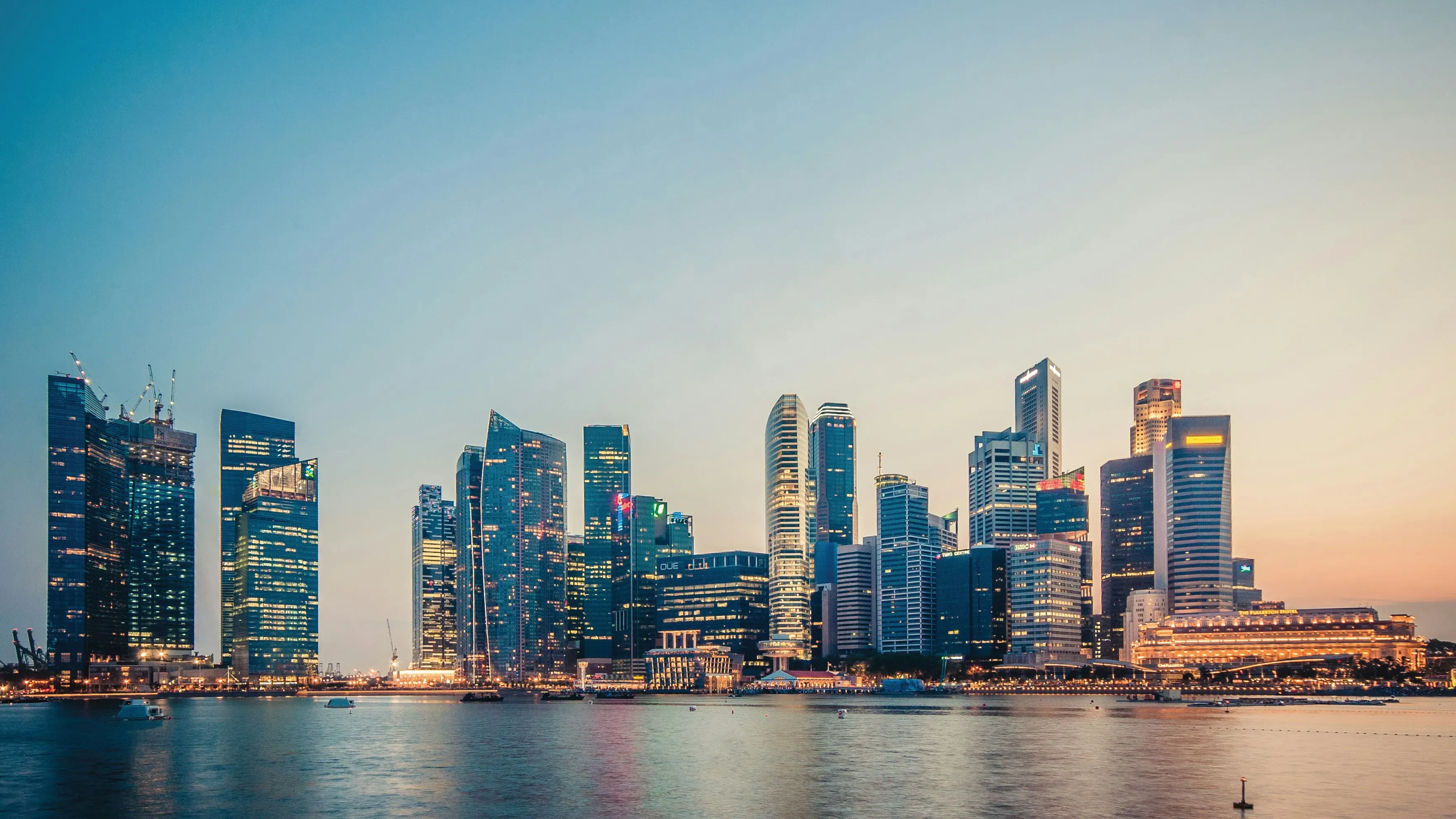
Singapore Overview
Singapore is 735 km² of tropics — and squeezed onto that island are one of the world's four most important financial centres, the second-busiest container port on earth, and a passport that opens 192+ countries visa-free. Sixty years ago, Singapore was thrown out of Malaysia with predictions it wouldn't last the decade. Today, 7,000+ multinationals run their regional headquarters here, more than 100 new family offices arrive every year, and the People's Action Party has governed without interruption since independence in 1965. The legal system runs on English common law; Singapore is a founding member of and a member of the Commonwealth, the United Nations, and the .
On This Page
- 1.Singapore Overview
- 1.1How Does Singapore Compare?
- 1.2Who does Singapore fit?
- 1.3Pros and Cons of Relocating to Singapore
- 1.4Singapore leads on Business — WRI 97/100
- 1.5Singapore leads on Education — WRI 94/100
- 1.6Residence
- 1.7Taxes on Personal Income
- 1.8Cost of Living
- 1.9Healthcare System
- 1.10Education System
- 1.11Banking & Finance
- 1.12Cryptocurrency Regulation
- 1.13Real Estate Market
- 2.Frequently Asked Questions
Quick Facts
- Passport Rank: 1
- Visa-Free Destinations: 192
- Capital: Singapore
- Population: 5.91 million
- Area: 735 km²
- Currency: Singapore Dollar (SGD)
- Official languages: English, Mandarin, Malay, Tamil
- Religions: Buddhism 31%, Christianity 19%, Islam 15%, Taoism 9%, Hinduism 5%, Other/None 21%
Key Indicators
- GDP (Nominal): $659.6 billion
- Unemployment Rate: 1.9%
- Human Development Index: 0.949
- GDP per Capita: $107,758
Safety & Governance
- Global Peace Index (IEP): 1.357
- Press Freedom Index (RSF): 45.78
- Corruption Perception (TI): 84/100
- Gini Coefficient (WB): 37.4
Health & Environment
- PM2.5 Air Pollution: 13.1 µg/m³
- Air Quality Category: Moderate
- ND-GAIN Adaptation Index: 72.4/100
- Life Expectancy: 84.1 years
The proposition for an investor or relocator is unusually clean: territorial taxation, full capital mobility, English-language jurisdiction, and a steadily expanding stack of programmes for international residents and family offices. The cost is also unusually clean: one of Asia's most expensive cities, very little land, no fast path to a passport, and no patience for ambiguity. Singapore does not try to be for everyone — it's clear from the start who it's for.
How Does Singapore Compare?
How Singapore stacks up against its closest peers on the WRI 2026:
Where Singapore wins: Singapore tops the peer group on three dimensions — Business (97 vs Luxembourg's 92, Switzerland's and the Netherlands' 90, Australia's 82), Education (94 vs Switzerland's and Australia's 92, Luxembourg's and the Netherlands' 88), and Investment (91, narrowly above Luxembourg at 90, Switzerland and the Netherlands at 88). The Business gap is the most decisive: Singapore's combination of 24-hour ACRA incorporation, the flat 17% corporate tax with effective rates often below 10%, and the 13O / 13U family office regimes outpaces every peer in this group — including jurisdictions historically built around financial services.
Where Singapore lags: Citizenship is Singapore's weakest point in absolute and relative terms. At 48, it sits below every peer in this group — Australia (78) and Luxembourg (74) offer materially more accessible naturalisation paths, and the Netherlands (60) and Switzerland (58) both edge ahead. The Residency score of 62 also trails the group, reflecting the absence of a dedicated lifestyle or retirement visa. Switzerland's 85 on Retirement marks a specific niche Singapore does not directly compete on.
Who does Singapore fit?
Summary
Singapore fits HNW investors and family office principals, founders building regional or global businesses, senior international executives moving on Employment Pass or , and corporate transferees on intra-company moves. It is a poor fit for lifestyle relocators wanting an easy long-term residency, remote workers and digital nomads, applicants pursuing family reunification or ancestry-based pathways, fast citizenship seekers, and asylum applicants.
Right fit:
- HNW investors and family office principals — Global Investor Programme from $7.8 million, plus the 13O and 13U family office regimes ($15.6M and $39M minimum AUM) for institutional-grade tax exemption on qualifying income.
- Founders and operators building regional or global businesses — the highest WRI Business score in our index, 24-hour incorporation through ACRA, 17% corporate tax with effective rates often below 10%, and regional-HQ status for 7,000+ multinationals.
- Senior international executives and specialists — the Employment Pass and the ONE Pass ($23,500/month salary threshold) make Singapore one of the most accessible top-tier destinations for senior international talent, with English-language jurisdiction and top-decile safety.
- Corporate transferees on intra-company moves — streamlined transfer routes inside the Employment Pass framework, supported by 90+ double taxation treaties and zero exchange controls for global payroll structures.
Wrong fit:
- Lifestyle relocators looking for an easy long-term residency — no dedicated lifestyle visa. Long-term residence requires an Employment Pass, , or equivalent professional or investment basis; the residency path rewards long-term commitment over speed.
- Remote workers and digital nomads — Singapore does not issue a digital nomad visa. Remote workers must hold a local Employment Pass tied to a Singapore-based employer.
- Applicants pursuing family reunification or roots-based pathways — Long-Term Visit Pass routes are limited and require sponsorship by a Citizen or Permanent Resident. There is no ancestry-based programme.
- Fast citizenship seekers — long -to-citizenship timelines, low approval rates, and no direct investment-to-passport programme.
- Asylum seekers and humanitarian applicants — Singapore is not a signatory to the 1951 Refugee Convention and operates no formal asylum framework. Exceptional-talent routes (Tech.Pass, ONE Pass) exist but are skill-based rather than humanitarian.
Pros and Cons of Relocating to Singapore
- 01TaxationTerritorial tax regime with no capital gains taxTerritorial tax regime with no capital gains tax and no inheritance tax.No CGT
- 02MobilityStrong passport with visa-free accessOne of the world's strongest passports — visa-free access to 192+ destinations.192+ dest.
- 03EconomyFull capital mobilityFull capital mobility, no exchange controls.No exchange controls
- 04BusinessHighest Business scoreThe highest Business score in our index, with 24-hour incorporation and effective corporate tax rates often below 10%.24-hour incorporation
- 05TaxationFamily office tax exemption13O and 13U regimes give family offices fund-level tax exemption on qualifying income.Tax exemption
- 06HealthcareMixed public-private healthcareMixed public-private healthcare consistently ranks near the top worldwide.Top healthcare
- 07LegalEnglish common law jurisdictionEnglish common law jurisdiction with predictable, on-time enforcement.Predictable enforcement
- 01Cost of livingHigh living costsOne of Asia's most expensive cities — a single professional budgets ~$3,800/month; a family of three around $6,300/month.High expenses
- 02Real EstateHigh Additional Buyer's Stamp Duty60% Additional Buyer's Stamp Duty (ABSD) on foreign property purchases since April 2023, which prices most foreigners out of residential ownership.60% ABSD
- 03ResidencyNo fast path to passportNo fast path to a passport: long PR-to-citizenship timelines and low approval rates.Long PR-to-citizenship
- 04ResidencyStrict long-term settlement criteriaLong-term settlement criteria for residency are strict.Strict criteria
- 05EducationHigh cost of international schoolingInternational schooling for expat families: $26,000–$33,000 per child per year, among the highest in Asia.High school fees
- 06TransportExpensive vehicle ownershipVehicle ownership is deliberately expensive — a Certificate of Entitlement (COE) for a standard car currently runs SGD $93,800 - 101,700 on top of the vehicle price.High COEHigh COE
- 07GeographyLimited access to space and nature735 km² leaves limited access to space, nature, and seasonal weather.Limited space
Singapore leads on Business — WRI 97/100
Singapore's Business score of 97 is the highest in our index, and the reason isn't subtle: this is a country built around removing friction for capital and operators. A private limited company can be incorporated online through ACRA in under 24 hours, with 100% foreign ownership and no minimum capital. Corporate tax is a flat 17%, but effective rates land well below that once partial exemptions and the start-up exemption — 75% off the first $74,000 of chargeable income for the first three years — apply. Singapore has 90+ double-taxation treaties, no exchange controls, and a banking system that implements serious KYC without making operations impossible. The Employment Pass route provides founders and senior staff with a clear path to residency; the EntrePass is specifically for innovative startup founders. For family offices, the 13O and 13U schemes ($15.6M and $39M minimum AUM) deliver fund-level tax exemption on qualifying income, which is why the 7,000+ multinational headquarters already on the island are joined by 100+ new family offices every year.
Singapore leads on Education — WRI 94/100
Singapore's Education score of 94 reflects two parallel realities. The local public school system has topped global student-assessment rankings in mathematics, science, and reading consistently since 2009 — one of the very few systems that genuinely earns the label. Expat families mostly can't access it: local schools are effectively closed to non-Permanent Residents at most year groups. The international school market that has grown around it is one of Asia's largest and most established — roughly 50 schools, including United World College South East Asia (UWCSEA), Singapore American School (SAS), Tanglin Trust School, Dulwich College Singapore, and the German European School Singapore. Plan around $26,000/year for primary and $33,000/year for IB or A-Levels. At university level, the National University of Singapore (NUS) and Nanyang Technological University (NTU) both sit in the world's top 15, with SMU adding a third strong option for business and law and INSEAD running a major MBA campus on the island. Permanent Residents get partial subsidies on local school admission; Employment Pass dependants can apply, but compete for whatever places remain.
Residence
Singapore does not rely on a 183-day rule alone. The Inland Revenue Authority of Singapore (IRAS) determines tax residency case-by-case, looking at days present and whether employment or business is conducted on the island. In practice, anyone physically present or employed in Singapore for 183 days or more in a calendar year will be treated as a tax resident. Tax residents pay Singapore income tax on Singapore-sourced income only; foreign-sourced income remitted into Singapore is generally exempt under the territorial system. There is no controlled foreign corporation (CFC) regime and no worldwide income taxation for individuals — which is why Singapore works as a structural base for internationally mobile capital. The Central Provident Fund (), the local forced savings and pension system, applies only to Citizens and Permanent Residents. Employment Pass holders sit outside it.
Safety is the other half of the residency case. Singapore sits in the top decile of the Global Peace Index; violent crime rates are among the lowest in the developed world; and the public-safety apparatus is unobtrusive but always present. Petty street crime is rare even in tourist zones, and women routinely move alone through any neighbourhood at any hour. The trade-off is a strict legal framework: drug-related offences carry mandatory severe penalties, including capital punishment for trafficking, and a long list of small offences (littering, jaywalking, importing chewing gum) carries on-the-spot fines. For residents who plan to live within the law, the experience is one of the calmest big-city environments in the world.
Taxes on Personal Income
Singapore's personal income tax sits at one of the lowest top rates in the developed world. Income up to $15,635 is taxed at 0%. The top marginal rate is 24% on chargeable income above $782,000 (with a 23% rate on the $391,000–$782,000 band), with no additional surtax or social security levy for non-citizen Employment Pass holders.
There is no capital gains tax, no inheritance tax, and no wealth tax. Dividends from Singapore-resident companies are tax-exempt under the one-tier corporate system. Rental income from Singapore property is taxed as ordinary income at marginal rates. Foreign-sourced dividends, branch profits, and service income are exempt if the headline tax rate in the source country was at least 15% and the income was actually taxed there. GST rose to 9% in January 2024 — you feel it on the bigger purchases. A Singapore resident earning $290,000 lands at an effective rate near 14%; the same income in Germany, France, or the UK falls into the 45–55% range.
Cost of Living
Singapore is one of Asia's most expensive cities, and there is no point pretending otherwise. A single professional should plan around $3,800/month for a comfortable life — rent, transport, dining, private health cover. A 1-bedroom in the central region runs $2,800/month; the same in the East or West costs around $1,800. A family of three without international school fees lands around $6,300/month. Vehicle ownership is deliberately expensive: the Certificate of Entitlement (COE) for a standard car (Category A) currently runs $ 93,800 - 101,700 on top of the vehicle price, which is why most families rely on public transport. The Mass Rapid Transit (MRT) is one of the cleanest, fastest, and cheapest metros you will find anywhere. Comprehensive international health insurance for a single expat is around $200/month. A live-in domestic helper costs $500–$700/month plus a $3,700 government bond.
Healthcare System
Healthcare is one of the things that stops worrying you the moment you arrive. Singapore runs a mixed public-private system that consistently sits near the top of global health rankings. The "restructured" public hospitals — Singapore General Hospital, National University Hospital, Tan Tock Seng — offer Citizens and Permanent Residents subsidised treatment with deductibles. Employment Pass holders use the same public hospitals at full unsubsidised rates: about $100–$200 for a specialist consultation, $400–$600 per inpatient day. Comprehensive international private cover for an expat family costs around $400/month. The gap shows up in waiting times: about 3 days for a private specialist appointment, 4–6 weeks in a public specialist outpatient clinic. Pharmacy prices are a fraction of US levels. Singapore is also a serious destination for oncology, cardiac surgery, and elective procedures, drawing roughly 500,000 medical tourists a year.
Education System
Singapore's education question for relocating families is largely about access rather than quality. The local public system — the one that delivers globally-leading student-assessment results — is effectively closed to non-Permanent Residents at most year groups. Children of Employment Pass holders can apply, but compete for whatever places remain after Citizens and PRs. International schools fill that gap, with applications opening 12–18 months ahead of intended enrolment for the most competitive of them. Mother-tongue support varies sharply by school — UWCSEA covers more than 25 languages, Tanglin runs a British curriculum, and the German European School Singapore offers a German-language track. University-level options run wide: NUS, NTU, and SMU for the local route; INSEAD's MBA campus and a long bench of Western university satellite programmes for international postgraduate study. Permanent Residency unlocks the local public system with partial subsidies — which makes PR a meaningful upgrade for any family with school-age children.
Banking & Finance
Opening a bank account here requires a valid Employment Pass, Dependent Pass, or Long-Term Visit Pass. Tourist visa holders cannot open accounts. The local big three are DBS, OCBC, and UOB; on the international side you'll see Standard Chartered, Citibank, and HSBC. Foreign credit history doesn't follow you across the border — most newcomers wait 6–12 months of local income records before a first credit card gets approved. Mortgages for foreigners on private property require a 25% minimum down payment; SGD-denominated mortgage rates currently sit around 3.8% on a 30-year term. There are no exchange controls — capital moves in and out freely. As a member and Common Reporting Standard () signatory, Singapore banks run thorough KYC and source-of-funds checks, particularly on high-value accounts. The Monetary Authority of Singapore (MAS) is the central bank and the single integrated financial regulator.
Cryptocurrency Regulation
Singapore is one of the world's clearer crypto regimes, and that clarity is a big part of why so many funds and Web3 outfits set up here. Digital payment tokens (DPT) sit under MAS via the Payment Services Act 2019 (amended 2021). Exchanges need either a Major Payment Institution (MPI) or Standard Payment Institution (SPI) licence to operate. Capital gains on crypto are not taxed — because there is no capital gains tax at all. But crypto received as payment for goods or services, or income from crypto trading run as a business, is taxed as ordinary income. GST at 9% applies to crypto-to-fiat and crypto-to-goods transactions from January 2020 onwards. MAS is openly cautious on retail, so leveraged crypto products for retail investors face hard limits. On the institutional and Web3 side Singapore is a serious hub, but AML/CFT enforcement is real, not theatrical. Offshore crypto income is exempt under the territorial rules if the qualifying conditions are met.
Real Estate Market
Foreigners can buy private condominium apartments without restriction; executive condominiums open up after 5 years. Landed property — houses, bungalows — requires government approval and is in practice reserved for Permanent Residents and Citizens. The number that defines this market is the Additional Buyer's Stamp Duty (ABSD): 60% of the purchase price for foreigners since April 2023. It is an explicit cooling measure aimed at foreign speculation, and it has done what it was designed to do. Permanent Residents pay 5% ABSD on a first property; Citizens pay 0% on a first. Prime District 9/10 condominiums (Orchard, Holland Village) trade around $2,800 per square metre; outside the Core Central Region, private condominiums average closer to $1,300 per square metre. Annual property tax on investment properties runs at progressive rates from 10–20% of the Annual Value. Gross rental yields average about 3.5%. Long-term capital appreciation has averaged 4% annually over the past decade — not spectacular, but steady, supported by strict government control of land supply.


