
Luxembourg Overview
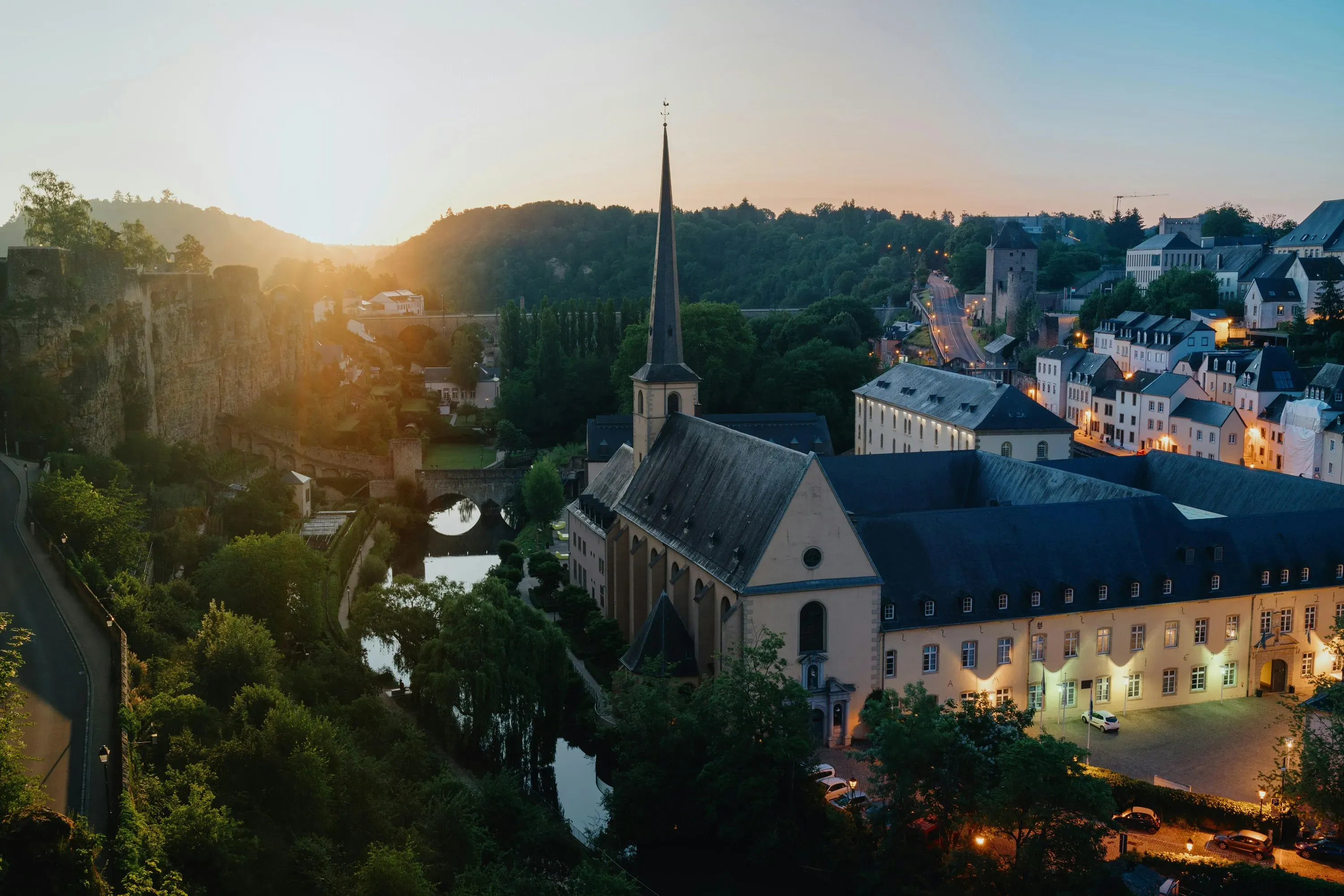
Luxembourg is a constitutional monarchy of 677,000 residents in Western Europe, ruled by Grand Duke Henri of the House of Nassau-Weilburg, and a founding member of the European Union (1957), (1949), the (1985), the , and the Council of Europe. The country sits at the geographic crossroads of Europe with land borders to Belgium, France, and Germany, runs on a civil-law system under the Constitution of 1868 (revised 2023), and operates the world's 2nd-largest investment fund jurisdiction after the United States — approximately €5.4 trillion in assets under management across UCITS and alternative-investment-fund structures. Luxembourg City, on the Pétrusse and Alzette river valleys, has been the capital since the 10th century and is one of three official capitals alongside Brussels and Strasbourg.
On This Page
- 1.Luxembourg Overview
- 1.1How Does Luxembourg Compare?
- 1.2Who does Luxembourg fit?
- 1.3Pros and Cons of Relocating to Luxembourg
- 1.4Luxembourg leads on Business — WRI 92.0 / 100
- 1.5Luxembourg leads on Investment — WRI 90.0 / 100
- 1.6Residence
- 1.7Taxes on Personal Income
- 1.8Cost of Living
- 1.9Healthcare System
- 1.10Education System
- 1.11Banking & Finance
- 1.12Cryptocurrency Regulation
- 1.13Real Estate Market
- 2.Frequently Asked Questions
Quick Facts
- Passport Rank: 4
- Visa-Free Destinations: 185
- Capital: Luxembourg City
- Population: 677,000
- Area: 2,586 km²
- Currency: Euro (EUR)
- Official languages: Luxembourgish, French, German
- Religions: Catholic 70%, other/none 30%

Key Indicators
- GDP (Nominal): $109 billion
- Unemployment Rate: 6.7%
- Human Development Index: 0.930 (Very High)
- GDP per Capita: $158,733

Safety & Governance
- Global Peace Index (IEP): 1.44 (Rank: 9, GPI 2024)
- Press Freedom Index (RSF): 78.92 (Rank: 22, RSF 2024)
- Corruption Perception (TI): 81/100 (Rank: 8, CPI 2024)
- Gini Coefficient (WB): 31.4
Health & Environment
- PM2.5 Air Pollution: 9.7 µg/m³
- Air Quality Category: Good
- ND-GAIN Adaptation Index: 67.2 (Rank: 32, ND-GAIN 2024)
- Life Expectancy: 83.0 years

The proposition for an investor or relocator is unusually clean: an EU passport opening 185 destinations visa-free (one of the world's top-4 passport ranks), one of Europe's deepest fund and banking ecosystems, the Investor Residence Programme from $600,000 in a Luxembourg-domiciled fund, and a 5-year naturalisation timeline with dual citizenship permitted since 2009. The cost is also unusually clean: cost of living among the EU's highest, a top marginal effective income tax rate near 45.78%, a tight housing market with rents of $2,800-$3,900/month for a 1-bedroom in Luxembourg City centre, and a Luxembourgish-language requirement (Sproochentest) for naturalisation. Luxembourg does not try to be for everyone — it is clear from the start who it is for.
How Does Luxembourg Compare?
Summary
Luxembourg (WRI 81.5, global rank 3) sits between Switzerland (83.0) and Singapore (80.9) in the live peer group, with Canada (83.4) at the top and Grenada (79.7) at the bottom. Luxembourg ranks second on Investment (90.0), Business (92.0), and Residency (78.0) — and trails the group decisively on Safety (66.8), reflecting the post-COVID petty-crime gap around Luxembourg City central station that pulls the score below GPI rank 9 expectations.
How Luxembourg stacks up against its closest peers on the WRI 2026:
Where Luxembourg wins: Investment (90.0) sits second only to Singapore (91), and ahead of Switzerland (88), Canada (82), and Grenada (75) — the world's 2nd-largest investment fund jurisdiction (~€5.4 trillion AUM) and 120+ banks under CSSF supervision anchor the score. Business (92.0) is also second only to Singapore (97), ahead of Switzerland (90), Canada (86), and Grenada (70) — the 24.94% combined corporate tax and full EU single-market access remain among the most competitive globally. Residency (78.0) is second only to Grenada (90), ahead of Canada (79), Switzerland (72), and Singapore (62);the Investor Residence Programme from $600,000 plus the 5-year naturalisation timeline are uniquely accessible at this WRI tier. Citizenship (74.0) leads Switzerland's 58 and Singapore's 48 by wide margins.
Where Luxembourg lags: Safety (66.8) is the weakest in the peer group by a wide margin: 25.9 points behind Switzerland (92.7), 24.3 behind Singapore (91.1), 17.2 behind Canada (84), and 5.2 behind Grenada (72). The post-COVID petty-crime spike around Luxembourg City central station and Bonnevoie districts pulls the score well below what the top-decile Global Peace Index rank (9 of 163) would suggest. Education (88.0) trails Canada and Singapore at 94, and Switzerland's 92 — the small trilingual population (677k) constrains the public system's scale despite high quality. Retirement (82.0) trails Switzerland and Grenada at 85, supported by tax-friendly Luxembourg regime but lacking the pensioner-specific incentives of Mediterranean peers.
Who does Luxembourg fit?
Summary
Luxembourg fits HNW investors seeking an EU passport pathway, fund managers and family-office principals building Luxembourg-domiciled structures, senior international executives moving with EU employers, and applicants seeking a 5-year route to EU citizenship. It is a poor fit for applicants prioritising macro-safety, English-only relocators outside the financial sector, foreign retirees wanting a territorial regime, lifestyle relocators on affordable budgets, and applicants from countries with limited Luxembourg consular presence.
Right fit:
- HNW investors seeking an EU passport pathway — Investor Residence Programme from $600,000 in a Luxembourg-domiciled fund (5-year lock) or $3,600,000 in existing Luxembourg company; 3-year renewable residence permit leading to permanent residency after 5 years and citizenship eligibility after 5 years with B1 Luxembourgish language proof.
- Fund managers and family-office principals — world's 2nd-largest investment fund jurisdiction (~€5.4 trillion AUM); UCITS, RAIF, SCSp, SOPARFI, and SPF structures with mature CSSF supervision; full EU passporting and tax-treaty network (75+ DTAs); English-comfortable practitioners across the Big Four, Magic Circle, and private-banking ecosystem.
- Senior international executives moving with EU employers — Luxembourg hosts EU institutions (Court of Justice, European Investment Bank, Eurostat), regional headquarters for major MNCs (ArcelorMittal, RTL Group, Cargolux, SES), and the financial sector employing roughly 50,000 people; framework supports senior international talent.
- Applicants seeking a 5-year route to EU citizenship — naturalisation requires 5 years legal residence plus B1 Luxembourgish (Sproochentest) plus 'Vivre Ensemble' civics course; dual citizenship permitted since 2009. One of the most accessible passport pathways within the EU's high-WRI tier.
Wrong fit:
- Applicants prioritising macro-safety — Safety dimension (66.8) is Luxembourg's weakest. Post-COVID urban petty-crime around the central station and Bonnevoie districts is materially higher than the top-decile Global Peace Index headline rank suggests.
- English-only relocators outside the financial sector — administrative and legal interfaces predominantly use French and German; Luxembourgish is the national language and is required for naturalisation. The financial sector is English-comfortable, but the broader public realm is not.
- Foreign retirees wanting a territorial tax regime — Luxembourg taxes worldwide income on residents at progressive rates up to 45.78% effective; there is no -equivalent new-resident incentive and no dedicated pensioner flat tax.
- Lifestyle relocators on affordable EU budgets — rents of $2,800-$3,900/month for a 1-bedroom in central Luxembourg City and overall cost of living among the EU's highest price most lifestyle relocators out; Germany, France, or Belgium offer comparable EU lifestyles at materially lower cost.
- Applicants from countries with limited Luxembourg consular presence — Luxembourg maintains 15 embassies globally; applicants from many non-EU countries face additional travel to obtain visas, apostilled documents, and interview appointments through consular networks in Brussels, Paris, or Berlin.
Pros and Cons of Relocating to Luxembourg
- 01MobilityEU Founding-Member PassportEU founding member with the world's 4th-strongest passport opening 185 destinations visa-free; full EU labour-market and freedom-of-movement rights for citizens.EU + 185 visa-free
- 02InvestmentWorld's 2nd-Largest Fund JurisdictionWorld's 2nd-largest investment fund jurisdiction at approximately €5.4 trillion in assets under management; 4,300+ fund structures and 120+ banks under CSSF supervision.€5.4T fund AUM
- 03CitizenshipAccessible EU Citizenship Pathway5-year naturalisation timeline with B1 Luxembourgish language requirement — one of the most accessible passport pathways among high-WRI jurisdictions; dual citizenship permitted since 2009.5-yr naturalisation
- 04ResidencyInvestor Residence ProgrammeInvestor Residence Programme from $600,000 in a Luxembourg-domiciled fund (5-year lock) or $3,600,000 in an existing Luxembourg company; 3-year renewable residence with family inclusion.$600k Investor Visa
- 05TaxationCompetitive Corporate Tax + DTA Network24.94% combined corporate tax (17% national + 7% solidarity + 6.75% Luxembourg City municipal); 75+ double-taxation treaties; full EU single-market and customs-union access.24.94% combined corp tax
- 06LanguageTrilingual Administrative JurisdictionTrilingual administrative jurisdiction (Luxembourgish, French, German) with English-comfortable financial sector; major MNC regional headquarters and EU institutions in Luxembourg City.Trilingual jurisdiction
- 07TaxationOne of EU's Lowest VAT Rates17% VAT — one of the EU's lowest standard VAT rates, supporting both consumer purchasing power and B2B trade competitiveness.17% VAT
- 01Cost of LivingHigh Cost of LivingCost of living among the EU's highest; rents of $2,800-$3,900/month for a 1-bedroom in central Luxembourg City, with a tight housing market and long waits for prime residential property.€2.5-3.5k/mo rent
- 02TaxationHigh Top Marginal Tax RateTop marginal effective income tax rate near 45.78% (42% + 9% solidarity surcharge at the top bracket); no NHR-equivalent new-resident incentive and no dedicated pensioner flat tax.45.78% top effective
- 03CitizenshipLuxembourgish Language RequirementLuxembourgish language requirement for naturalisation — B1 Sproochentest plus 'Vivre Ensemble' civics course is a meaningful barrier for applicants without prior exposure to the language.B1 Sproochentest
- 04EconomySmall Domestic MarketSmall domestic market (677,000 residents) limits consumer-facing business and constrains the labour pool; many local positions require trilingual capacity.677k market
- 05SafetyUrban Petty-Crime GapSafety dimension (66.8) reflects elevated post-COVID urban petty-crime around the Luxembourg City central station and Bonnevoie districts, despite the country's top-decile Global Peace Index rank.Safety 66.8
- 06LanguageLimited English Outside Financial SectorAdministrative and legal interfaces predominantly use French and German; non-financial sectors are not English-default, and key documentation requires sworn translation.FR/DE outside finance
- 07ConsularLimited Consular NetworkLimited consular presence globally (15 embassies); applicants from many non-EU origin countries travel to Brussels, Paris, or Berlin for visa applications and document legalisation.15 embassies
Luxembourg leads on Business — WRI 92.0 / 100
Luxembourg's Business score of 92.0 reflects one of Europe's most concentrated and capital-efficient business environments, and the reason is not subtle: a flat 17% national corporate tax plus 7% solidarity surcharge plus 6.75% Luxembourg City municipal business tax delivers a combined effective rate of approximately 24.94%, one of the EU's most competitive headline structures for holding-company, finance, and IP structures. Foreign ownership is 100% across most sectors; the standard Société à responsabilité limitée (S.à r.l.) requires minimum capital of €12,000 (approximately $13,200), and the Société anonyme (S.A.) requires €30,000 (approximately $33,000). Luxembourg has 75+ double-taxation treaties, EU single-market and customs-union access, and the world's deepest fund-administration ecosystem outside the US, anchored by the Commission de Surveillance du Secteur Financier (CSSF). The Employment Pass-equivalent stack runs through the EU Blue Card for non-EU specialists (minimum salary €58,968 in 2024, approximately $65,000), plus standard work-permit routes. The trade-off is the small domestic market — 677,000 residents limit the consumer base — and the trilingual administrative requirement that constrains the labour pool for many roles.
Luxembourg leads on Investment — WRI 90.0 / 100
Luxembourg's Investment score of 90.0 reflects the world's 2nd-largest investment fund jurisdiction after the United States, with approximately €5.4 trillion in assets under management across UCITS, AIFs (alternative investment funds), and a deep RAIF (Reserved Alternative Investment Fund) and SCSp (Special Limited Partnership) ecosystem. The country hosts 4,300+ fund structures, 120+ banks (mostly subsidiaries of European, US, Chinese, and Middle Eastern parents), and a custody and fund-administration sector employing roughly 50,000 people under CSSF supervision. The Investor Residence Programme (under the 8 March 2017 law) offers four routes: $600,000 in a 5-year locked bank deposit, $600,000 in a Luxembourg-domiciled fund (5-year hold), $3,600,000 in an existing Luxembourg company, or $24,000,000 in social-impact investments — each delivering a 3-year renewable residence permit with permanent-residency eligibility after 5 years. Luxembourg participates in OECD automatic exchange and is -compliant, and the local banking proposition is tax efficiency on declared wealth (since 2014 reforms abolished banking secrecy) rather than opacity.
Residence
Luxembourg's tax residency is determined by the 183-day rule (presence in Luxembourg for more than 183 days in a calendar year), supplemented by a "centre of vital interests" test that captures permanent home, family, and economic ties. Full tax residents pay Luxembourg income tax on worldwide income at progressive rates of 0-42%, plus a 7% solidarity surcharge (low/middle brackets) or 9% (top bracket), and a small dependents' contribution; top marginal effective rate lands near 45.78%. Tax classes apply: Class 1 (single), Class 1a (single parent or 65+), Class 2 (married joint filing). Social-security contributions on local employment add approximately 12.45% (employee) plus 11.65% (employer). Luxembourg has no territorial regime, no NHR-equivalent new-resident incentive, and no dedicated lump-sum scheme; every dollar of foreign salary, dividend, or business profit lands inside the Luxembourg base. Luxembourg participates in the EU's CFC framework and has 75+ double-taxation treaties, including with the US, UK, Germany, France, and most major Asian and Middle Eastern jurisdictions. The Investor Residence Programme (8 March 2017 law) delivers a 3-year renewable residence permit from $600,000 in a Luxembourg-domiciled fund (5-year hold) or other qualifying routes, with full family inclusion.
Safety is the other half of the residency case. Luxembourg sits at rank 9 of 163 on the Global Peace Index with a score of 1.44, in the top decile globally and well above any non-Nordic European peer except Switzerland. Day-to-day safety in residential neighbourhoods (Belair, Limpertsberg, Merl) and the Centre Ville is high; petty crime is concentrated around the central railway station (Gare) and the Bonnevoie district — areas where post-COVID burglary, mobile-phone theft, and aggressive panhandling have risen materially since 2021 and pull the country's Safety WRI dimension to 66.8, below what the GPI headline rank would suggest. Women's safety is generally high outside the Gare quarter at night. Corruption Perception Index 81 of 100 (rank 8 of 180) and Press Freedom rank 22 of 180 mark a strong governance environment that is fully aligned with Western EU peers; the safety profile is structurally strong, with the headline gap concentrated in two specific districts of the capital.
Taxes on Personal Income
Luxembourg's personal income tax is a progressive 23-band structure: 0% on income up to approximately $12,000, rising to 42% on income above approximately $234,000 (Class 1 single filer 2024). On top, a 7% solidarity surcharge applies to low and middle brackets and 9% to the top bracket, lifting the top marginal effective rate to approximately 45.78%. Married couples can elect Class 2 joint filing, which broadly halves brackets and is materially advantageous for unequal-income households. Capital gains: short-term gains (<6 months) on shares are taxed as ordinary income; long-term gains (>6 months) on shares with <10% ownership are tax-exempt; gains on principal residence are exempt. Dividends benefit from a 50% exemption if qualifying conditions are met. Inheritance and gift tax: 0% direct line for in-life gifts; 0-15% on inheritances varying by relationship and amount. There is no individual wealth tax. VAT is 17% standard (one of the EU's lowest), with reduced rates of 14%, 8%, and 3%. A Luxembourg resident earning $500,000 lands at an effective combined rate near 44% (federal PIT plus solidarity plus social charges), close to the upper range of EU peers but below France, Belgium, or Germany on a like-for-like basis.
Cost of Living
Luxembourg is among the European Union's most expensive countries, and there is no point pretending otherwise — the cost reflects the small domestic market, tight housing supply, and the concentration of high-earning financial-sector employees and EU-institutions staff. A single professional in Luxembourg City should plan around $4,500-$5,500/month for a comfortable life: rent, transport, dining, private health cover. A 1-bedroom in the central districts (Centre Ville, Limpertsberg, Belair) runs $2,800-$3,900/month; the same outside the city in Differdange, Esch-sur-Alzette, or Bettembourg runs $1,500-$2,300/month. A family of three lands $9,000-$13,000/month including international school fees averaged across the year. Vehicle ownership is straightforward ($30,000-$50,000 for a new mid-range sedan, around $1,400/year insurance, $1,500/year fuel); cross-border commuting from Belgium, Germany, and France is normalised, with roughly 200,000 cross-border workers ("frontaliers") commuting daily into Luxembourg. Comprehensive international private health insurance for a single expat runs $150-$280/month (with CNS coverage providing the baseline for residents). Restaurant prices: a casual meal $20-30, a mid-range dinner $50-90, a top tasting menu $200-400+.
Healthcare System
Luxembourg runs a universal healthcare system anchored by the Caisse Nationale de Santé (CNS), the single statutory health insurer covering all residents through mandatory contributions of approximately 6.4% of gross salary (split employer/employee). The CNS reimburses around 80-100% of standard care costs across a network of public and private clinics; out-of-pocket co-payments are modest. The country has roughly 12 hospitals and clinics serving 677,000 residents, with the Centre Hospitalier de Luxembourg (CHL), the Hôpitaux Robert Schuman, and the Centre Hospitalier Emile Mayrisch in Esch the main facilities. Specialist consultation runs $80-$150 private (with CNS reimbursement covering most of the cost); an inpatient day $400-$800. Complex specialty procedures are often referred to teaching hospitals in Brussels, Paris (especially Necker, Pitié-Salpêtrière), Frankfurt, or Liège: distances are short by EU standards. Wait times for elective specialist appointments run 2-6 weeks in the public network; private clinics typically faster. Comprehensive private expat insurance for a single $150-$280/month; a family $350-$650/month, layered on top of mandatory CNS coverage. Life expectancy of 83.0 years sits in the top tier among EU peers.
Education System
Luxembourg's K-12 public system runs on a uniquely trilingual model: primary schooling in Luxembourgish and German, transitioning to French as the secondary instruction language for many subjects — a structure designed for the native population that is challenging for newly-arrived expat families. The European School of Luxembourg I and II are the dominant international choice for EU-institutions families, with EU-curriculum tracks in 11 languages and tuition heavily subsidised for EU-institution employees; for non-eligible families, fees run approximately $13,000-$18,000/year. The International School of Luxembourg (ISL) is the principality's main IB-curriculum English-medium school, with primary fees $25,000-$28,000/year and secondary $28,000-$36,000/year. The French-curriculum École Internationale Differdange and the Lycée Vauban serve French-track families. Tertiary education is concentrated at the Université du Luxembourg (founded 2003) in Esch-Belval, with English-, French-, and German-medium programmes and strong tracks in finance, IT, and law; tuition runs €400-€800/semester (roughly $440-$880) for most programmes. Many Luxembourg students continue postgraduate education at French, Belgian, German, or top Anglo-American universities.
Banking & Finance
Opening a Luxembourg bank account requires a residence permit (or pending application) and standard KYC including source-of-funds documentation, proof of address, and a personal interview. The dominant local banks are Banque et Caisse d'Épargne de l'État (BCEE, the state-owned retail bank), BIL (Banque Internationale à Luxembourg), and Spuerkeess; international and private banks include BGL BNP Paribas, ING Luxembourg, HSBC Continental Europe, Deutsche Bank Luxembourg, Credit Suisse (UBS Luxembourg), Pictet & Cie (Europe), and Edmond de Rothschild (Europe). The sector hosts 120+ banks under CSSF supervision and €6+ trillion in custody and fund-administration assets — the world's 2nd-largest fund jurisdiction. Foreign credit history does not transfer; most newcomers wait 6-12 months of Luxembourg income records to access mortgages or unsecured credit. Mortgages for foreign EU buyers are available at moderate down payments (20-30%) at rates currently around 3.5-4.5% on 20-30 year terms. There are no exchange controls; Luxembourg participates in OECD CRS and is FATCA-compliant — banking secrecy was abolished by the 2014 reforms. The Banque centrale du Luxembourg (BCL) operates within the European System of Central Banks; the CSSF acts as integrated financial supervisor.
Cryptocurrency Regulation
Luxembourg's crypto regime sits inside the EU's MiCA framework (Markets in Crypto-Assets Regulation, effective 2024) supplemented by national law transposed under the Loi du 22 mai 2024. Cryptocurrencies are legal to hold, trade, and use; the CSSF authorises crypto-asset service providers (CASPs) under MiCA with passporting rights across the EU single market. Capital gains on crypto held for more than 6 months by individuals are tax-exempt (under the standard long-term shareholding rule that applies to securities generally); gains on crypto held less than 6 months are taxed as ordinary income at the resident's marginal rate (up to 45.78%). Crypto-to-fiat transactions are not subject to VAT under the EU VAT Directive as interpreted by the Court of Justice of the European Union. Luxembourg has positioned the Grand Duchy as one of the EU's more crypto-friendly jurisdictions on regulatory clarity, with CSSF licensing for institutional players (Bitstamp, several European exchanges, several Asian-bridge custodians) and a growing institutional crypto-custody footprint. Self-custody is unrestricted; MiCA travel-rule AML standards apply at licensed exchanges from January 2026.
Real Estate Market
Foreign buyers can purchase Luxembourg real estate: EU citizens face no restrictions on residential property, and non-EU buyers can typically obtain Ministry of Foreign Affairs approval as a routine matter for standard residential transactions. Agricultural land is restricted to qualifying farmers under EU rules. The headline number is the housing-supply pressure: Luxembourg's population has grown roughly 25% since 2010 while housing construction has not kept pace, driving prime per-square-metre prices to among the EU's highest. Prime Luxembourg City (Centre Ville, Limpertsberg, Belair) condominiums average $13,000-$18,000/m²; broader Luxembourg City $9,000-$12,000/m²; suburban areas (Differdange, Esch-sur-Alzette) $5,000-$7,500/m². Title-deed registration tax runs 7% (6% registration + 1% transcription) on transactions, with a "Bëllegen Akt" reduction of up to €30,000 for primary-residence buyers. Annual property tax is municipal and modest — typically 0.7-1.0% of unitary value (which understates market value materially), so the effective annual rate is far below standard European levels. Gross rental yields run 2.5-3.5% in central Luxembourg City and 4-5% in suburban areas. Long-term capital appreciation has averaged 7-9% annually nationally over the past decade, with prime-district segments compounding faster.


