WorldPath AIWORLDPATH•AI
Africa

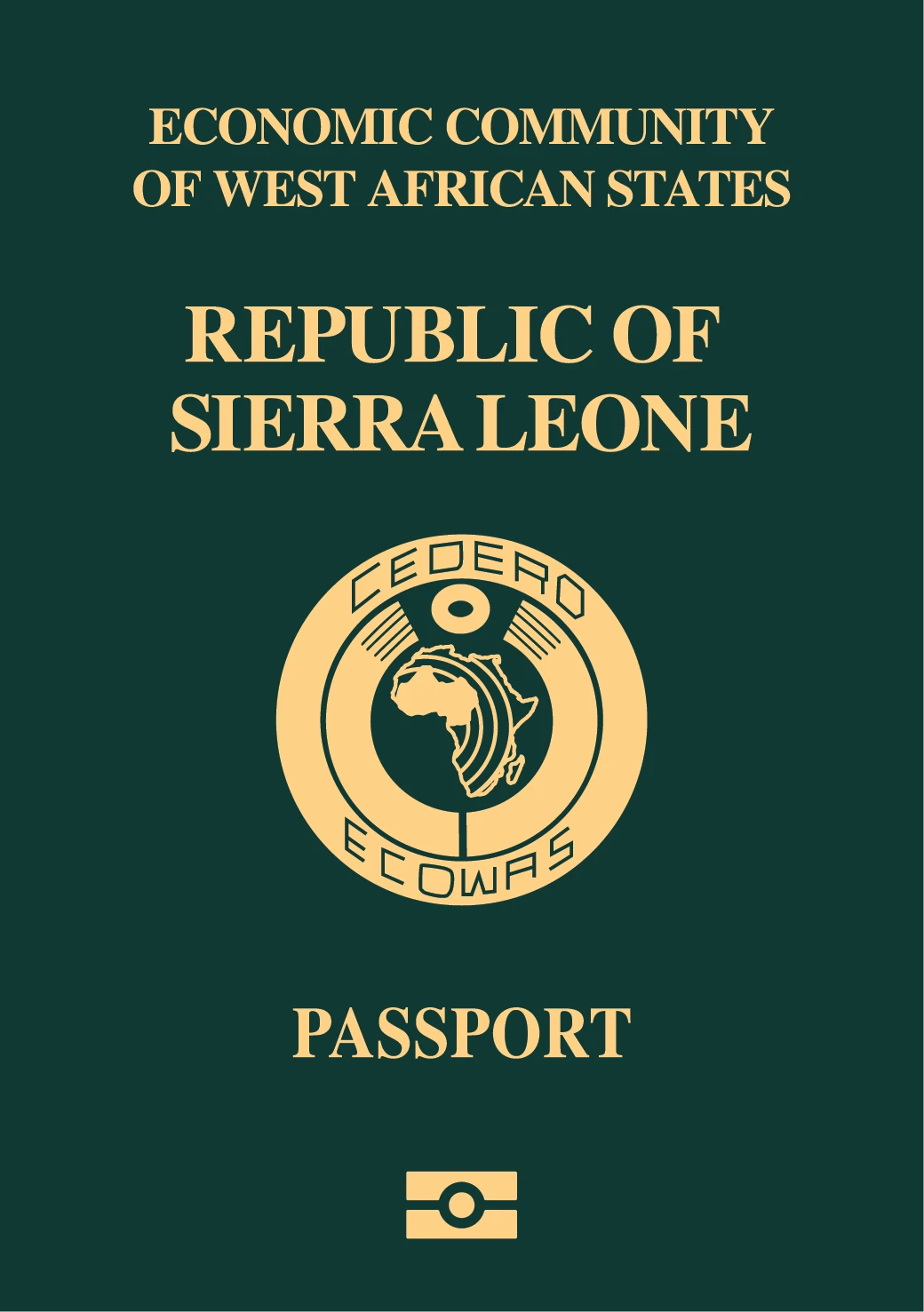
Sierra Leone Passport

Ranked #74 Globally

The Sierra Leone passport is the official travel document of the Republic of Sierra Leone, a coastal nation in West Africa where English is the official language. In 2026 it ranks around #74 worldwide on the main global mobility indices, placing it in the middle band of African travel documents. Holders reach 62 destinations without arranging a visa first, either fully visa-free or with a visa stamped on arrival. The real strength sits close to home: Sierra Leone belongs to (the Economic Community of West African States, a regional bloc founded in 1975), whose rules let citizens cross member borders for up to 90 days without a visa. Beyond the region, it opens parts of East and Southern Africa, a short list of Asian and Pacific destinations, and much of the Caribbean. The United States, the United Kingdom, and Europe's still require a visa in advance.

74th
Global Ranking
62
Destinations
2.86
Mobility Score
Sierra Leone Passport - Passport Power 93rd | worldpath.ai WRI

Sierra Leone Passport Global Mobility Context

The Sierra Leone passport is modest by global measure; its value is regional, not worldwide. Its biggest advantage is membership of (the Economic Community of West African States, a regional bloc set up in 1975). Under a 1979 ECOWAS rule, a citizen of one member state can enter any other for up to 90 days without a visa, opening neighbouring West African economies on the passport alone.

English is Sierra Leone's official language, a legacy of British rule that ended in 1961. Sierra Leoneans apply for study places, work permits, and visit visas in the United Kingdom, the United States, Canada, and Australia in their own working language, easing the paperwork even where a visa is needed.

The document itself is modern. Sierra Leone began issuing a biometric ePassport in 2015 and redesigned the book with an upgraded chip in 2022. The chip meets the international (International Civil Aviation Organisation) 9303 standard, so e-gates can read it.

Sierra Leone has also opened the door to dual nationality. Since a 2006 change to the citizenship law, a Sierra Leonean may hold another country's passport at the same time. This was designed partly for the large diaspora that left during the 1991 to 2002 civil war, who can keep their Sierra Leonean passport alongside a new one.

The chip embedded in the passport makes it electronically readable and could be used at any E-gate.

Sierra Leone Passport at a Glance

Global rank (2026)

Around #74 worldwide on the main mobility indices. Sources place it between #70 and #75 depending on method and month. It sits mid-table among African passports.

Visa-free destinations

62 destinations visa-free or with a visa on arrival. The list is led by West Africa, then East and Southern Africa, with a handful of Asian, Pacific, and Caribbean stops.

Document type

Biometric ePassport with an embedded electronic chip, built to the international 9303 standard so airport e-gates worldwide can read it. Issued since 2015, redesigned in 2022.

Page count

Standard booklet of 32 pages for ordinary travellers, in the green cover used across the West African regional bloc for its member states.

Languages

Printed in English and French. English is Sierra Leone's official language; French is added because it is the working language of many neighbouring West African states.

Adult validity

Five years for the ordinary adult passport, after which the holder renews. This is shorter than the ten-year books some wealthier countries issue.

Child validity (under 16)

Children are issued their own passport, with the same five-year maximum validity as adults under current Immigration Department practice.

Dual citizenship

Allowed since the 2006 amendment to the citizenship law. A Sierra Leonean may hold another nationality at the same time, a change aimed partly at the diaspora abroad.

Issuing authority

The Sierra Leone Immigration Department (), the government agency that handles passports, residence permits, and border control. Its motto is Service Excellence, Security with Patriotism.

History

Sierra Leone gained independence from Britain in 1961. After a civil war that ended in 2002, it returned to regular multiparty elections. Biometric passports arrived in 2015.

Sierra Leone Passport Visa-Free Destinations by Region

Regional Mobility

Economic Mobility Score: 2.86%Country GDP: 8.64%
Visa Exceptions
Africa is the strongest region for this passport, led by visa-free movement across the West African bloc. Europe shows almost no visa-free access, and the United States and Canada both require a visa arranged in advance. Several Asian and Pacific destinations grant a visa on arrival or an electronic visa.

A Sierra Leone passport works best inside West Africa, where regional rules erase the visa entirely. Outside the region the open doors thin out fast. The 62 destinations split roughly into 31 in Africa, around 13 in the Caribbean and the Americas, 10 in Asia, and 9 across the Pacific islands. Europe contributes none on a visa-free basis, and neither the United States nor Canada is on the list. The single most useful entry for most travellers is the 90-day visa-free window across fellow members of the West African bloc.

Africa

Africa is by far the strongest region for this passport, with about 31 destinations open. The core is West Africa: Benin, Burkina Faso, Cape Verde, Cote d'Ivoire, The Gambia, Ghana, Guinea, Guinea-Bissau, Liberia, Mali, Niger, Nigeria, Senegal, and Togo are all reachable visa-free. Most of these fall under the (Economic Community of West African States) 90-day rule, so entry is a passport stamp rather than an application. Beyond the west, holders also reach Botswana, Eswatini, Kenya, Lesotho, Malawi, Mauritius, Rwanda, the Seychelles, and Uganda without a prior visa, while Ethiopia, Madagascar, Mozambique, Tanzania, Zambia, and Zimbabwe grant a visa on arrival or a quick electronic visa. This regional depth is the practical heart of the document for trade, family visits, and work across the continent.

Americas

The Americas open mainly through the Caribbean, not the mainland. Sierra Leoneans enter Barbados for up to six months and Dominica for up to six months, two of the longest welcome windows on the whole list. The Bahamas, Grenada, Haiti, and Trinidad and Tobago each allow stays of around 90 days, and Belize, Jamaica, Saint Kitts and Nevis, Saint Lucia, and Saint Vincent and the Grenadines are also visa-free. In South America, Bolivia, Ecuador, and Suriname admit holders without a prior visa. The big absences are decisive: the United States and Canada both require a visa arranged well in advance, which shapes most long-haul travel plans for Sierra Leoneans.

Asia-Pacific

Asia offers a short but useful set of doors. Singapore and Malaysia both admit Sierra Leoneans visa-free, giving the passport two well-connected hubs in Southeast Asia. The Maldives grants a free visa on arrival, and Macao is open visa-free, while Bangladesh, Cambodia, Nepal, Sri Lanka, and Timor-Leste grant a visa on arrival. Note the limits: Indonesia and Thailand need an electronic visa, and Hong Kong and the Philippines require a full visa. The Pacific is friendlier in spite of the distance. Fiji allows four months, Vanuatu up to 120 days, Samoa 60 days, and the Cook Islands, Kiribati, Micronesia, Niue, Palau, and Tuvalu round out about nine island destinations.

Middle East

The Middle East is effectively closed to visa-free travel on this passport. The major hubs in the Gulf, including the United Arab Emirates, Saudi Arabia, Qatar, and Kuwait, all require a visa arranged before travel, usually an electronic visa or one sponsored by a host or employer. Iran is the one outlier sometimes listed as open to Sierra Leoneans, but rules there shift, so any traveller should confirm the current position with the destination's own authorities before booking. For pilgrimage, business, or transit through the Gulf, a Sierra Leonean should plan for a visa step rather than assume free entry.

Offshore Jurisdictions

A few small island and dependency territories sit outside the main country count but matter to travellers. The British Virgin Islands and Montserrat, both British Overseas Territories in the Caribbean, admit Sierra Leoneans without a prior visa, as do several of the independent Caribbean micro-states already noted. These are leisure and family-visit destinations rather than financial centres for most holders. Sierra Leone is not part of any offshore banking network the way wealthier passports are, so the practical value here is tourism access to a handful of small Caribbean and Pacific territories rather than business mobility through tax-haven hubs.

Europe

Europe is the clearest gap in the passport's reach. There are no visa-free destinations on the continent for Sierra Leoneans. The , the borderless travel zone covering most of the (European Union) plus a few neighbours, requires a short-stay visa applied for at an embassy or visa centre before travel. The United Kingdom, despite the deep historical and language ties, also requires a visa. From late 2026 the bloc plans to add (European Travel Information and Authorisation System, an online pre-screening), but that affects only travellers who are already visa-free, so it does not change the picture for Sierra Leone, where a full visa remains the rule for now.

Where a Visa Is Still Required

  • The United States and Canada: both require a visitor visa arranged in advance; there is no visa-free or visa-on-arrival option.
  • The Schengen Area and the wider European Union: a short-stay Schengen visa is needed before travel.
  • The United Kingdom: a standard visitor visa is required despite the close historical and language links.
  • The Gulf states (United Arab Emirates, Saudi Arabia, Qatar, Kuwait, and neighbours): an electronic or sponsored visa is needed before arrival.
  • Major Asian economies such as China, Japan, South Korea, the Philippines, Indonesia, and Thailand: a visa or electronic visa is required.

How to Get a Sierra Leone Passport

1

Establish Residence in Sierra Leone

The Sierra Leone passport is issued only to citizens, so the journey for a foreign-born adult begins with lawfully living in the country. There is no investor passport, no donation route, and no fast-track for wealthy applicants. A person who is not already a citizen by birth or descent must first settle in Sierra Leone on a valid residence status and build a continuous record of living there.

The Sierra Leone Immigration Department (), the agency in charge of immigration, issues the residence and work permits that let a foreign national stay long-term. The clock that matters for citizenship is continuous residence, so the goal at this stage is a stable, documented, lawful presence in the country rather than short or broken visits.

This first stage rewards patience and paperwork. Keep permits current, hold on to entry and exit records, and maintain proof of address and local ties. Those documents become the evidence base for the naturalisation application years later, when the Immigration Department checks how long and how continuously the applicant has actually lived in Sierra Leone.

2

Build the Required Residency History

Sierra Leone's citizenship law sets the residence period by descent, and the rule is unusually explicit. An applicant of Negro African descent must show eight years of continuous lawful residence before applying to naturalise. An applicant who is not of Negro African descent must show fifteen years. This descent-based split comes from the Sierra Leone Citizenship Act of 1973 and the racial criterion it carries forward; it is one of the most distinctive features of Sierra Leonean nationality law.

Across whichever window applies, the residence must be continuous, not a patchwork of short stays. The applicant is also expected to be of good character, to show knowledge of an indigenous Sierra Leonean language, and to demonstrate a capacity to contribute to the country's development. These are the standard tests the Immigration Department and the responsible ministry weigh when deciding a naturalisation case.

Because the qualifying period is long, this is the stage where most applicants simply live their lives in Sierra Leone, keeping their permits valid and their records clean. The length of the wait, eight or fifteen years depending on descent, is the single biggest practical hurdle on the path to the passport for someone who did not acquire citizenship at birth.

3

Apply for Citizenship

Once the residence requirement is met, the applicant files for naturalisation as a Sierra Leonean citizen. Citizenship is the gateway: only a citizen can hold the passport, so this approval is the decisive step. The application is assessed against the Citizenship Act, as amended, by the Sierra Leone Immigration Department and the government ministry responsible for internal affairs.

The 2006 amendment to the citizenship law is good news for applicants who already hold another nationality. Since that change, Sierra Leone has allowed dual citizenship, so a new citizen does not have to give up their existing passport. A later 2017 amendment also strengthened the right of Sierra Leonean mothers to pass citizenship to children born abroad, widening who qualifies by descent.

Approved applicants are recorded as citizens and may be required to take an oath of allegiance as part of the process. From the moment citizenship is granted, the person holds the same rights as any other Sierra Leonean, including the right to apply for the national passport and to vote. The naturalisation certificate is the document that proves citizenship for the passport application that follows.

4

Apply for the Passport

With citizenship confirmed, the final step is the passport itself. The Sierra Leone Immigration Department runs an online system with three stages: buy a payment voucher, complete the online application and upload documents, then book a biometric appointment. At the appointment, the applicant's fingerprints and photograph are captured for the chip, and a citizenship interview may be required in some cases.

The fee for an ordinary passport is published by the Immigration Department, set at the local-currency equivalent of roughly 100 US dollars, with an express service available at extra cost. Applicants are warned on the official portal to use verified information only and to avoid unofficial agents, a caution aimed at the touts who target passport applicants in many countries.

The passport that arrives is a biometric ePassport, valid for five years, with a green cover bearing the inscription of the West African regional bloc. The embedded chip stores the holder's data to the international 9303 standard, so it can be read at automated e-gates abroad. Renewal follows the same online voucher-and-biometrics process when the five years are up.

Sierra Leone has a clear citizenship-by-descent route, but it carries a legal feature most countries do not. Under the Sierra Leone Citizenship Act of 1973, citizenship by descent is reserved for people of Negro African descent. The law defines that as a person whose mother or father, and any grandparent of that parent, is or was a Negro of African descent. A person with a Sierra Leonean parent who meets this descent test is a citizen, wherever in the world they were born.

This racial criterion dates back to a 1962 amendment made just after independence and has been carried forward ever since. It means the descent route is open to the global Sierra Leonean diaspora of African heritage, including the many families who left during the 1991 to 2002 civil war, but it does not operate the same way for descendants who are not of Negro African descent. Anyone relying on descent should confirm their exact position with the Sierra Leone Immigration Department, because the law's wording is specific and has been the subject of ongoing legal debate.

The rules on passing citizenship through mothers have widened over time. A 2006 amendment let children born in Sierra Leone take citizenship from their mother on equal terms, where earlier law had favoured the father. A 2017 amendment went further, allowing Sierra Leonean mothers to pass citizenship to children born abroad as well. For diaspora families, that 2017 change matters: a child born overseas to a Sierra Leonean mother of African descent can now claim citizenship that an earlier generation could not.

Citizenship by descent, where it applies, is faster and cheaper than naturalisation because there is no multi-year residence requirement. The applicant proves the parental and grandparental link with birth certificates and supporting records, then applies through the Immigration Department. Because dual citizenship has been allowed since 2006, claiming Sierra Leonean citizenship by descent does not force the applicant to give up another nationality they already hold.

Comparison of Sierra Leone Passport With Other Top Passports

Passport

Rank

Visa-free

Key edge

Singapore Passport

#1

192

The world's strongest passport, at the opposite end of the mobility scale

United Kingdom Passport

#6

184

English-speaking common-law peer with deep historical ties

Namibia Passport

#60

74

A fellow African passport one band higher in global reach

France Passport

#4

185

EU benchmark: free movement and work across 27 member states

United States Passport

#10

179

Largest economy; worldwide citizenship-based taxation contrast

The Sierra Leone passport is best understood next to passports it does not resemble. On global reach it sits far below the strongest documents, but it carries a regional free-movement right even top-ranked passports lack.

Versus the top-ranked passport. Singapore holds the top global rank, with access to well over 190 destinations. Sierra Leone's 62 is roughly a third of that. Europe, North America, and the wealthy economies of East Asia are open to a Singaporean on arrival and closed to a Sierra Leonean without a prior visa.

Versus an English-speaking peer. The United Kingdom is the most relevant Western comparison, given the shared language and the colonial history that ended in 1961. A UK passport reaches well over 180 destinations; a Sierra Leonean still needs a visa for the UK itself. The shared English language eases the paperwork, but the mobility gap is wide.

Versus a fellow African passport. Namibia is a useful African yardstick, ranked around #62 with roughly 76 destinations open. It sits a notch above Sierra Leone, helped by stronger Southern African access. Both share the same core limits: the US, the UK, and Europe all require a visa.

Versus the largest economy. The United States passport reaches around 180 destinations and comes with worldwide citizenship-based taxation, meaning Americans file US taxes wherever they live. Sierra Leone taxes on a residence basis, so a Sierra Leonean abroad does not owe home tax on foreign income the way an American does. The lighter-touch tax position is the simpler one for a mobile holder.

Pros and Cons of the Sierra Leone Passport

Pros7 strengths
Cons7 frictions
  • 01Standing
    English Is the Official Language
    English is Sierra Leone's official language, a legacy of British rule that ended in 1961. Holders apply for study, work, and visit visas to the UK, US, Canada, and Australia in their own working language.
    English
  • 02Mobility
    Visa-Free Movement Across West Africa
    As an ECOWAS (Economic Community of West African States) member, Sierra Leone gives citizens up to 90 days visa-free in fellow member states under a 1979 regional rule. This is the passport's single biggest practical advantage.
    ECOWAS 90 days
  • 03Rights
    Dual Citizenship Allowed Since 2006
    A 2006 amendment to the citizenship law lets a Sierra Leonean hold another nationality at the same time. There is no need to renounce an existing passport, a change aimed partly at the diaspora.
    Dual OK 2006
  • 04Mobility
    62 Visa-Free or Visa-on-Arrival Destinations
    Holders reach 62 destinations without a prior visa, led by West, East, and Southern Africa, plus a short list of Asian, Pacific, and Caribbean stops including Singapore, Malaysia, Barbados, and Fiji.
    62 dest.
  • 05Document
    Modern Biometric Document
    Sierra Leone has issued a biometric ePassport since 2015 and redesigned the book with an upgraded chip in 2022. The chip meets the international ICAO 9303 standard, so airport e-gates abroad can read it.
    ePassport 2015
  • 06Descent
    Citizenship by Descent for the Diaspora
    People with a Sierra Leonean parent of African descent are citizens wherever they were born. A 2017 amendment extended this to children born abroad to Sierra Leonean mothers, widening diaspora access.
    Descent route
  • 07Tax
    Residence-Based Taxation
    Sierra Leone taxes on a residence basis, not a citizenship basis. A Sierra Leonean living abroad does not owe Sierra Leonean tax on foreign income simply for holding the passport, unlike US citizens.
    Residence tax
  • 01Mobility
    Weak Global Mobility Ranking
    At around #74 worldwide with 62 destinations, the passport sits in the lower-middle global band. It opens roughly a third of the destinations the world's strongest passports reach on arrival.
    Rank ~74
  • 02Mobility
    Europe Requires a Visa
    There are no visa-free destinations in Europe. The Schengen Area and the United Kingdom both require a short-stay visa applied for in advance, despite Sierra Leone's deep English-language ties to the UK.
    No Schengen
  • 03Mobility
    No Visa-Free Access to North America
    Both the United States and Canada require a visitor visa arranged well in advance. There is no visa-free or visa-on-arrival option, which shapes most long-haul travel for Sierra Leoneans.
    US/Canada visa
  • 04Descent
    Race-Based Descent Criterion
    Citizenship by descent is reserved for people of Negro African descent under the 1973 Citizenship Act, a criterion dating to 1962. The rule is specific and has drawn ongoing legal debate.
    Descent rule
  • 05Eligibility
    Long Naturalisation Wait
    Naturalisation requires eight years of continuous residence for applicants of African descent and fifteen years for others. The long qualifying period is the main hurdle for foreign-born applicants.
    8 or 15 yrs
  • 06Validity
    Shorter Five-Year Validity
    The ordinary passport is valid for five years, shorter than the ten-year books some wealthier countries issue. Holders renew more often through the Immigration Department's online system.
    5-yr book
  • 07Support
    Limited Consular Network Abroad
    Sierra Leone maintains a relatively small network of embassies and consulates, so visa applications and emergency help abroad can mean longer distances and waits than holders of major passports face.
    Small network

Dual Citizenship and the Sierra Leone Passport

Sierra Leone allows dual citizenship, and that has been the legal position since 2006. Before then, the Sierra Leone Citizenship Act of 1973 forbade it: an adult who took another nationality was expected to lose Sierra Leonean citizenship. The 2006 amendment reversed this, stating that a citizen of Sierra Leone may hold the citizenship of another country in addition to their own.

Why the rule changed. The 1991 to 2002 civil war pushed hundreds of thousands of Sierra Leoneans abroad. Many built new lives and took on British, American, or other nationalities. Allowing dual citizenship from 2006 was, in large part, a way to keep this diaspora connected, letting people who had naturalised elsewhere keep their Sierra Leonean passport, property rights, and ability to invest at home.

What it means at the border. A dual citizen should enter and leave Sierra Leone on the Sierra Leonean passport, and use the other passport for that other country. Abroad, the traveller presents whichever passport gives the smoother entry. Because Sierra Leone taxes on residence rather than citizenship, holding the passport while living overseas does not by itself create a Sierra Leonean tax bill on foreign earnings.

The descent dimension. Dual citizenship interacts with the descent rules. A child born abroad to a Sierra Leonean parent of African descent can be a Sierra Leonean citizen and a citizen of the country of birth at the same time. The 2017 amendment that let mothers pass citizenship to children born abroad widened this, so more diaspora children now qualify to hold both nationalities from birth.

Final Assessment

The Sierra Leone passport is a regional document with a global ranking to match: around #74 worldwide, with 62 destinations reachable without a prior visa. Anyone judging it by Schengen access or visa-free entry to North America will find it limited, because those doors are closed and require a visa applied for in advance.

Where it delivers. Its value is concentrated and real. The free-movement right turns West Africa into open territory for trade, work, and family, reachable on the passport alone for up to 90 days. English as the official language smooths visa paperwork for the English-speaking world. And the document is modern, with a biometric chip read at e-gates worldwide.

Where it falls short. The honest weaknesses are the long naturalisation wait of eight or fifteen years, the race-based descent criterion carried forward from 1962, the lack of any visa-free access to Europe or North America, and a small consular network abroad. These are structural limits, not paperwork problems, and they are unlikely to change quickly.

Who it suits. For the global Sierra Leonean diaspora of African descent, the passport is straightforward to claim and worth holding, especially alongside a second nationality that handles the long-haul mobility. For someone whose priority is worldwide visa-free travel, it works best as a second passport that secures roots, voting rights, and West African access, rather than as a primary travel document.

Sierra Leone Passport FAQ

What is the Sierra Leone passport ranking in 2026?

The Sierra Leone passport ranks #74 on global passport rankings in 2026, granting visa-free or visa-on-arrival access to 62 destinations. This represents a significant recovery from its lowest point of 90th in 2015. With a Mobility Score of 66/100, it holds a mid-tier position among West African passports, ahead of Nigeria (#88) but behind Ghana (#71).

Does Sierra Leone allow dual citizenship?

Yes. Sierra Leone fully permits dual and multiple citizenship under the 2006 Citizenship Amendment Act. US, UK, and EU citizens face no conflict acquiring Sierra Leonean citizenship. The only restriction: dual citizens cannot stand for Parliament or hold presidential office under the 1991 Constitution (Section 76). Citizens of China, UAE, or Saudi Arabia should verify their home country's rules before applying.

How much does Sierra Leone citizenship by investment cost?

The GO-FOR-GOLD (GFG) program offers two tiers: Fast-Track Naturalization at $140,000 (all-inclusive, 90-day processing) and Heritage Naturalization at $100,000 (for applicants with DNA-verified African ancestry, 60-day processing). Adding legal fees, total all-in costs are $150,000–$160,000 for a single applicant, or $170,000–$190,000 for a family of four.

What is the Sierra Leone GO-FOR-GOLD program?

GO-FOR-GOLD (GFG) is Sierra Leone's citizenship-by-investment program, launched in late 2024 under Section 27A of the Citizenship Act. It offers one of Africa's most affordable second citizenship pathways with 100% remote processing — no visit to Sierra Leone required. Applicants receive full citizenship and a passport, not just residency. It includes a unique Heritage tier for the African diaspora with DNA-verified ancestry.

Can African Americans get Sierra Leone citizenship through DNA testing?

Yes — this is unique globally. The Heritage Naturalization tier of the GO-FOR-GOLD program allows applicants with DNA-proven African ancestry to obtain Sierra Leone citizenship for $100,000 (vs. $140,000 for standard fast-track). No other country offers citizenship based on genetic heritage at this price. Processing takes 60 days and is fully remote, making it the most accessible legal route to African citizenship for the diaspora.

Is Sierra Leone part of ECOWAS and what does that mean for travel?

Yes. Sierra Leone is a full ECOWAS member, which grants visa-free movement across all 15 West African member states — a combined market of 393 million people with GDP exceeding $633 billion. This includes Nigeria, Ghana, Senegal, and Côte d'Ivoire. ECOWAS citizens can also live and work in member countries without a work permit, making the Sierra Leone passport highly practical for West Africa-focused business and investment.

What is the cheapest African citizenship by investment?

Sierra Leone's GO-FOR-GOLD Heritage tier at $100,000 is among the most affordable CBI programs on the continent. Compare: Dominica ($100,000 but Caribbean, not African), Grenada ($235,000), St. Kitts ($250,000). For African citizenship specifically, Sierra Leone has no comparable competitor. The $100,000 price point combined with 60-day remote processing and ECOWAS membership makes it exceptionally cost-effective for investors targeting West Africa.

Can I get Sierra Leone citizenship without living there?

Yes. Both GO-FOR-GOLD tiers — Fast-Track ($140,000) and Heritage ($100,000) — offer 100% remote processing with no requirement to visit Sierra Leone at any stage. This distinguishes GFG from residency-based CBI programs that require physical presence. The entire process from application submission to citizenship certificate and passport issuance can be completed without traveling to the country.

Verified by

Sarah Mitchell
Senior Immigration Advisor
at WorldPath AI