
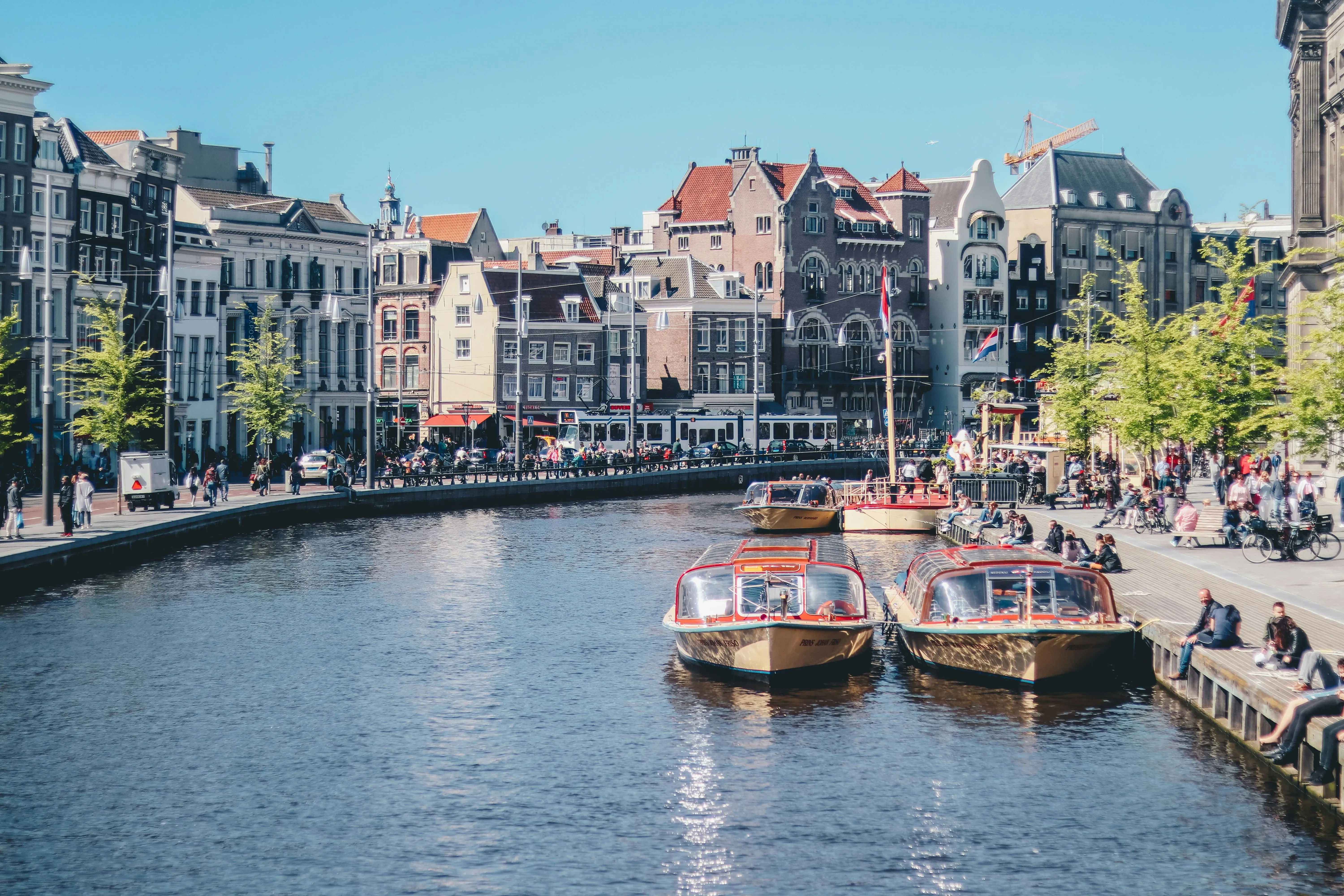
Netherlands Overview
The Netherlands is a parliamentary constitutional monarchy in northwestern Europe, occupying 41,543 km² at the delta of the Rhine, Meuse, and Scheldt rivers. King Willem-Alexander has been head of state since 2013; Prime Minister Dick Schoof leads the PVV-VVD-NSC-BBB coalition government since July 2024. The Kingdom of the Netherlands also includes Aruba, Curaçao, Sint Maarten, plus three special municipalities in the Caribbean (Bonaire, Sint Eustatius, Saba), but the European Netherlands (with 12 provinces) is the primary fiscal and immigration jurisdiction. The legal system runs on Dutch civil law derived from the Code Napoléon framework. Amsterdam is the constitutional capital; The Hague is the seat of government and home to the International Court of Justice and the International Criminal Court. The Netherlands is a founder of the European Union, the Eurozone, , the , the Benelux Economic Union, and a member of the United Nations and the . Population is 17.9 million.
On This Page
- 1.Netherlands Overview
- 1.1How Does Netherlands Compare?
- 1.2Who does the Netherlands fit?
- 1.3Pros and Cons of Relocating to Netherlands
- 1.4Netherlands leads on Business — WRI 90.0 / 100
- 1.5Netherlands leads on Investment — WRI 88.0 / 100
- 1.6Residence
- 1.7Taxes on Personal Income
- 1.8Cost of Living
- 1.9Healthcare System
- 1.10Education System
- 1.11Banking & Finance
- 1.12Cryptocurrency Regulation
- 1.13Real Estate Market
- 2.Frequently Asked Questions
Quick Facts
- Passport Rank: 4
- Visa-Free Destinations: 185
- Capital: Amsterdam (constitutional); The Hague (seat of government)
- Population: 17.9 million (CBS 2024)
- Area: 41,543 km² (European Netherlands; 12 provinces)
- Currency: Euro (EUR); 1 EUR ≈ 1.1620 USD (May 2026 spot)
- Official languages: Dutch (official); Frisian (co-official in Friesland); English fluency 90%+ in business
- Religions: No religion 54.5%, Roman Catholic 18.9%, Protestant 12.9%, Islam 5.4%, other 8.3% (CBS 2024)
Key Indicators
- GDP (Nominal): $1,272 billion (World Bank 2024)
- Unemployment Rate: 3.6% (CBS 2024)
- Human Development Index: 0.946 (Very High, Rank: 10, HDR 2024)
- GDP per Capita: $68,219 (World Bank 2024)
Safety & Governance
- Global Peace Index (IEP): 1.491 (Rank: 14, GPI 2025)
- Press Freedom Index (RSF): 88.27 (Rank: 1, RSF 2024)
- Corruption Perception (TI): 78/100 (Rank: 8, CPI 2025)
- Gini Coefficient (WB): 28.5 (CBS, most recent)
Health & Environment
- PM2.5 Air Pollution: 12.4 µg/m³ (WHO 2024)
- Air Quality Category: Moderate
- ND-GAIN Adaptation Index: 68.2 (Rank: 12, ND-GAIN 2023)
- Life Expectancy: 81.9 years (WHO 2024)

The proposition for an investor or relocator is unusually clean: the world's 4th-strongest passport (tied) with 185 visa-free destinations, the 30% Ruling tax-free allowance for qualifying expats (restored to flat 30% for 2025-26 and stepping to 27% from 2027), the Highly Skilled Migrant route (Kennismigrant) from $6,250 per month at 30+ (IND 2026 gross-salary baseline), full English-language business and academic environments, and the deepest holding-company tax architecture in continental Europe with the participation exemption, the Innovation Box, and a 90+ tax treaty network. The cost is also clean: top marginal income tax of 49.5% on worldwide income above $89,300 makes the post-30%-Ruling tax position heavier than Mediterranean or Caribbean alternatives; the $1,340,000 Investor Residence Permit was abolished in 2024; no citizenship-by-investment route; limited dual citizenship outside marriage and specific exceptions; Amsterdam, Utrecht, and The Hague rents have risen 35-50% since 2020. The Netherlands does not try to be for everyone — it is clear from the start who it is for.
How Does Netherlands Compare?
Summary
On the worldpath.ai WRI 2026, the Netherlands (80.0) sits between Luxembourg (81.5) and Singapore (80.9), with Australia (79.9) and Grenada (79.8) anchoring the peer group below. The Netherlands holds top-3 positions on Business, Investment, and Safety through participation-exemption holding architecture, the Innovation Box, and a CPI-top-10 governance record, but trails on Residency since the 2024 abolition of the Investor Residence Permit removed the principal capital-investment route and on Citizenship against the peers in the peer group.
How the Netherlands stacks up against its closest peers on the WRI 2026:
Where the Netherlands wins: Business at 90 puts the Netherlands third in the peer group behind Singapore at 97 and Luxembourg at 92, and clearly ahead of Australia at 82 and Grenada at 70. The driver is the participation exemption on qualifying subsidiary dividends and capital gains, the Innovation Box (effective 9% rate on qualifying patent and software income), a 90+ tax-treaty network, full English-language business culture, Schiphol Airport's position as Europe's third-largest passenger hub, and Rotterdam's role as Europe's largest port (overtaken globally by Shanghai in 2004, still the anchor for transatlantic and inter-continental container flow). Investment at 88 sits behind Singapore at 91 and Luxembourg at 90 but ahead of Australia at 82 and Grenada at 75; Euronext Amsterdam is the second-deepest equity market in the EU, and the Dutch pension-fund industry holds approximately $2.0 trillion in assets, one of the largest pools per capita globally. Safety at 88 ties Australia and leads Luxembourg at 66.8 and Grenada at 72, just behind Singapore at 91.1; Global Peace Index 2025 rank 14, Corruption Perceptions Index 2025 rank 8 (score 78 of 100, unchanged year-on-year), placing the Netherlands among the global top-10 for institutional integrity.
Where the Netherlands lags: Residency at 65 trails Grenada at 90 and Luxembourg at 78 by wide margins; the Netherlands ranks above Singapore at 62 and Australia at 60 on points, not on practical wide-road residency options. The driver is the abolition of the $1,340,000 Investor Residence Permit in 2024 and the absence of any capital-only investor route; the Highly Skilled Migrant (Kennismigrant) salary route and the are the principal HNW-relevant residence pathways, supplemented by the (Dutch-American Friendship Treaty) at $5,200 capital for US citizens. Citizenship at 60 trails Grenada at 90, Australia at 78, and Luxembourg at 74, with only Singapore at 48 sitting lower; standard naturalisation requires 5 years of residence with the -level Civic Integration Examination (Inburgering) and, in most cases, renunciation of prior citizenship (with limited exceptions for refugees, spouses of Dutch nationals, and dual-national EU citizens). Retirement at 75 ties Singapore and Australia but trails Grenada at 85 and Luxembourg at 82; the absence of a dedicated retirement visa plus the cool-wet northern European climate constrains retiree positioning relative to Mediterranean and Caribbean alternatives.
Who does the Netherlands fit?
Summary
The Netherlands fits HNW founders using the 30% Ruling expat tax allowance plus the Kennismigrant route, US-citizen entrepreneurs leveraging the DAFT $5,200 self-employment route, families prioritising English-language tertiary education at TU Delft / Erasmus / Leiden, and holding-company operators stacking participation exemption + Innovation Box. It does not fit pure-capital investors (no investor visa since 2024), fast-citizenship seekers (5-year residence + Inburgering A2 test + renunciation of prior citizenship usually required), Mediterranean-climate retirees, or anyone uncomfortable with worldwide-arising tax at top marginal 49.5%.
Right fit:
- HNW founders using the 30% Ruling + Kennismigrant — the 30% Ruling provides a tax-free allowance of up to 30% of qualifying expat employment income for 5 years (reduces to 27% from 1 January 2027); 2026 minimum salary $55,800 / under-30 with Master's $42,400; combines with the Highly Skilled Migrant route (Kennismigrant from $6,250/month at 30+; IND 2026 EUR baseline applies) processed by Immigration and Naturalisation Service (IND); recognised-sponsor employer required.
- US-citizen entrepreneurs on the DAFT — Dutch-American Friendship Treaty 1956 grants US citizens the right to establish a Dutch business with minimum capital of $5,200 (€4,500) deposited in a Dutch business account; 2-year initial residence permit, renewable in 2-year increments; permanent residence eligible after 5 years of continuous legal residence; uniquely accessible vs other entrepreneur routes that require Dutch-interest assessment under points-based criteria.
- Families prioritising English-language tertiary education — TU Delft (global top 100 in QS engineering), Erasmus University Rotterdam, Leiden University, the University of Amsterdam, Utrecht University, the University of Groningen, and Wageningen University (global top 100 in agriculture/life sciences); over 2,000 English-taught Bachelor and Master programmes; international schools (American School of The Hague, Amity International, British School of Amsterdam, International School Hilversum) deliver IB / IGCSE / A-Level at $25,000-45,000 per year.
- Holding-company operators stacking EU tax architecture — participation exemption on qualifying subsidiary dividends and capital gains (no Dutch tax on properly-structured holding income); Innovation Box regime delivering effective 9% rate on qualifying patent and software IP income; 90+ tax treaty network including most major OECD economies; English common-law-compatible Dutch commercial-law framework familiar to international counsel.
Wrong fit:
- Pure-capital investors seeking instant — the $1,340,000 Investor Residence Permit was abolished in 2024 and not replaced; no citizenship-by-investment route exists; no donation-based or property-based residence-by-investment pathway; Kennismigrant requires employer sponsorship + salary threshold, not capital deployment.
- Fast-citizenship seekers — standard naturalisation requires 5 years of lawful residence with the A2-level Civic Integration Examination (Inburgering) and, in most cases, renunciation of prior citizenship (limited exceptions for refugees, spouses of Dutch nationals, applicants from a country that does not permit renunciation, and certain dual-EU-citizen scenarios); no fast-track route.
- Mediterranean-climate retirees — Dutch climate is cold-wet with average winter temperatures of 2-7°C and summers of 17-22°C; meaningful winter-darkness exposure (December-January daylight 8 hours); no dedicated retirement visa; standard worldwide taxation applies (49.5% top marginal); structural drag on retiree positioning vs Italian / Spanish / Portuguese / Greek alternatives.
- HNW residents seeking territorial taxation — the Netherlands taxes residents on worldwide income (Box 1 employment + Box 2 substantial-interest + Box 3 wealth-yield); no Beckham-style permanent flat-tax inpatriate regime; the 30% Ruling provides front-loaded relief during the first 5 years but reverts to standard taxation afterward.
- Anyone uncomfortable with the Box 3 transitional uncertainty — the existing notional-yield Box 3 wealth tax was declared unconstitutional by the Hoge Raad (Dutch Supreme Court) in 2024; the Restoration of Rights Act 2024 plus the Transitional Act provide interim relief while a permanent actual-yield framework is being developed for 2027 onwards; meaningful planning uncertainty for HNW residents holding significant non-employment investment portfolios.
Pros and Cons of Relocating to Netherlands
- 01Taxation30% tax-free allowance restored; 27% from Jan 202730% Ruling (Expat Scheme) restored to flat 30% tax-free allowance for 2025-26 (reversing the 2024 30/20/10 taper); steps to 27% from 1 January 2027; 5 years (60 months) duration; 2026 minimum salary $55,800 / under-30 with Master's $42,400; salary cap $304,500 (Balkenende norm).30% Ruling, 27% from 2027
- 02MobilityDutch passport rank 4 globally, 185 visa-freeDutch passport at rank 4 globally (tied with Italy, Germany, Spain, Finland, France) with 185 visa-free or visa-on-arrival destinations; full EU citizenship grants freedom of movement and work across 27 EU + 3 EEA member states; dual citizenship permitted in limited cases.Top-4 passport, 185 VF
- 03InvestmentExempts Dutch holding-co subsidiary incomeParticipation exemption (deelnemingsvrijstelling) on qualifying subsidiary dividends and capital gains — the structural feature that makes Netherlands EU's principal holding-company jurisdiction for multinational structures; 90+ tax treaty network; treaty-based withholding-tax reductions on dividends, interest, royalties.Participation exemption
- 04Investment9% effective rate on qualifying IP incomeInnovation Box (innovatiebox) regime delivers effective 9% tax rate on qualifying patent and software intellectual-property income (vs 25.8% headline corporate tax / 19% on first $232k); among the most competitive IP-box regimes in the EU, distinct from broader corporate tax.Innovation Box 9% IP
- 05Education2,100 English-taught Bachelor + Master programsNetherlands offers approximately 2,100 English-taught Bachelor and Master programmes — the deepest English-language tertiary curriculum in continental Europe; TU Delft global top 100 (QS Engineering top 20); Erasmus, Leiden, Amsterdam, Utrecht, Wageningen in global top 50-200.2,100+ English tertiary
- 06SafetyTop-10 CPI + top-15 GPI globallyCorruption Perceptions Index 2025 rank 8 of 182 (score 78/100, unchanged YoY) — global top-10 institutional integrity; Global Peace Index 2025 rank 14 of 163 (score 1.491); RSF Press Freedom 2024 rank 1 globally; AFM + DNB regulatory framework comparable to UK FCA + PRA depth.CPI rank 8, GPI rank 14
- 07ResidencyDAFT entrepreneur route from $5,200 for US citizensDutch-American Friendship Treaty 1956 (DAFT) grants US citizens uniquely accessible self-employment residence-permit: minimum capital $5,200 (€4,500) deposited in Dutch business account; 2-year initial permit + renewable for 5 years; permanent residence and citizenship pathway; no Dutch-interest assessment unlike other zelfstandig ondernemer route.DAFT US citizens $5.2k
- 01Residency$1.34M Investor Residence Permit terminated$1.34 million Investor Residence Permit abolished in 2024 — no replacement capital-only investor route; Highly Skilled Migrant (Kennismigrant), EU Blue Card, DAFT (for US citizens), and self-employed (zelfstandig ondernemer) routes remain; Netherlands now one of few major OECD economies without an active residence-by-investment programme.Investor Visa ended 2024
- 02TaxationWorldwide income taxed; top marginal 49.5%Dutch tax residents taxed on worldwide income through three-box system; Box 1 top marginal 49.5% on income above $89,300; Box 2 substantial-interest 24.5/31%; Box 3 wealth-yield in transitional reform after 2024 Hoge Raad unconstitutionality ruling; 30% Ruling provides 5-year relief only.Worldwide tax 49.5% top
- 03Citizenship5-yr residence + Inburgering + renunciation typicalNo citizenship-by-investment route exists; standard naturalisation requires 5 years of lawful residence with A2-level Civic Integration Examination (Inburgering); in most cases requires renunciation of prior citizenship (limited exceptions for refugees, spouses of Dutch nationals, applicants from countries that don't permit renunciation).No CBI, 5-yr + A2 test
- 04TaxationWealth tax in 2024 unconstitutional ruling reformExisting notional-yield Box 3 wealth-tax system declared unconstitutional by Hoge Raad 2024 rulings; Restoration of Rights Act 2024 + Transitional Act provide interim relief at ~2% notional yield × 36% rate; permanent actual-yield framework being developed for 2027 onwards; meaningful HNW wealth-planning uncertainty during transition.Box 3 wealth tax reform
- 05LifestyleCold-wet climate; 8-hour winter daylightDutch climate is cold-wet with average winter 2-7°C and summer 17-22°C; meaningful winter-darkness exposure (December-January daylight 8 hours including Seasonal Affective Disorder risk); no Mediterranean alternative; structural drag on retiree positioning vs Italy/Spain/Portugal/Greece.Cold-wet climate
- 06Cost of LivingAmsterdam rents up 35-50% since 2020Amsterdam rents appreciated approximately 35-50% from 2020 to 2024 under sustained housing-supply constraint; prime Amsterdam Centrum/Zuid 1-bedroom $1,800-2,800/month; family of 3 Amsterdam Centrum $5,200-9,000/month including international school $25k-45k/yr per child; Affordable Rent Act 2024 imposed mid-segment rent caps.Amsterdam rent +35-50%
- 07Real Estate10.4% transfer tax on non-owner-occupied propertyStamp Duty (transfer tax / overdrachtsbelasting) at 10.4% on non-owner-occupied investment properties since 1 January 2026 (raised from prior rates); 2% on owner-occupied homes; exempt for first-time buyers aged 18-35 below $560,000; meaningful cost for HNW buy-to-let or holiday-home investors.Stamp 10.4% buy-to-let
Netherlands leads on Business — WRI 90.0 / 100
The Netherlands posts a Business score of 90 in the WRI 2026 peer group, ahead of Australia at 82 and Grenada at 70, and behind Luxembourg at 92 and Singapore at 97. The driver is the depth of Dutch holding-company tax architecture combined with full English-language business culture and the largest European logistics infrastructure. The participation exemption (deelnemingsvrijstelling) exempts Dutch corporate-resident holdings of qualifying subsidiary dividends and capital gains from Dutch tax — the structural feature that has made the Netherlands the EU's principal holding-company jurisdiction for multinational corporations. The Innovation Box (innovatiebox) regime delivers an effective 9% tax rate on qualifying patent and software intellectual-property income, distinct from the broader Dutch corporate income tax of 25.8% headline (19% on first $232,000 of profit). The Dutch tax-treaty network spans 90+ jurisdictions, including comprehensive coverage of the OECD and major emerging-market economies, with treaty-based withholding-tax reductions on dividends, interest, and royalties. Rotterdam is Europe's largest port (overtaken globally by Shanghai in 2004; today consistently in the global top-15 by container traffic), handling 436 million tonnes of cargo annually and serving as the principal European entry point for Asian and Atlantic shipping. Schiphol Airport is Europe's third-largest passenger hub and the principal European cargo airport, served by KLM, Air France-KLM Group, Delta, and 100+ international carriers. Amsterdam's financial district anchors a Tier-1 private banking ecosystem through ABN AMRO, ING, Rabobank, Triodos, plus international subsidiaries (Goldman Sachs Amsterdam, JPMorgan Amsterdam, UBS Wealth). The Dutch business environment is broadly considered the easiest in continental Europe for English-only operations, with 90%+ workplace English-fluency in Amsterdam, Utrecht, The Hague, Rotterdam, and Eindhoven business districts.
Netherlands leads on Investment — WRI 88.0 / 100
The Netherlands posts an Investment score of 88, behind Luxembourg at 90 and Singapore at 91 but decisively ahead of Australia at 82 and Grenada at 75 in the WRI 2026 peer group. The driver is the combination of Euronext Amsterdam (the second-deepest equity market in the EU after the London Stock Exchange post-Brexit), the participation exemption that re-anchors Dutch holding companies as the standard European headquarter jurisdiction, the Innovation Box regime's 9% effective rate on qualifying IP income, and the 30% Ruling expat tax allowance (restored to flat 30% in 2025-26 and stepping to 27% from January 2027). The Dutch pension-fund industry holds approximately $2.0 trillion in assets across mandatory-occupational schemes (ABP for civil servants, PFZW for healthcare, PMT for metal/technology, BPF Bouw for construction) and is among the largest globally on a per-capita basis. The DNB (De Nederlandsche Bank) supervises the financial-services sector under European Central Bank single-supervisory-mechanism framework; the AFM (Autoriteit Financiële Markten) regulates capital markets. Capital mobility is fully unrestricted within the Eurozone and EU framework. The 30% Ruling, after the 2024 reform that briefly introduced a 30/20/10 taper, was reversed to a flat 30% rate for 2025-26 and will drop to 27% from 1 January 2027 — keeping the Netherlands competitive against EU and global peer expat-tax regimes. Box 3 wealth tax remains under transitional uncertainty following the 2024 Hoge Raad ruling; the Restoration of Rights Act 2024 + Transitional Act provide interim relief while permanent actual-yield framework develops for 2027 onwards.
Residence
The Netherlands applies a residence-based personal income tax regime: tax residency triggers on the "facts and circumstances" test (centre of vital interests, permanent home, family location) under Dutch civil tax law, supplemented by the standard OECD residency -breakers under treaty. Tax residents are taxed on worldwide income on the arising basis through the three-box system: Box 1 (employment, self-employment, primary-residence imputed income) at progressive rates; Box 2 (substantial-interest holdings of 5%+ in companies); Box 3 (wealth-yield, currently in transitional reform). The 30% Ruling (Expat Scheme) provides qualifying foreign-recruited employees with a tax-free allowance of up to 30% of taxable employment income for 5 years (60 months); the 2024 30/20/10 taper was reversed for 2025-26 and the percentage drops to 27% from 1 January 2027. 2026 thresholds: $55,800 (€48,013) minimum annual salary general / $42,400 (€36,497) under-30 with Master's degree; $304,500 (€262,000) salary cap ("Balkenende norm"). Residence permits are administered by Immigration and Naturalisation Service (IND, ind.nl). Principal HNW-relevant routes: Highly Skilled Migrant Kennismigrant (IND 2026 gross-salary thresholds: $6,250/month at 30+ / $4,580/month under-30 / $3,290/month recent-graduates; EUR baselines indexed annually) requiring recognised-sponsor employer; EU Blue Card; Self-employed (zelfstandig ondernemer) with points-based Dutch-interest assessment; DAFT (Dutch-American Friendship Treaty) for US citizens at $5,200 capital deposit. The $1,340,000 Investor Residence Permit was abolished in 2024. Permanent residency follows 5 years of legal residence; standard naturalisation requires 5 years with A2-level Civic Integration Examination (Inburgering) and, in most cases, renunciation of prior citizenship.
Safety sits at 88 in the WRI 2026, leading most of the peer group except Singapore. The Global Peace Index 2025 places the Netherlands at rank 14 of 163 with a score of 1.491. The Corruption Perceptions Index 2025 (released February 2026) places the Netherlands at rank 8 of 182 globally with a score of 78 of 100, unchanged year-on-year and placing the country in the global top-10 for institutional integrity. Reporters Without Borders Press Freedom Index 2025 places the Netherlands among the global top-5 (Norway at #1; updated annually). Violent crime is materially below averages; recent rises in shootings linked to organised crime (the Mocro Maffia, drug-trafficking groups) have concentrated in Amsterdam South-East and parts of Rotterdam, with operational crime spillover into journalist and crown-prosecutor security in 2022-24 prompting Anti-Mocro-Mafia Programme legislative action. The lived security experience in Amsterdam Zuid, Utrecht Wittevrouwen, The Hague Benoordenhout, Rotterdam Kralingen, and Eindhoven Centrum is excellent by international standards.
Taxes on Personal Income
The Netherlands applies a residence-based personal income tax regime administered by the Belastingdienst (Dutch Tax Administration). Tax residents are taxed on worldwide income through the three-box system: Box 1 (employment, self-employment, primary residence) at progressive rates of 35.82% on the first $44,700 ($38,441 EUR-equivalent) of annual income, 37.48% from $44,700 to $89,300 ($38,441-$76,817 EUR), and 49.50% above $89,300 ($76,817 EUR). Box 2 (substantial-interest holdings of 5%+ in companies) is taxed at 24.5% on the first $77,800 ($67,000 EUR) of Box 2 income and 31% above. Box 3 (wealth-yield) is currently in transitional reform after the 2024 Hoge Raad ruling that the notional-yield system was unconstitutional; the Restoration of Rights Act 2024 plus the Transitional Act provide interim relief at modified rates (currently approximately 2.0% notional yield × 36% rate, with actual-yield framework planned for 2027). The 30% Ruling provides qualifying foreign-recruited employees with a tax-free allowance of up to 30% of taxable employment income for 5 years (60 months), restored to flat 30% in 2025-26 and reducing to 27% from 1 January 2027. There is no general capital gains tax outside Box 2 and Box 3 (asset disposals by private individuals are generally outside CGT scope under Dutch law). Inheritance tax (erfbelasting) runs at 10-20% for children/spouses, 18-36% for grandchildren, and 30-40% for others — material for HNW estate planning. VAT (BTW) is 21% standard, 9% reduced, 0% for exports. Corporation tax is 19% on first $232,000 ($200,000 EUR) of profit and 25.8% above. The effective tax rate for a $400,000-earning Dutch resident on the 30% Ruling is approximately 35% federally; without the Ruling, the same earner pays approximately 47-49% federally — the structural reason expat tax planning anchors HNW Netherlands relocation economics.
Cost of Living
The Netherlands runs a moderate-to-high cost-of-living profile in EU context, with significant Amsterdam versus regional spread. A single professional in central Amsterdam (Centrum, Zuid, Oud-West, De Pijp, Jordaan) budgets $2,800-4,500 a month for a one-bedroom apartment at $1,800-2,800, utilities, transit ($110 monthly OV-chipkaart unlimited), and basic groceries; the same lifestyle in Utrecht, The Hague, or Rotterdam runs $2,300-3,700, in Eindhoven, Groningen, or Maastricht $1,900-3,100, and in regional towns $1,700-2,700. A family of three in central Amsterdam budgets $5,200-9,000 a month including a two- or three-bedroom rental at $2,800-5,000, transit (private vehicle expected outside CBDs), groceries, and international school fees at the American School of The Hague, Amity International, British School of Amsterdam, or International School Hilversum ($25,000-45,000 per year per child); the same family in Utrecht or The Hague runs $4,000-6,500, in Eindhoven or Groningen $3,300-5,500. Inexpensive restaurant meals average $20-30 per person; mid-range $50-90; supermarket prices are 5-15% above EU average. Private health insurance (Zorgverzekering) is compulsory at $135-180 per month per adult; basic coverage includes GP, hospital, and prescriptions; supplementary cover for dental and physiotherapy adds $20-50 per month. A mid-range second-hand vehicle runs $9,000-18,000 and is the default outside the Randstad transit-dense corridor. The Euro and Schengen integration removes currency-conversion friction for European capital. Amsterdam rents have risen 35-50% since 2020 under sustained housing-supply constraints, prompting recent regulatory action under the Affordable Rent Act 2024 to introduce rent caps on mid-segment rentals.
Healthcare System
The Netherlands runs a universal healthcare system under the Health Insurance Act 2006 (Zorgverzekeringswet) with mandatory basic health insurance (basisverzekering) provided through approximately 10 private insurance companies regulated under publicly-defined coverage standards. Basic insurance is compulsory for all residents at approximately $135-180 per month per adult and covers GP services, hospital care (with co-payment), prescription medications, mental health, basic dental for under-18s, and pregnancy/maternity care. The compulsory deductible (eigen risico) is $446 per year for adults. Supplementary health insurance for adult dental, physiotherapy, alternative medicine, and orthodontics adds $20-50 per month. Major Dutch insurers include Achmea (Zilveren Kruis), VGZ, CZ, and Menzis, with international supplementary cover available through Aetna, AXA, Cigna, and Allianz. GP services serve as gatekeepers to specialist care; specialist referral is required for most non-emergency procedures. Public hospitals include Amsterdam UMC, Erasmus MC Rotterdam, UMC Utrecht, Leiden UMC, Radboudumc Nijmegen, and Maastricht UMC+; private and university hospitals deliver comparable European OECD-tier specialist care. Specialist wait times in the Dutch public system run 3-8 weeks for most procedures, materially shorter than UK NHS waits but longer than Belgian or German private alternatives. Life expectancy is 81.9 years (WHO 2024), in the upper tier of OECD countries. The Dutch healthcare system consistently ranks in the European top 5 for outcomes and access (Euro Health Consumer Index, OECD Health at a Glance), with the structural concern being concentrated in long-term care workforce shortages and rising mental-health system pressure.
Education System
The Netherlands runs a tripartite education system from age 4 (informally) through tertiary, organised by the Ministry of Education, Culture and Science. Primary education (basisonderwijs) runs ages 4-12; secondary education differentiates into three tracks at age 12 based on Cito-test scores plus teacher recommendation: VMBO (preparatory vocational, 4 years), HAVO (general secondary, 5 years), and VWO (pre-university, 6 years). The VWO track delivers Atheneum or Gymnasium qualification with Latin/Greek for university entry. Public schools are tuition-free for citizens, permanent residents, and most temporary-visa-holder dependents; voluntary contributions $100-400 per year cover materials and excursions. Private schools serve approximately 4% of students at $5,000-15,000 per year. International schools deliver IB / IGCSE / A-Level / American curricula: the American School of The Hague (American + IB, $30,000-45,000 per year), Amity International Amsterdam (IB, $25,000-40,000), the British School of Amsterdam ($28,000-42,000), the International School Hilversum, the European School Bergen, the Dutch International School Eindhoven, plus French Lycées Vincent van Gogh The Hague + Lycée Français Amsterdam ($8,000-18,000). At the tertiary level, the Netherlands operates 13 research universities and 36 universities of applied sciences (hogescholen); TU Delft sits in the global top 100 (QS Engineering top 20), with Erasmus University Rotterdam, Leiden University, the University of Amsterdam, Utrecht University, and Wageningen University in the global top 50-200. Wageningen University consistently leads the global top 100 in agriculture, life sciences, and food science. The Netherlands offers approximately 2,100 English-taught Bachelor and Master programmes — the deepest English-language tertiary curriculum in continental Europe — making it a particularly accessible destination for international students. Domestic tuition is regulated at approximately $2,800 per year for EU students; international students pay $8,000-18,000 per year for non-engineering programmes and $15,000-30,000 for medicine, dentistry, and engineering.
Banking & Finance
The Netherlands's banking system is supervised by De Nederlandsche Bank (DNB, the Dutch Central Bank) under European Central Bank single-supervisory-mechanism framework, with capital markets regulated by the Autoriteit Financiële Markten (AFM). The system is dominated by the Dutch "Big Three" (ABN AMRO, ING Group, and Rabobank) plus international subsidiaries (BNP Paribas Netherlands, Deutsche Bank Netherlands), specialist Triodos (ethical/sustainable), bunq (digital-native challenger), and the cooperative-banking sector. Euronext Amsterdam is the second-deepest equity market in the EU after Brexit, with the AEX 25 large-cap index, AMX mid-cap, and AScX small-cap. Account opening for non-residents requires a Burgerservicenummer (BSN, citizen service number) issued by the municipality upon registration, valid residence permit or visa, proof of Dutch address, and source-of-funds documentation under AML4 directive framework; standard opening 1-3 weeks. Foreign credit history does not transfer; new residents build local credit from zero. Mortgage rates for residents run 3.5-4.5% fixed over 30-year maturities with 100% LTV typical (Netherlands has unusual 100% mortgage LTV norms by international standards, supported by mandatory mortgage interest tax deductibility that is gradually being phased down); non-residents face 4.5-6% rates at 70-80% LTV. The Affordable Rent Act 2024 introduced rent caps on mid-segment rentals to address sustained housing affordability pressure. and are in force. ABN AMRO, ING, and Rabobank all offer English-language online banking with PSD2 open-banking integration. The European Central Bank Digital Euro is in development; the Netherlands participates in ECB consultation with no immediate domestic CBDC launch.
Cryptocurrency Regulation
The Netherlands treats cryptocurrency as a property-class asset for tax purposes under the Dutch Box 3 wealth-yield framework rather than as currency for legal-tender purposes. Crypto-asset holdings by residents are subject to Box 3 notional-yield taxation at the standard rate (currently approximately 2.0% notional yield × 36% rate after the Hoge Raad 2024 transitional rulings, with actual-yield framework being developed for 2027 onwards). Mining, staking, and airdrop income are taxed as Box 1 ordinary income at marginal rates (35.82-49.50%) if rising to the level of business activity, or as Box 3 wealth asset if held as investment. The 30% Ruling does not extend to crypto-asset disposals for Box 3 purposes. Crypto-asset service providers are regulated under the EU Markets in Crypto-Assets (MiCA) regulation framework, with MiCA's full authorisation regime in effect from 30 December 2024; the Autoriteit Financiële Markten (AFM) is the principal Dutch CASP supervisor, supplemented by DNB for stablecoin issuers. Domestic-compliant exchanges include Bitvavo, Bitonic, Direct, and Coinmerce, with international operators (Coinbase, Binance, Kraken) operating under MiCA passporting. The AFM has been an active early enforcer of MiCA provisions including the consumer-protection and disclosure-of-financial-promotions rules. The Netherlands is not a Web3 hub on the order of Switzerland, the UAE, or Singapore but offers a clear EU regulatory baseline through MiCA + AFM + DNB framework alignment with strong English-language financial-services counsel infrastructure. The Dutch Crypto Tax Calculator and Bitcoin Onbelast services support tax-compliance reporting integration.
Real Estate Market
Foreigners can purchase Dutch residential and commercial property freely with no Alien Land Holding Licence restrictions, FIRB-equivalent approval, or foreign-buyer-specific stamp duty surcharge at the federal level. EU citizens enjoy full equivalent rights with Dutch citizens; non-EU foreigners require valid residence-permit status for mortgage access. Acquisition costs total approximately 7-9% of transaction value for new-build properties: 2% Stamp Duty (transfer tax, with 10.4% rate for non-owner-occupied properties since 2026 — up from 10.4% imposed since 1 January 2026 for investment properties); 1-1.5% notary fees (notaris); 1-2% legal-advice fees; survey/inspection $500-1,500. Owner-occupied properties pay 2% transfer tax (homeowners aged 18-35 buying their first property below $560,000 / €482,000 are exempt under the Starter Stamp Duty Exemption since 2021). Annual property tax (Onroerende-zaakbelasting, OZB) runs 0.05-0.20% of WOZ-value (municipal valuation), structured by gemeente (municipal council). Prime Amsterdam Centrum, Zuid, Oud-West, and Jordaan run $9,500-15,000 per square metre; central Utrecht, The Hague Statenkwartier $7,500-11,000 per square metre; central Rotterdam Kralingen, Erasmus districts $5,500-8,500; central Eindhoven, Groningen, Maastricht $4,000-6,500; regional towns $3,000-5,000. Amsterdam property prices appreciated approximately 35-50% from 2020 to 2024 with sustained inventory shortage prompting Affordable Rent Act 2024 (rent caps on mid-segment rentals up to $1,800/month) and Stamp Duty for investment-property hike to 10.4% since 1 January 2026. Gross rental yields run 3-4% in prime Amsterdam long-term lets, 4-6% in Utrecht and The Hague, and 5-7% in Rotterdam and regional cities. Mortgage rates for residents at 3.5-4.5% fixed over 30 years with 100% LTV norms (uniquely Dutch feature); non-residents at 4.5-6% with 70-80% LTV. Transactions typically close in 6-12 weeks from offer acceptance through notarial passing.


