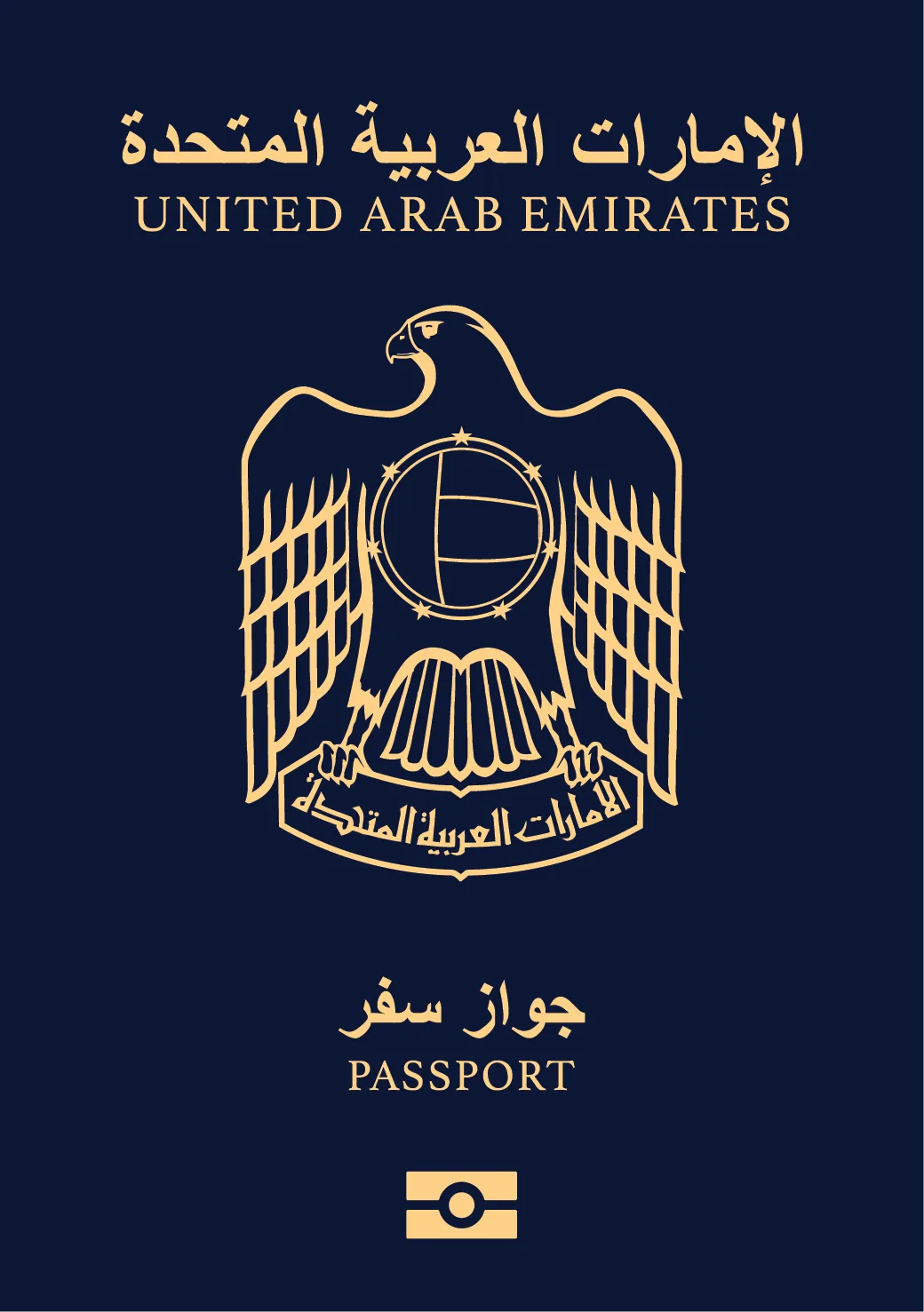
Geopolitical Value
As of April 2026, the UAE passport holds 2nd place on the Henley Passport Index — tied with Japan and South Korea — with visa-free or visa-on-arrival access to 187 destinations worldwide. On the Passport Index, the UAE ranks #1 globally with a Mobility Score of 181. This represents the most dramatic rise in passport index history: the UAE climbed 57 places over 20 years, adding 149 visa-free destinations since 2006 — the largest gain ever recorded by any country. In 2012 the UAE ranked 64th; by 2019 it had entered the top 20; by 2024 it had overtaken the US, UK, and Canada; by 2025 it broke into the top 10; and in Q1 2026 it reached rank 2. Only Singapore (rank 1, 192 destinations) ranks higher on Henley. The UAE is the only Arab-majority state passport in the global top 10, and its rise reflects sustained diplomatic investment: the 2015 Schengen visa waiver was the pivotal milestone that accelerated the ascent into the top 40. UAE passport holders now access virtually every major economy visa-free, including the United States, the full Schengen Area, the United Kingdom, Japan, South Korea, Australia, and New Zealand.
Practical Advantages
UAE passport holders enjoy visa-free or visa-on-arrival access across all four major global regions. In North America: the United States, Canada, and Mexico all grant visa-free entry. In Europe: all 27 Schengen states, the United Kingdom, Switzerland, and all Balkan nations are accessible without advance visa. In Asia: Japan, South Korea, Singapore, Hong Kong, Taiwan, Malaysia, Thailand, and China (via e-visa) all grant visa-free or streamlined access. In the Gulf region, all GCC countries grant full freedom of movement to UAE passport holders. Across Africa, over 60 countries grant visa-free, visa-on-arrival, or e-visa access. Across Latin America, the UAE passport opens Argentina, Brazil, Chile, Colombia, Peru, and most of Central America. There are fewer than 30 destinations requiring advance visas — primarily certain North African and Central Asian states. The UAE passport is notable for being one of the few non-Western passports with visa-free access to the United States, which alone justifies its geopolitical premium. For comparison, Turkish passport holders require a US visa; Indian passport holders require US, EU, and UK visas; Chinese passport holders require visas for all of the above.
Acquisition Pathways
UAE citizenship is not available through a standard investment program open to the general public. Under Federal Decree-Law No. 17 of 2021, the UAE grants citizenship by exception through a fully discretionary process, reserved for: (1) investors of exceptional and strategic economic value, (2) scientists, physicians, and specialised professionals of outstanding calibre recognised by UAE government ministries, (3) intellectuals, artists, and creative talents of distinction, and (4) children born to UAE citizen mothers married to foreign nationals. There is no fixed investment threshold or application form — citizenship nominations originate from UAE ministries, free zone authorities, or Ruler's courts. Realistic all-in cost for investors who are nominated: it is not purchased but earned through demonstrated exceptional contribution to the UAE economy or society. For relocators who prioritise UAE citizenship over UAE residency, the Golden Visa (10-year renewable residency at AED 2 million / $545,000 in real estate) represents the accessible pathway, with citizenship as a long-term possibility for exceptional contributors.
Value Assessment
The UAE passport's value as an asset is extraordinary for the narrow group eligible to receive it. Access to 187 destinations — including the US, full Schengen, UK, Japan, and Australia — delivers a mobility score exceeding Germany, France, and Italy. Unlike most strong passports, the UAE imposes zero personal income tax on its citizens globally (unlike the US, which taxes citizens on worldwide income regardless of residency). UAE citizens living abroad pay no UAE income tax on foreign earnings. There is no inheritance tax, no wealth tax, and no capital gains tax for UAE nationals. The passport also grants GCC mobility rights, enabling UAE citizens to live, work, and own businesses across Saudi Arabia, Kuwait, Bahrain, Qatar, and Oman without visas or work permits — a massive practical advantage for Gulf-region business. Compared to EU passports obtainable through CBI programs such as Malta (rank 5, 189 destinations, €600,000+ donation) or the eliminated Portuguese Golden Visa, the UAE passport ranks lower in destination count but significantly higher in tax advantage. For non-US citizens without existing strong passports, the UAE passport represents the most powerful Arab-world travel document by a wide margin.
Dual Citizenship
The UAE prohibits dual citizenship under Federal Law No. 17 of 1972 as amended. Any foreign national granted UAE citizenship is required to renounce all prior nationalities within three years of naturalisation. Similarly, UAE nationals who acquire foreign citizenship are legally required to notify the Ministry of Interior and may have their UAE citizenship revoked. In practice, some UAE citizens hold undisclosed second passports, but this creates legal risk. For US nationals (who cannot legally renounce US citizenship without formal renunciation proceedings at a US embassy), and for other nationalities with irrevocable citizenship laws, the UAE naturalisation requirement to renounce creates a significant barrier. UK and EU nationals face the same constraint — obtaining UAE citizenship means losing their existing passport rights. This prohibition is the primary reason UAE citizenship carries a low WRI Citizenship score despite the passport's exceptional strength: the population eligible to genuinely benefit without losing a stronger existing passport is small.
Final Assessment
The UAE passport is the most powerful passport available from an Arab-majority state and one of the top 2 globally. Its unique appeal lies in zero personal tax for citizens, US/EU/UK visa-free access, GCC mobility, and a government that actively expands bilateral visa agreements. Its primary constraint is the prohibition on dual citizenship, which limits its target audience to individuals without existing strong passports (Indian, Pakistani, Bangladeshi, Russian, African nationalities) and those willing to renounce prior citizenship. For this group, UAE naturalisation represents the most powerful passport upgrade available in the Middle East region. For investors seeking UAE residency without citizenship, the Golden Visa delivers the practical benefits of UAE living — zero tax, global mobility of residents, safety, infrastructure — while retaining the original passport. The UAE Golden Visa is in many cases the superior strategic choice for dual-passport holders from weaker passport countries, while UAE citizenship is the target for those from the world's weakest-passport nations.