
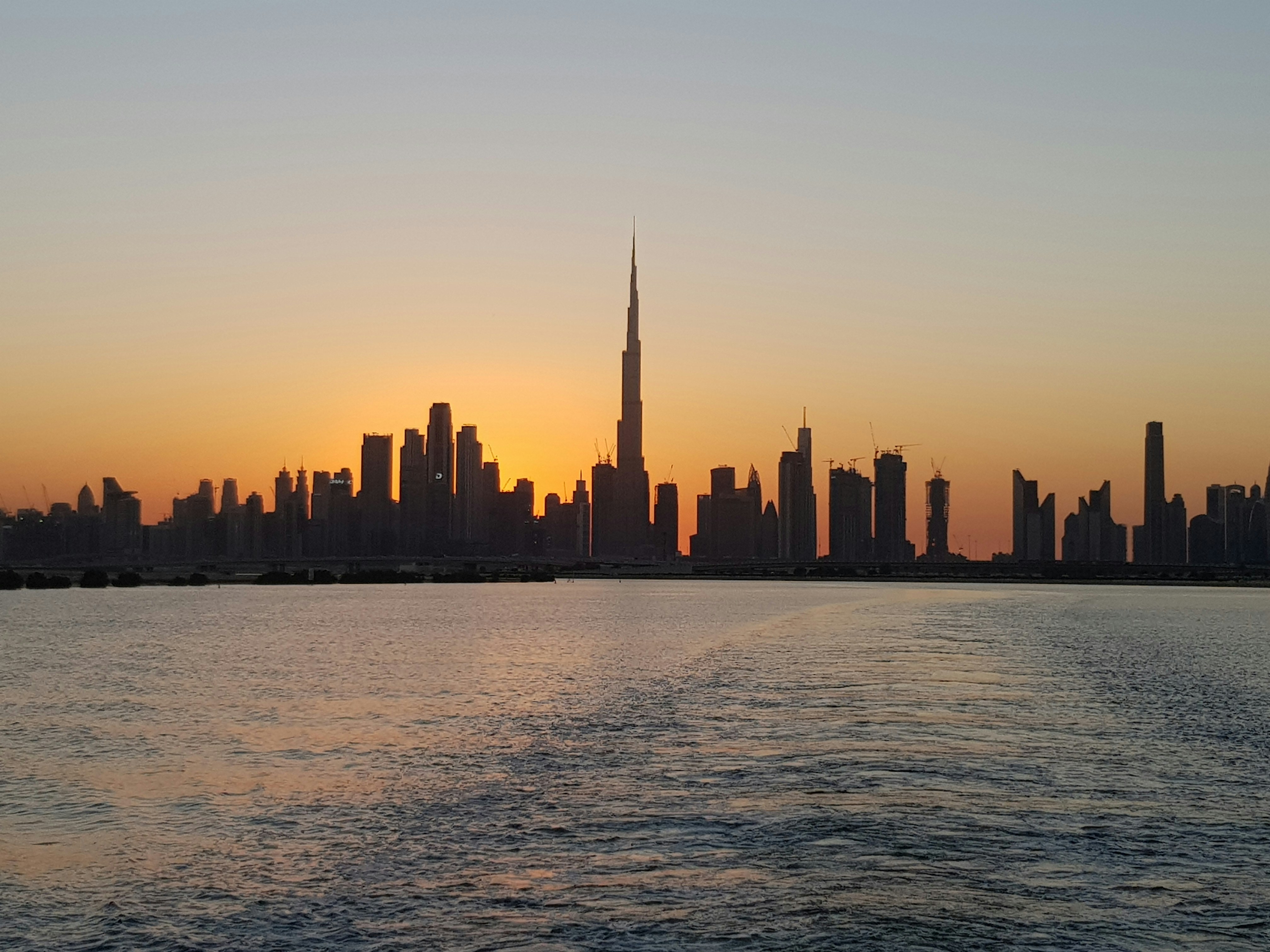
United Arab Emirates Overview
The United Arab Emirates is a federation of seven emirates established in 1971: Abu Dhabi (the capital), Dubai, Sharjah, Ajman, Umm Al Quwain, Fujairah, and Ras Al Khaimah. A constitutional federation under a presidential system, with the President drawn from the Al Nahyan family of Abu Dhabi and the Prime Minister from the Al Maktoum family of Dubai. The legal system runs on civil law plus Sharia for personal-status matters; commercial disputes in the Dubai International Financial Centre (DIFC) and the Abu Dhabi Global Market (ADGM) run on English common law under independent courts. The Emirati passport climbed from rank 38 globally in 2016 to rank 2 in 2026, with visa-free or visa-on-arrival access to 187 destinations.
On This Page
- 1.United Arab Emirates Overview
- 1.1How Does the United Arab Emirates Compare?
- 1.2Who does the United Arab Emirates fit?
- 1.3Pros and Cons of Relocating to the United Arab Emirates
- 1.4United Arab Emirates leads on Business — WRI 90.0 / 100
- 1.5United Arab Emirates leads on Investment — WRI 88.0 / 100
- 1.6Residence
- 1.7Taxes on Personal Income
- 1.8Cost of Living
- 1.9Healthcare System
- 1.10Education System
- 1.11Banking & Finance
- 1.12Cryptocurrency Regulation
- 1.13Real Estate Market
- 2.Frequently Asked Questions
Quick Facts
- Passport Rank: 2
- Visa-Free Destinations: 187
- Capital: Abu Dhabi
- Population: 11.59 million (Worldometer 2026; World Bank 11.35M 2024)
- Area: 83,600 km²
- Currency: UAE Dirham (AED)
- Official languages: Arabic (official); English widely used in business and government
- Religions: Islam 76% (official), Hinduism 10%, Christianity 9%, other 5%
Key Indicators
- GDP (Nominal): $537 billion (World Bank 2024)
- Unemployment Rate: 2.1% (ILO modelled, 2024)
- Human Development Index: 0.940 (Very High, HDR 2024)
- GDP per Capita: $53,300 (World Bank 2024)
Safety & Governance
- Global Peace Index (IEP): 1.812 (GPI 2025, improved from 1.897 GPI 2024)
- Press Freedom Index (RSF): 27.5 (RSF 2025)
- Corruption Perception (TI): 68/100 (Rank: 23, CPI 2024 — top in MENA)
- Gini Coefficient (WB): 32.5 (World Bank 2018, most recent)
Health & Environment
- PM2.5 Air Pollution: 37.7 µg/m³ (WHO 2024 — desert dust + fossil-fuel exposure)
- Air Quality Category: Unhealthy for Sensitive Groups
- ND-GAIN Adaptation Index: 56.3 (ND-GAIN 2023)
- Life Expectancy: 82.9 years (WHO 2024)
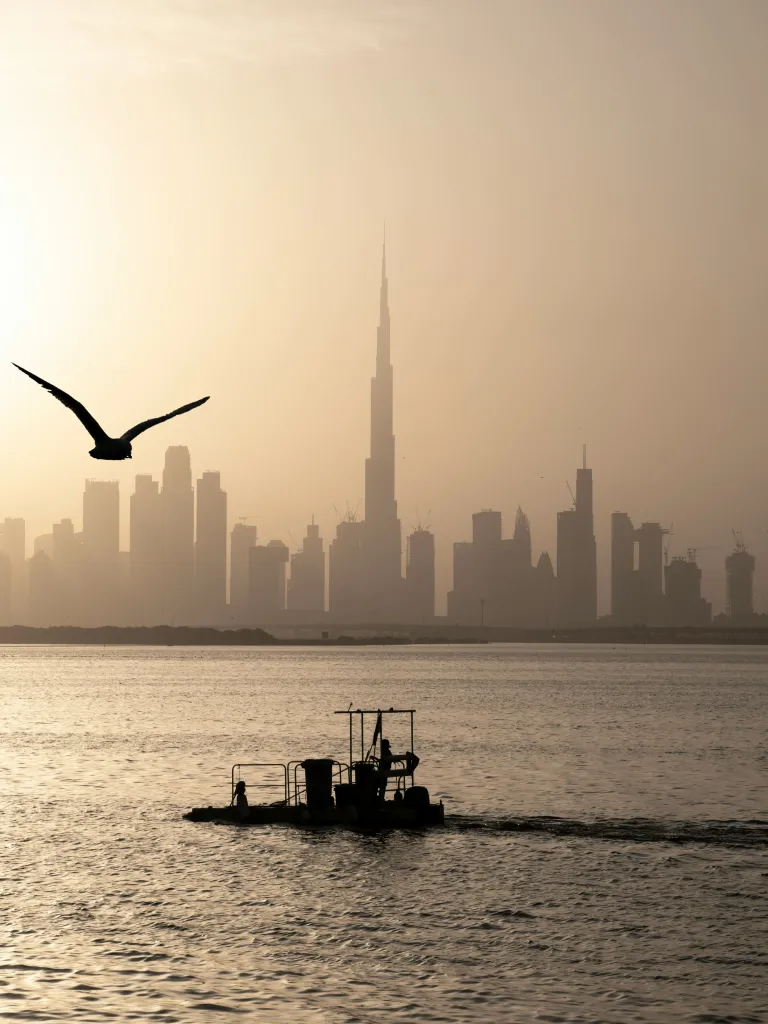
The proposition for an investor or relocator is unusually clean: zero personal income tax, a 9% federal corporate rate kicking in only above $102,000 of annual taxable income, Golden Visa residency from $545,000 in property, and 100% foreign ownership across most mainland sectors. The cost is also clean: no path to a passport for almost anyone, two parallel realities for residents (visa class drives almost everything), and a desert climate that runs 45°C in summer with PM2.5 sitting at 37.7 µg/m³, well above WHO guidelines. The United Arab Emirates does not try to be for everyone — it is clear from the start who it is for.
How Does the United Arab Emirates Compare?
Summary
On the worldpath.ai WRI 2026, the United Arab Emirates (74.3) sits between the United Kingdom (76.1) and France (74.2) at rank 12 globally, in a peer group anchored by Monaco (75.8) and Hungary (73.5). The leads the group on Business, Residency, and Investment, and trails on Citizenship and Education.
How the United Arab Emirates stacks up against its closest peers on the WRI 2026:
Where the UAE wins: The UAE tops the peer group on Business at 90.0, well ahead of the UK and Monaco at 82, Hungary at 78, and France at 72. The drivers are not subtle: a 9% federal corporate tax that applies only above $102,000 of taxable income, 100% foreign ownership in mainland companies, and zero personal income tax. Residency at 85.0 is also the highest in the group (UK 60, Monaco 72, France 70, Hungary 74): the Golden Visa from $545,000 in property runs 10 years renewable with no minimum stay and no upfront-payment requirement: a February 2026 federal circular confirmed that eligibility now hinges solely on the DLD-certified property value reaching 2,000,000, regardless of mortgage balance or payment schedule. Investment at 88.0 sits second only to Monaco's 90, ahead of the UK's 85 and France's 74.
Where the UAE lags: The UAE posts the lowest Citizenship score in the peer group at 20.0 — the reason is not subtle. Naturalization is effectively closed to most foreigners: the 2021 "exceptional talent" reform produced only a small annual cohort of discretionary approvals, and there is no investment-to-passport route. Every other country in the peer group scores higher: France at 65, Hungary at 62, the UK at 55, and even Monaco at 30 — which itself has no ordinary naturalization route — all sit above the UAE on this dimension. Education at 72.0 is tied with Hungary at the bottom of the group, well behind the UK's 88, Monaco's 88, and France's 85; the international school market is deep but no UAE university sits in the global top 100. Monaco's Retirement at 95 and the UK's Education at 88 mark specific niches the UAE does not directly compete on.
Who does the United Arab Emirates fit?
Summary
The UAE fits HNW investors using DIFC / ADGM structures, founders building regional businesses on the 9% federal CT base, senior executives on the Skilled-Professional Golden Visa, and foreign retirees with substantial liquid wealth. It does not fit fast-citizenship seekers, anyone who needs a democratic civic framework, or relocators sensitive to air quality and 45°C summers.
Right fit:
- HNW investors and family office principals — DIFC Foundation and ADGM SPV structures for asset segregation, 0% personal income tax on dividends and capital gains, AED 2 million ($545,000) property route to the 10-year Golden Visa, and English-common-law commercial courts in DIFC and ADGM.
- Founders building regional or global businesses — 100% foreign ownership in mainland companies, 9% federal corporate tax with the $102,000 exemption threshold for SMEs, and 50+ free zones (DIFC, ADGM, JAFZA, Dubai South, RAKEZ) offering qualifying-income exemption from federal CT.
- Senior international executives and specialists — employer-sponsored standard work visas plus the Skilled-Professional Golden Visa (10-year, no sponsor required) for senior salaries above AED 30,000 per month ($8,200).
- Foreign retirees with substantial liquid wealth — the Retirement Visa (55+) requires AED 1 million ($272,000) in financial assets, AED 1 million ($272,000) in property, or AED 20,000 ($5,445) + monthly income; 0% personal and inheritance tax makes UAE-domiciled retirement attractive for $5M+ portfolios.
Wrong fit:
- Fast citizenship seekers — naturalization is effectively closed; the 2021 "exceptional talent" reform produced few annual approvals and is highly discretionary.
- Anyone allergic to a strict legal framework — public alcohol, cohabitation, and blasphemy rules liberalized in 2020 but remain stricter than norms; cheque-bouncing and debt-related custody risks persist.
- Buyers chasing affordable cost of living— Dubai sits among the 15 most expensive cities globally on the 2025 index; central one-bedroom rent runs $1,700-2,400 per month before school fees, vehicle costs, and health insurance.
- Lifestyle relocators who need democratic civic rights — foreign residents have no electoral franchise; the Federal National Council is partly appointed and elected by a narrow citizen pool.
- Anyone who prioritizes outdoor air quality — PM2.5 sits at 37.7 µg/m³ (WHO 2024), more than 7x the WHO annual guideline of 5 µg/m³.
Pros and Cons of Relocating to the United Arab Emirates
- 01Taxation0% personal income tax across the federationUAE residents pay 0% on salary, dividends, capital gains, and inheritance; the only individual federal tax exposure is 5% VAT on most goods and services and the 4% Dubai municipal rental fee on residential leases.0% income tax
- 02MobilityEmirati passport at world rank 2 with 187 visa-freeThe UAE passport climbed from rank 38 globally in 2016 to rank 2 in 2026, tied with Japan and South Korea, with visa-free or visa-on-arrival access to 187 destinations including the US, UK, China, Schengen, and Japan.Top-2 passport, 187 VF
- 03ResidencyGolden Visa from $545,000 in property, 10-year renewableThe Golden Visa property route requires AED 2,000,000 ($545,000) in equity, with mortgage balance no longer counted (January 2024 reform); renewable indefinitely under a Compliance Audit at expiry.Golden Visa $545k
- 04Business9% corporate tax only above $102,000 incomeFederal CT of 9% applies only to taxable income above AED 375,000 ($102,000); free zone qualifying income remains 0% exempt; the 15% DMTT top-up applies only to MNEs above EUR 750M global revenue.9% federal CT
- 05Business50+ free zones with full foreign ownershipDIFC, ADGM, JAFZA, Dubai South, RAKEZ, DMCC, and 50+ other free zones offer 100% foreign ownership, full profit repatriation, and dedicated commercial courts under English common law in DIFC and ADGM.50+ free zones, 100% FDI
- 06HealthcareModern healthcare with international hospital networksMandatory employer-funded health insurance covers all residents; Cleveland Clinic Abu Dhabi, Mediclinic, NMC, Burjeel, and Sheikh Khalifa Medical City deliver consultant-led international-standard care; life expectancy 82.9 years.International healthcare
- 07BankingDIFC and ADGM run English common law courtsDIFC Courts and ADGM Courts operate under English common law with British and Commonwealth-trained judges, independent of the federal civil-law system; predictable jurisdiction for international commercial and trust disputes.DIFC/ADGM common law
- 01CitizenshipNaturalization effectively closed for most foreignersCitizenship by naturalization requires Cabinet discretion; the 2021 "exceptional talent" reform produced few annual approvals and dual citizenship is permitted for the few naturalized but the route is not a planning tool.No citizenship route
- 02BureaucracyVisa class determines almost everythingHealthcare, schooling, banking, mortgages, and family entry all key off visa class; an Employment Visa and a Golden Visa offer different access tiers despite similar nominal residence.Visa-class drives access
- 03LifestylePM2.5 at 37.7 µg/m³, 7x WHO guidelineAnnual PM2.5 sits at 37.7 µg/m³ (WHO 2024) against a WHO annual guideline of 5 µg/m³; partly desert dust and partly fossil-fuel exposure; substantially higher than EU and North-Asian peers.PM2.5 at 37.7
- 04Cost of LivingAmong the 15 most expensive cities globallyDubai climbed three places to among the 15 most expensive cities globally in 2025; central one-bedroom rent runs $1,700-2,400/month; international school primary fees $13,000-32,000/year; mandatory health insurance $1,500-4,000/year.High Dubai rent/fees
- 05LifestyleSix months of 35-45°C summer heatThe May-October summer routinely exceeds 40°C with high humidity; outdoor life shifts indoors; air-conditioning electricity is a meaningful component of expat household budgets.45°C summer climate
- 06SafetyStricter legal framework than EU normsMandatory health insurance, alcohol / cohabitation / blasphemy rules liberalized in 2020 but stricter than EU; cheque-bouncing and debt-related custody risks; women's safety on the street is strong but the legal posture is conservative.Stricter legal framework
- 07StabilityForeign residents have no electoral franchiseThe Federal National Council is partly appointed and partly elected by a narrow citizen pool; foreign residents do not vote; political stability is high but civic-rights frameworks differ markedly from EU and G7 norms.No democratic franchise
United Arab Emirates leads on Business — WRI 90.0 / 100
The UAE posts the highest Business score in the WRI 2026 peer group at 90.0, ahead of the UK and Monaco at 82 and France at 72. The reason is not subtle. Federal corporate tax sits at 9% and applies only to taxable income above AED 375,000 ($102,000) — below that threshold, the rate is 0%. Free zone qualifying income remains 0% exempt under the federal CT framework, and the 15% Domestic Minimum Top-up Tax (DMTT, effective January 2025) applies only to multinational enterprises with consolidated global revenues above EUR 750 million. Mainland incorporation now allows 100% foreign ownership across most sectors. 50+ free zones (DIFC, ADGM, JAFZA, Dubai South, RAKEZ, DMCC) offer one-stop licensing and dedicated commercial courts; DIFC Courts and ADGM Courts run English common law under British and Commonwealth-trained judges, independent of the federal civil-law system. The UAE has 140+ double taxation treaties, supports full profit repatriation, and the Federal Tax Authority (FTA) provides English-language guidance for foreign-owned entities.
United Arab Emirates leads on Investment — WRI 88.0 / 100
The UAE posts the second-highest Investment score in the peer group at 88.0, behind only Monaco at 90 and ahead of the UK at 85, France at 74, and Hungary at 70. The Golden Visa property route requires AED 2,000,000 ($545,000) in real estate as certified by the Dubai Land Department or Abu Dhabi equivalent land authority. A February 2026 federal policy circular extended the 2022–2024 mortgage reforms further: the previous requirement to have paid at least 50% of the property's value — or a minimum of AED 1,000,000 ($272,000) — upfront was removed entirely. Eligibility now hinges solely on the DLD-certified total property value reaching the AED 2,000,000 ($545,000) threshold, regardless of payment schedule or outstanding mortgage balance. Off-plan, mortgaged, and combined-title-deed properties all qualify under this framework, provided the aggregate certified value meets the mark and the lending bank issues a no-objection certificate. The 10-year renewable Golden Visa places a DLD lien on the qualifying property for the visa's duration; the property may not be sold or transferred without first substituting a qualifying replacement asset. Public investment in approved funds also qualifies at the AED 2,000,000 ($545,000) threshold. The April 2026 reform removed the minimum property value floor on the 2-year investor residence visa for sole owners; sole title-deed holders now qualify without a minimum threshold. For joint owners, each individual's share must independently reach AED 400,000 ($110,000) to qualify under the 2-year route. The 2-year investor visa and the 10-year Golden Visa remain separate products with distinct eligibility rules; only the AED 2,000,000 ($545,000) property route leads to the 10-year Golden Residence. DIFC and ADGM provide mature fund-domicile platforms with English common law trustee structures, foundations, and SPVs. Capital is fully mobile, FX is freely convertible, and AED-USD parity has held at 3.6726 under a long-standing peg.
Residence
Federal tax residency for individuals is governed by Cabinet Decision No. 85 of 2022 and triggers on any of three tests: 183 days physically present in the UAE in the calendar year, 90 days with a habitual abode and primary financial / personal interests in the UAE for citizens / residents of treaty partners, or a permanent place of abode in the UAE. Personal income tax remains 0% across all emirates, so residence is most relevant for treaty access, federal corporate-tax exposure (for individuals operating a business above AED 1 million / $272,000 in annual turnover), and Emirates ID administration. ICP (Federal Authority for Identity, Citizenship, Customs & Port Security) administers federal residence visas and Emirates ID; GDRFA Dubai handles Dubai-emirate residence procedures. Visa categories include the 10-year Golden Visa (property, investment, talent, retirement), 5-year Green Visa (freelancers, skilled employees), standard 2-year employment visa, 5-year Retirement Visa (55+), and 1-year Remote Work Visa for digital nomads. Permanent residence as understood in Europe does not exist; long-stay status is via renewable Golden Visa.
Safety sits at 79.7 in the WRI 2026. The Global Peace Index 2025 records the UAE at 1.812 (improved from 1.897 in 2024), the Corruption Perceptions Index 2024 places the UAE at 68/100 and rank 23 globally (highest in MENA), and violent and petty crime are both extremely low. Women's safety on the street is among the strongest in the region. The trade-off shows up as institutional posture: stricter legal framework than EU norms, no electoral franchise for foreign residents, mandatory employer-funded health insurance, and cheque-bouncing or debt-related custody risks for residents who default on financial obligations.
Taxes on Personal Income
The UAE has no federal or emirate-level personal income tax: 0% on salary, dividends, capital gains, inheritance, and gifts for individuals. The principal federal tax exposure for residents is 5% VAT on most goods and services (introduced January 2018) and the 4% Dubai municipal rental fee on residential leases collected through DEWA utility bills. There is no federal withholding tax on dividends, interest, or royalties for individual residents. Federal corporate tax at 9% applies to individuals only when running a business above AED 1,000,000 ($272,000) in annual turnover, and only on taxable income above the AED 375,000 ($102,000) exemption threshold; the 15% Domestic Minimum Top-up Tax (DMTT) applies only to MNEs above EUR 750 million in consolidated global revenues. Estate planning for non-Muslim residents typically routes through DIFC Wills under English common law to bypass Sharia-default inheritance distribution; Muslim residents fall under Sharia for personal-status matters federally. No federal property tax outside the 4% Dubai municipal rental fee and the 4% Dubai Land Department transfer fee on purchase.
Cost of Living
Dubai ranks among the 15 most expensive cities globally per the 2025 index, having climbed three positions in the year. A single professional in central Dubai (Marina, Downtown, JLT, Business Bay) budgets $2,800-4,000 per month for a one-bedroom rental, utilities, transit / fuel, and basic groceries; the same lifestyle in central Abu Dhabi runs $2,200-3,200, and in Sharjah $1,500-2,200. A family of three in central Dubai budgets $8,000-15,000 per month including a two-bedroom rental at $2,500-4,500, transport, groceries, and school fees; in Abu Dhabi the same family runs $6,500-12,000. Inexpensive restaurant meals average $14-20 per person. Public transit (Dubai Metro, RTA buses) is cheap and clean but limited geographically; private vehicle ownership is the default and runs $250-450 per month with cheap fuel. Mandatory health insurance for residents costs $1,500-4,000 per year for individual basic and $5,000-15,000 for executive plans. Domestic helpers are widespread: live-in housekeepers run $700-1,200 per month plus a sponsoring residency, drivers $1,000-1,500.
Healthcare System
The UAE runs a two-tier healthcare system: public service for citizens and certain federal employees, mandatory employer-funded private insurance for the rest of residents. The federal Ministry of Health and Prevention sets standards, with Dubai (DHA) and Abu Dhabi (DOH) running separate regulatory authorities for licensing 4,000+ clinics and hospitals federation-wide. Private healthcare delivers consultant-led international-standard care through Cleveland Clinic Abu Dhabi, Mediclinic, NMC Health, Sheikh Khalifa Medical City, and the Burjeel Holdings network; a specialist private consultation runs $80-180, a private hospital day $400-1,200. Mandatory employer-funded health insurance is the legal default for residence visa holders and covers basic care; family members are insured under a sponsoring resident's visa. Medical-tourism status is growing — Dubai Health Authority licensed 4,000+ medical facilities and the federation reports $2.5 billion in inbound medical tourism in 2024. Life expectancy is 82.9 years (WHO 2024); preventable mortality has fallen 30% since 2015 driven by primary-care investment.
Education System
The UAE runs two parallel education realities. Public schools are open to citizens and some federal employees, are free of tuition, and are Arabic-medium with English as a second language. The international school market is one of the largest globally — 600+ schools across the federation, with UK National Curriculum, IB Continuum, American, French, German, Indian, and Pakistani curricula. Dubai's leading IB schools include Dubai College, Dubai American Academy, GEMS Wellington, and Repton; Abu Dhabi's include the British International School, the American Community School, and Cranleigh. Annual primary fees run $4,000 for entry-level Indian-curriculum schools to $32,000 for top British / IB programmes; secondary and IB Diploma fees reach $40,000 at the top. Public schools are not generally open to non-citizen children of investor and Golden Visa holders, which makes international school fees a meaningful relocation cost. At university level, no UAE institution sits in the global top 100; New York University Abu Dhabi (NYUAD) is a partner campus running selective US-style admissions, and Mohammed Bin Rashid University of Medicine and Health Sciences is rising regionally.
Banking & Finance
The Central Bank of the UAE (CBUAE) regulates federal banking. The big-four local banks are Emirates NBD, First Abu Dhabi Bank (FAB), Abu Dhabi Commercial Bank (ADCB), and Mashreq, with Dubai Islamic Bank, Abu Dhabi Islamic Bank, and Sharjah Islamic Bank operating on Sharia-compliant principles. DIFC and ADGM host international banking arms of HSBC, Standard Chartered, JPMorgan, Goldman Sachs, and Citi under English common law commercial courts. Account opening requires Emirates ID, valid visa, passport, and a reference letter; HNW clients are served by private banking arms with dedicated international desks and structured-product platforms. Mortgages for foreign residents typically require 20-25% down for non-citizens (vs 15-20% for citizens), with fixed 25-year rates at 4.0-5.5% (CBUAE base rate plus spread). Foreign credit history does not transfer; expats build local credit from zero. EU/US capital mobility is unrestricted, and the AED is pegged to USD at 3.6726. The UAE was removed from the grey list in 2024 and is fully + compliant.
Cryptocurrency Regulation
The UAE regulates crypto-assets at federal and emirate levels under a multi-regulator framework. The Securities and Commodities Authority (SCA) handles federal-level crypto-asset regulation outside free zones. The Virtual Assets Regulatory Authority (VARA) in Dubai, established 2022 under Law No. 4, runs comprehensive licensing for crypto exchanges, custodians, brokers, lenders, and advisors operating in the emirate. The Financial Services Regulatory Authority (FSRA) in ADGM has run crypto regulation since 2018 — among the earliest comprehensive regimes globally. The Dubai Multi Commodities Centre (DMCC) hosts a separate crypto-licensed cluster. Capital gains on crypto held personally remain untaxed under the 0% personal income tax regime; crypto-as-payment for goods or services is subject to 5% federal VAT. Bitcoin and Ether are not legal tender but are legally tradeable through SCA / VARA / FSRA licensed venues. UAE-based stablecoin issuance is moving forward under CBUAE supervision following the 2024 Payment Token Services Regulation. Retail derivatives leverage follows VARA / FSRA caps that vary by venue.
Real Estate Market
Foreigners can buy residential and commercial property freely in designated freehold zones — Dubai (Dubai Marina, Palm Jumeirah, Downtown Dubai, JLT, Business Bay, Emirates Hills, Arabian Ranches), Abu Dhabi (Al Reem Island, Yas Island, Saadiyat Island, Reem Island), and Ras Al Khaimah / Sharjah / Ajman select developments. Outside freehold zones, foreigners purchase via leasehold (99 years typical) or restricted. There is no annual property tax federally; Dubai charges a 4% municipal rental fee on residential leases (collected via DEWA), and the Dubai Land Department levies a 4% transfer fee on purchase (typically split 2% buyer / 2% seller, often paid in full by buyer). Dubai aggregate prices sit at $4,700/m² (September 2025); prime Downtown Dubai, Palm Jumeirah, and DIFC exceed $10,000/m² with select Palm Jumeirah frontline villas reaching $25,000/m². Abu Dhabi aggregate runs $2,800/m²; Saadiyat Island and Yas Island prime exceed $5,000/m². Foreign-buyer mortgage terms run 4.0-5.5% fixed at 25-year maturity, 20-25% minimum down. Gross rental yields run 6-8% in Dubai mid-tier and 5-7% in Abu Dhabi; prime Dubai yields compress to 4-5%.


