
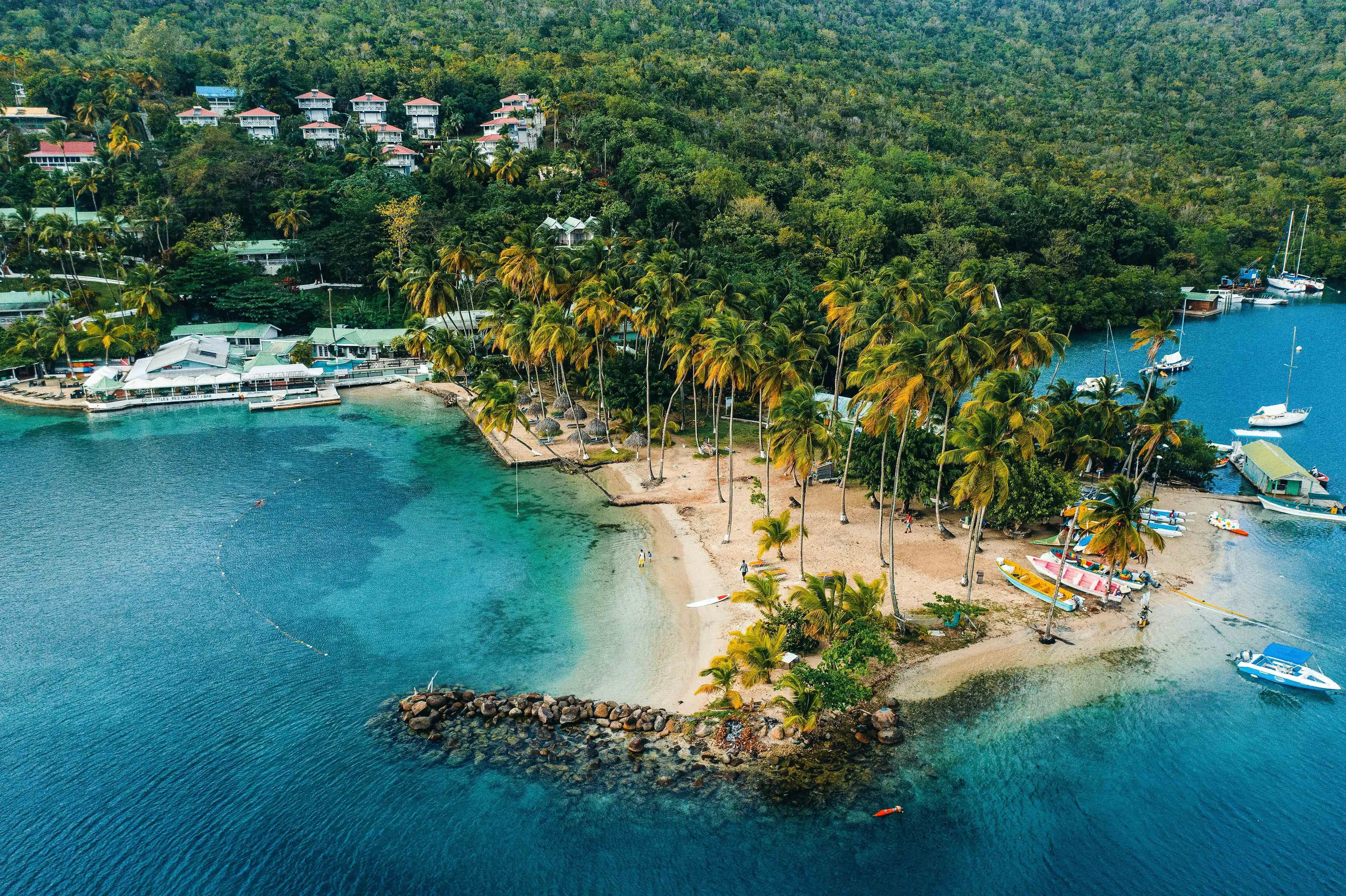
Saint Lucia Overview
Saint Lucia is a mountainous volcanic island of about 180,000 people in the Eastern Caribbean, an independent parliamentary democracy and a Commonwealth realm with King Charles III as head of state, represented by a Governor-General. It is a member of , the Organisation of Eastern Caribbean States, and the United Nations, and it shares the East Caribbean dollar — pegged at 2.70 to the US dollar since 1976 — with seven neighbours. The economy runs on tourism, which drives close to half of output, supplemented increasingly by revenue from selling citizenship.
On This Page
- 1.Saint Lucia Overview
- 1.1How Does Saint Lucia Compare?
- 1.2Who does Saint Lucia fit?
- 1.3Pros and Cons of Relocating to Saint Lucia
- 1.4Saint Lucia leads on Citizenship — WRI 88.0 / 100
- 1.5Saint Lucia leads on Residency — WRI 77.0 / 100
- 1.6Residence
- 1.7Taxes on Personal Income
- 1.8Cost of Living
- 1.9Healthcare System
- 1.10Education System
- 1.11Banking & Finance
- 1.12Cryptocurrency Regulation
- 1.13Real Estate Market
- 2.Frequently Asked Questions
Quick Facts
- Passport Rank: 27
- Visa-Free Destinations: 144
- Capital: Castries
- Population: 180,000
- Area: 617 km²
- Currency: East Caribbean dollar (XCD)
- Official languages: English
- Religions: Roman Catholic 61%, Protestant 26%, other/none 13%
Key Indicators
- GDP (Nominal): $2.77 billion (IMF, 2026)
- Unemployment Rate: 9.5% (2025, ILO)
- Human Development Index: 0.725 (High, HDR 2025)
- GDP per Capita: $15,100 (IMF, 2026)
Safety & Governance
- Global Peace Index (IEP): Not ranked (micro-state, GPI 2025)
- Press Freedom Index (RSF): Not ranked (RSF 2026)
- Corruption Perception (TI): 59/100 (Rank: 39, CPI 2025)
- Gini Coefficient (WB): 43.0 (World Bank, 2016)
Health & Environment
- PM2.5 Air Pollution: 12 µg/m³ (est., 2023)
- Air Quality Category: Moderate
- ND-GAIN Adaptation Index: 53.8 (Rank: 64, ND-GAIN 2023)
- Life Expectancy: 73.0 years (2024)
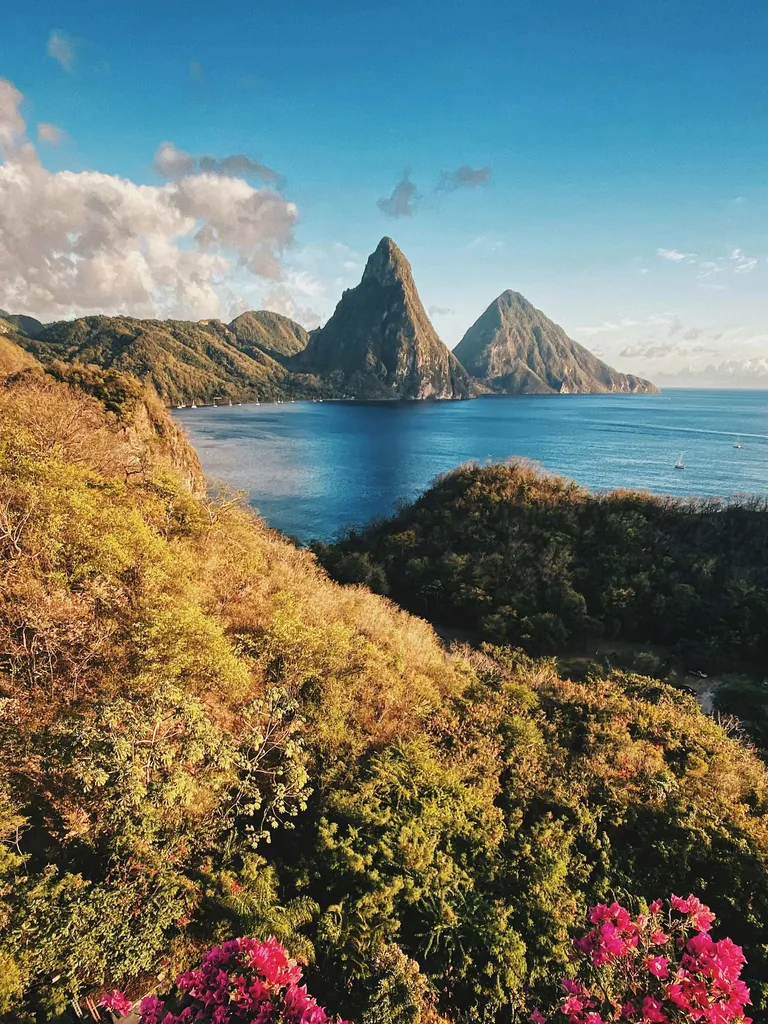
The proposition is narrow and clear: Saint Lucia sells a passport, not a place to live. For a donation from $240,000, an investor and family receive full citizenship in a few months, with no requirement to ever set foot on the island, dual nationality allowed, and no tax on foreign income for those who stay non-resident. The cost is the island itself as a home — a serious violent-crime problem, thin healthcare, and a passport whose value is being chipped away by visa restrictions. Saint Lucia does not try to be for everyone; it is clear from the start who it is for.
How Does Saint Lucia Compare?
Summary
Saint Lucia sits in the lower-middle of the WRI 2026, clustered with the other Eastern Caribbean citizenship-by-investment islands. Against them it offers a slightly pricier passport and a larger, more diversified economy, but it carries the region's most serious violent-crime problem.
How Saint Lucia stacks up against its closest peers on the WRI 2026:
Where Saint Lucia wins: Saint Lucia leads its peer group on the dimensions that matter most to an investor-citizenship buyer. Citizenship at 88.0 is the second-highest score in the table, trailing only St. Kitts and Nevis at 93.0 and edging Dominica at 87.0, and it reflects a passport granted in months with no residence requirement and dual nationality allowed. Residency at 77.0 ties Dominica and sits just below Georgia's 78.0, but the mechanism is different: Saint Lucia's score comes from citizenship by investment, which requires zero days on the island rather than a conventional permit ladder. Investment at 66.0 leads the Eastern Caribbean islands in the table — ahead of Dominica at 63.0 — reflecting the island's more diversified economy. Business at 58.0 also leads the Caribbean CBI peers, ahead of St. Kitts at 50.0 and Dominica at 54.0.
Where Saint Lucia lags: The gap is the island as a place to live. Safety at 48.0 is the weakest score in the peer group by a wide margin — below Dominica at 56.0, St. Kitts and Nevis at 57.0, Georgia at 63.5, and Uruguay at 70.3 — driven by a homicide rate near 40 per 100,000 that is among the highest in the world. Education at 38.0 trails every country in the table: Georgia scores 43.0, Uruguay 48.0, and even the smaller CBI islands come in at 35.0. Retirement at 47.0 ties Dominica at the bottom of that dimension, reflecting healthcare that evacuates serious cases and no university on the island. On overall score, Saint Lucia sits third in the five-country group at 59.5, behind Uruguay at 62.3 and St. Kitts and Nevis at 61.9.
Who does Saint Lucia fit?
Summary
Saint Lucia fits investors who want a second passport and a tax-light base they will not necessarily live in. It is a poor fit for anyone seeking a primary home, a safe family environment, or a passport they can rely on long-term.
Right fit:
- HNW investors buying a second citizenship — the $240,000 donation or $300,000 real-estate route grants a passport in months.
- Globally mobile entrepreneurs — non-residents pay no tax on foreign income, and there is no capital gains, inheritance, or wealth tax.
- Frequent travellers wanting visa-free range — the passport opens 144 destinations including the and Singapore.
- Families seeking a Plan-B citizenship — dual nationality is permitted, with no residence or visit requirement.
Wrong fit:
- Families relocating with children — one international school and no universities.
- Anyone prioritising personal safety — a homicide rate among the world's highest.
- Retirees needing reliable healthcare — serious cases require evacuation to Martinique or the US.
- US-bound travellers — no US visa-free access, and the UK reimposed visas in March 2026.
- Anyone seeking deep, liquid markets to invest in — the economy is small and tourism-dependent.
Pros and Cons of Relocating to Saint Lucia
- 01CitizenshipFast citizenship by investmentA donation from $240,000 grants full citizenship in roughly three to five months, with dual nationality permitted.Passport in months
- 02ResidencyCitizenship with zero stayApplicants never need to live on or visit the island; the entire process can be completed remotely through a licensed agent.No residence needed
- 03TaxationTax-free for non-residentsNon-residents pay no tax on foreign income, and there is no capital gains, inheritance, or wealth tax.No foreign-income tax
- 04MobilityBroad visa-free travelThe passport opens around 144 destinations visa-free, including the Schengen Area, Singapore, and Hong Kong.144 visa-free
- 05LanguageEnglish is the official languageAll official, legal, and business processes run in English, easing relocation for many applicants.English-speaking
- 06StabilityStrong anti-corruption recordSaint Lucia ranks 39th of 180 on the global corruption index, a stable democracy with credible institutions.Clean governance
- 07EconomyLargest Eastern Caribbean economyAt about $2.8 billion, Saint Lucia has the most diversified economy among the Eastern Caribbean CBI islands.Diversified economy
- 01SafetyAmong the world's highest murder ratesGang violence drives a homicide rate near 40 per 100,000, one of the highest globally, concentrated around Castries.High homicide rate
- 02MobilityNo US visa-free; UK revoked 2026The passport carries no US visa-free access, and the United Kingdom reimposed visas on Saint Lucian nationals in March 2026.No US access
- 03MobilitySchengen access at riskThe EU named citizenship-by-investment as grounds to suspend Schengen visa-free access in a December 2025 report.EU suspension risk
- 04HealthcareSerious cases need evacuationHealthcare is adequate for routine needs; complex cases require evacuation to Martinique, Barbados, or the US.Thin healthcare
- 05EducationOne international school, no universitiesThe island has a single international school and no universities, making it hard for families with older children.Weak schools
- 06Cost of LivingMost goods are costly importsNearly everything is imported under 12.5% VAT, and electricity is among the most expensive in the Caribbean.Expensive imports
- 07Real EstateSmall, illiquid property marketThe property market is small with no central registry; most foreign buying runs through a few CBI-approved resort projects.Illiquid property
Saint Lucia leads on Citizenship — WRI 88.0 / 100
Saint Lucia leads on Citizenship with a WRI score of 88.0, and the reason is the product itself: the country sells citizenship directly. A non-refundable donation to the National Economic Fund from $240,000 for a single applicant or a family of four, or an approved real-estate purchase from $300,000, delivers a full passport in roughly three to five months, with no requirement to live on or even visit the island. Dual nationality is permitted and there is no language or residence test for the investment route. The passport opens around 144 destinations visa-free, including the Schengen Area, Singapore, and Hong Kong. The honest caveat sits inside the score: that value is eroding. The United Kingdom reimposed visas on Saint Lucian nationals in March 2026, the United States never granted them, and the European Union signalled in late 2025 that citizenship-by-investment is itself grounds to suspend Schengen access. The passport is real and fast; its future reach is not guaranteed.
Saint Lucia leads on Residency — WRI 77.0 / 100
Saint Lucia leads on Residency with a WRI score of 77.0, almost as a by-product of the citizenship programme. Because investors receive citizenship outright, the usual residency ladder is irrelevant: there is no minimum stay, no renewal treadmill, and no path-to-permanence to navigate. For those who do want to live on the island without buying citizenship, a residence permit is available and permanent residence follows after five years, and a separate residency-by-investment option starts lower than the passport route. English is the working language, which removes the friction that slows relocation elsewhere, and the tax treatment is the real draw: a non-resident pays nothing on foreign income, and even residents face no capital gains, inheritance, or wealth tax. What the score does not reward is daily life, which is where Saint Lucia is weakest. Residency here is easy to acquire and pleasant on paper; the island is harder to actually settle into than the paperwork suggests.
Residence
Residence and tax residence are separate things in Saint Lucia, and the gap is the point. Citizenship by investment confers nationality without ever creating a tax obligation: a passport holder who does not live on the island is a non-resident, taxed only on Saint Lucia-source income, with foreign income untouched. Becoming tax-resident takes a permanent home plus presence, or 183 days in the year, at which point worldwide income for the ordinarily resident comes into scope, taxed up to 30%. For those relocating in earnest, a renewable residence permit leads to permanent residence after five years; there is no dedicated retirement visa, and income sufficiency is assessed case by case. The island has no forced-savings or social-insurance scheme of the kind found in larger economies.
Safety is where an honest page has to slow down. Saint Lucia is a stable democracy with clean institutions — its corruption score ranks 39th in the world, ahead of several members — but it carries a violent-crime problem far out of proportion to its size. The homicide rate has run near 40 per 100,000 in recent years, among the highest anywhere, driven by gang conflict concentrated around Castries, and 2024 set a record. Tourist areas and the gated north are insulated, and the violence rarely targets foreigners, but the figure is real, and a family weighing the island as a home rather than a passport has to reckon with it. This single number is the largest reason Saint Lucia's overall score sits where it does.
Taxes on Personal Income
Saint Lucia is a low-tax jurisdiction, and for the non-resident it can be a no-tax one. There is no capital gains tax, no inheritance or estate tax, and no wealth tax. Personal income tax applies only to residents and to local-source income, rising through bands to a top rate of 30% above roughly $11,000 of chargeable income, after a tax-free allowance of about $9,300. A citizen who lives abroad is a non-resident and pays nothing on foreign income; only money sourced in or remitted to Saint Lucia is taxed. The corporate rate is 30%, though international companies operating offshore are effectively exempt on foreign income. VAT is 12.5%, with reduced rates for the tourism sector. There is no special new-resident tax regime to apply for, because for most CBI investors the default non-resident position already shelters foreign income entirely. For the globally mobile, the effective rate on worldwide income can be zero.
Cost of Living
Saint Lucia is not cheap, and newcomers are often surprised. The island imports nearly everything, so a 12.5% VAT and freight costs push grocery and household prices above what the local wage would suggest; electricity, at roughly $0.86 per kilowatt-hour, is among the most expensive in the Caribbean, and air-conditioning compounds it. A one-bedroom in the expat-favoured north, around Rodney Bay and Cap Estate, runs from about $750 to $1,100 a month, well above the local average in Castries. A single professional should budget $1,500 to $2,500 a month all in, a couple $2,000 to $3,000. Locally grown produce is inexpensive and the lifestyle is open-air, which offsets some of the import premium. There is no domestic-helper economy at the scale of larger markets, though household help is affordable. The headline is simple: the weather is free, almost nothing else is.
Healthcare System
Healthcare is the area where the gap between a passport and a home is widest. The public system centres on the Owen King EU Hospital in Castries, opened in 2020 with European funding — modern by regional standards but chronically stretched, with staffing and supply shortfalls that local politics regularly airs. Most expatriates and citizens of means use the private Tapion Hospital or private clinics for routine care, where a consultation runs $40 to $110. For anything serious, the real plan is evacuation: Martinique is a twenty-minute flight, and complex cases go on to Barbados or the United States. International health insurance with medical-evacuation cover is treated as essential, not optional. Life expectancy is about 73 years. The standard of care is adequate for everyday needs and thin for emergencies, which is why no one relocates here without an off-island medical plan.
Education System
Education is one of the island's thinnest offerings for a relocating family. Public schooling is free, compulsory to age sixteen, and taught in English on the Caribbean examinations curriculum, but quality varies and it is built for locals, not international transfers. The international market is a single school: the International School of Saint Lucia in Rodney Bay, which runs a Canadian curriculum with international-baccalaureate elements from kindergarten through grade twelve, with fees in the rough range of $5,000 to $10,000 a year. A Montessori centre covers the early years. Beyond that there is no full international or boarding option, and families with secondary-age children often look off-island. Higher education on the island means the distance-learning campus of the University of the West Indies and a couple of offshore medical schools that serve foreign pre-med students rather than residents. For a family, the practical conclusion is that Saint Lucia works for early years and becomes harder as children get older.
Banking & Finance
Banking in Saint Lucia is functional but guarded. The sector sits under the Eastern Caribbean Central Bank, which runs the shared currency and its dollar peg, with the Bank of Saint Lucia and Republic Bank the main retail names. A resident or citizen can open an account with a passport, proof of address, and bank references, though remote opening requires notarised documents and patience. The wider challenge is structural: Caribbean banks have been steadily de-risked by international correspondents, so accounts for non-resident and newly-naturalised clients face heavy source-of-funds scrutiny and can be slow. Saint Lucia reports under both the US regime and the international common reporting standard, so account information flows to home tax authorities. The island is not on any money-laundering blacklist but remains under enhanced monitoring. For a new citizen, the realistic expectation is that opening and keeping a local account takes documentation and time, and that banking the rest of one's life offshore is often simpler.
Cryptocurrency Regulation
Saint Lucia regulates crypto rather than ignoring it. The Financial Services Regulatory Authority licenses virtual-asset businesses under a 2022 Act, with five licence classes covering exchange, custody, payments, advice, and token offerings, and minimum capital running from roughly $100,000 to $250,000 depending on class. For an individual, the tax position follows the island's broader regime: there is no capital gains tax, so gains on personal crypto holdings are not taxed as capital, and a non-resident pays nothing on foreign-sourced gains; only crypto activity that amounts to a local trade or business is taxed as income. There is no value-added tax on crypto trading itself. The regional central-bank digital currency experiment, DCash, was shut down in 2024 and a replacement has been shelved, so the East Caribbean dollar remains the only legal tender. The framework is light, clear, and built early, which suits a citizen who holds digital assets and lives elsewhere.
Real Estate Market
Foreigners can buy property in Saint Lucia, but most need an Alien Landholding Licence first — a flat, property-specific fee rather than a percentage, and a process that takes weeks to months. The exception is the citizenship programme: buying into an approved CBI development from $300,000 waives the licence entirely, which is why most foreign purchases run through a handful of sanctioned resort projects rather than the open market. That open market is small and illiquid: a three-bedroom home runs roughly $200,000 to $400,000, beachfront and Cap Estate villas $750,000 to over a million, with no central listings registry and prices set by private negotiation. Stamp duty for a buyer is about 2%, and a non-resident seller faces a 10% transfer charge on the way out. The annual property tax is light, 0.25% of value for homes. Rental yields are modest at 2% to 5%, though tourism gives well-placed villas strong short-let demand. The market rewards buyers who treat property as part of a citizenship plan, not as a liquid investment.


