
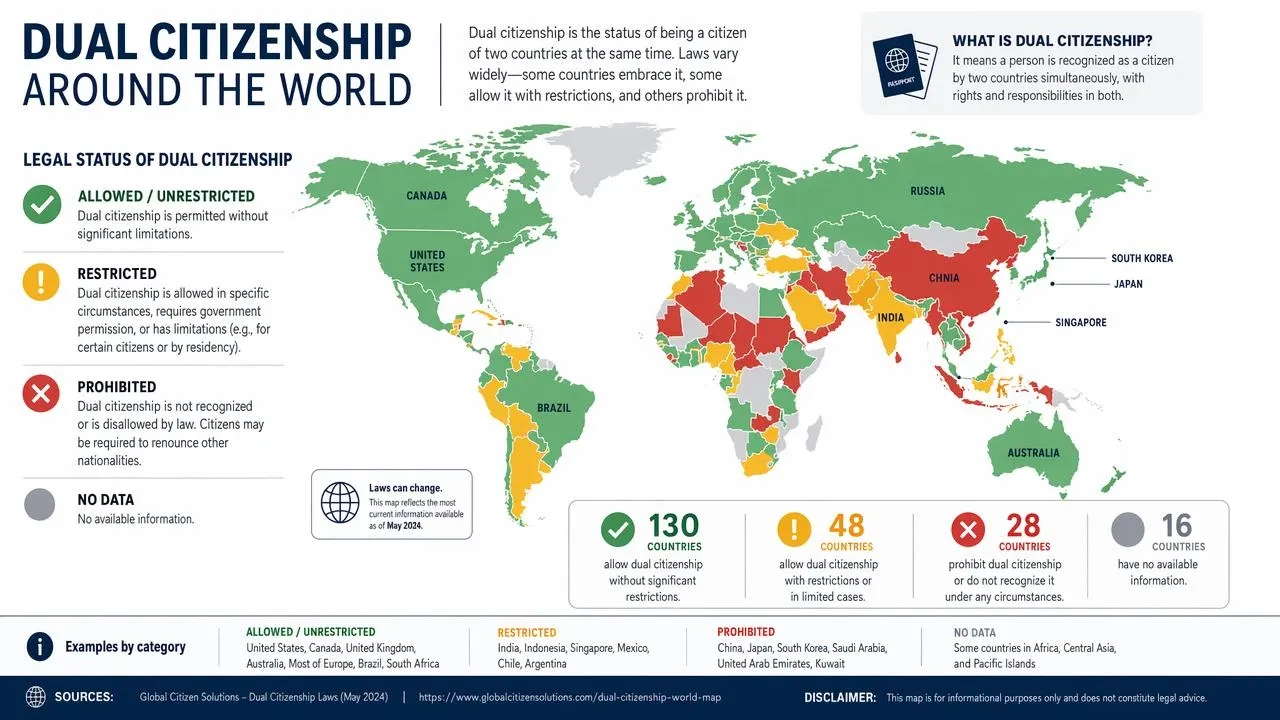
Key Takeaways
- Dual citizenship is a matter of national law: Each country decides whether it permits its citizens to hold another nationality, and the rules vary widely
- Two questions matter: Whether your current country lets you keep its citizenship when you acquire another, and whether the new country requires you to renounce your existing one
- Many top destinations allow it: A large number of popular relocation and investment-migration countries fully permit dual citizenship
- Some major countries restrict or prohibit it: Several significant countries require renunciation or do not recognise dual nationality, with important exceptions
- Restrictions are often conditional: Many "restrictive" countries allow dual citizenship in specific circumstances, such as by birth or with permission
- It affects strategy directly: Whether dual citizenship is allowed shapes which second-passport routes are viable without losing your current nationality
- Both countries' rules apply: You must check the rules of both your existing country and any prospective new one, as either can constrain the outcome
- Rules change and nuances abound: Laws evolve and contain exceptions, so the current, specific position for your nationalities should always be verified
How Dual Citizenship Actually Works
Dual citizenship — holding the nationality of two countries at once — is often misunderstood as a single yes-or-no question, when in fact it depends on the interaction of two separate national laws. Each country sets its own rules on whether its citizens may hold another nationality, and whether it will grant citizenship to someone who retains their existing one. Your ability to hold two passports therefore depends on both countries' rules, and either can constrain the outcome independently.
The first question is whether your current country of citizenship permits you to keep its nationality if you voluntarily acquire another. Some countries are entirely relaxed about this, allowing their citizens to acquire additional nationalities freely while retaining the original. Others take the opposite view, providing that a citizen who voluntarily acquires another nationality automatically loses the original — so that acquiring a second passport costs you your first. This is the rule that catches many people by surprise: they focus on the new country's willingness to grant citizenship, without checking whether their existing country will let them keep what they already have.
The second question is whether the new country you wish to naturalise in requires you to renounce your existing nationality as a condition of granting its own. Some countries readily grant citizenship without requiring renunciation, allowing you to add their passport to your existing one. Others require you to give up your prior nationality to naturalise, forcing a choice between the two. Again, this is independent of your home country's rules — a country can require renunciation regardless of whether your home country would have let you keep its citizenship.
Because both questions must be answered favourably for dual citizenship to result, the practical guidance is always to check both countries' rules for your specific nationalities. And because the rules contain nuances and exceptions — many countries restrict dual citizenship in general but permit it in specific circumstances, such as citizenship acquired by birth or descent, or with official permission — the general position must always be checked against the specific, current rules for the individuals and countries involved. The tables that follow set out the general position for popular relocation destinations, but they are a starting point for verification, not a substitute for it.
Countries That Allow Dual Citizenship
Many of the world's most popular relocation and investment-migration destinations permit dual citizenship, which is a significant part of their appeal to those seeking a second passport without giving up their first. The table below sets out twenty-five popular destinations that generally allow dual citizenship, together with the principal immigration or citizenship path each is known for.
Country | Dual Citizenship | Common Immigration / Citizenship Path |
Portugal | Allowed | Golden Visa (historically), D7, naturalisation by residence |
Malta | Allowed | Citizenship by investment; residence routes |
Cyprus | Allowed | Non-dom residence; naturalisation by residence |
Ireland | Allowed | Citizenship by descent; naturalisation by residence |
Italy | Allowed | Citizenship by descent; elective residence; flat-tax regime |
France | Allowed | Naturalisation by residence; talent routes |
United Kingdom | Allowed | Skilled/work routes; naturalisation by residence |
Greece | Allowed | Golden Visa; non-dom flat tax |
Switzerland | Allowed | Residence and naturalisation; lump-sum tax residence |
Sweden | Allowed | Work and residence routes |
Canada | Allowed | Express Entry; Start-Up Visa; provincial routes |
United States | Allowed | Employment, family, and investor (EB-5) routes |
Australia | Allowed | Skilled migration; employer sponsorship |
New Zealand | Allowed | Skilled and investor routes |
Mexico | Allowed | Temporary/permanent residence; naturalisation |
Brazil | Allowed | Residence routes; naturalisation |
Argentina | Allowed | Residence and naturalisation |
Turkey | Allowed | Citizenship by investment (real estate) |
Antigua & Barbuda | Allowed | Citizenship by investment |
St Kitts & Nevis | Allowed | Citizenship by investment |
Grenada | Allowed | Citizenship by investment |
Dominica | Allowed | Citizenship by investment |
Panama | Allowed | Friendly Nations and residence routes |
Belgium | Allowed | Residence and naturalisation |
Finland | Allowed | Work, residence, and naturalisation |
These countries share a permissive stance: their nationals can generally acquire another citizenship while retaining their own, and they generally grant citizenship without requiring renunciation of the applicant's existing nationality. This is precisely why so many of them feature prominently in second-passport and investment-migration planning — a Caribbean citizenship-by-investment programme, for instance, is attractive partly because those countries permit dual citizenship, allowing the new passport to be added rather than substituted. For someone seeking to add a second nationality without losing their first, these permissive destinations are the natural focus, subject always to their own country's rules permitting them to keep their original citizenship.
Countries That Restrict or Prohibit Dual Citizenship
A number of significant countries, including some popular for relocation, restrict or prohibit dual citizenship — requiring renunciation to naturalise, or providing that citizens lose their nationality on voluntarily acquiring another. The table below sets out twenty-five such countries, with the nature of the restriction and the relevant path, though it is essential to understand that many of these restrictions are conditional rather than absolute.
Country | Dual Citizenship | Nature of Restriction / Path |
China | Not recognised | Acquiring another nationality generally means losing Chinese |
India | Not allowed | No dual citizenship; OCI card offers a partial alternative |
Japan | Restricted | Generally requires choosing one nationality by adulthood |
Singapore | Not allowed | Renunciation generally required; strict enforcement |
Austria | Restricted | Generally prohibited; permitted only with special permission |
Netherlands | Restricted | Restricted with exceptions; renunciation often required |
Norway (historic) | Now allowed | Recently liberalised; previously restrictive |
Spain | Restricted | Allowed with specific countries; renunciation otherwise |
Germany (historic) | Now broadly allowed | Recently liberalised; previously restrictive |
Saudi Arabia | Restricted | Generally requires permission to hold another nationality |
UAE (for nationals) | Restricted | Emirati nationals generally restricted; expats unaffected |
Indonesia | Not allowed for adults | Choice required at adulthood |
Malaysia | Not allowed | Renunciation required; strict enforcement |
Thailand | Restricted in practice | Tolerated in some cases; legally ambiguous |
Nepal | Not allowed | No dual citizenship |
Kazakhstan | Not allowed | Renunciation required |
Ukraine (historic) | Restricting | Traditionally not recognised; reforms ongoing |
Estonia | Restricted | Restricted by naturalisation; birthright dual tolerated |
Slovakia | Restricted | Loss on voluntary acquisition, with exceptions |
Lithuania | Restricted | Limited; referendum debates ongoing |
South Korea | Restricted | Limited; generally requires renunciation with exceptions |
Iran | Not recognised | Does not recognise the other nationality |
Bahrain | Restricted | Generally requires permission |
Kuwait | Not allowed | Renunciation required |
Andorra | Not allowed | Renunciation required to naturalise |
The crucial point about this list is that "restricted" rarely means "absolutely prohibited in all circumstances." Many of these countries permit dual citizenship in specific situations — most commonly for citizenship acquired automatically at birth (by being born in a territory or to parents of different nationalities), for children, or with official government permission. Others restrict it only for naturalising citizens while tolerating dual nationality acquired by birth or descent. And some, such as Germany and Norway, have recently liberalised their rules, moving from a restrictive to a more permissive stance — a reminder that these laws evolve. The category is therefore best understood as "restricts dual citizenship in some or all circumstances" rather than a uniform prohibition, and the specific rules and exceptions for any given case must be checked.
What This Means for Your Strategy
Understanding who allows and who restricts dual citizenship translates directly into practical strategy for anyone considering a second passport or a naturalisation, because it determines which routes are viable without sacrificing an existing nationality.
The first implication is that both of your relevant countries' rules must be checked, and either can be the binding constraint. If your existing country strips citizenship on voluntary acquisition of another, then naturalising anywhere — even in a country that permits dual citizenship — may cost you your original nationality. Conversely, if the country you wish to naturalise in requires renunciation, you face losing your existing citizenship regardless of your home country's permissive stance. Only when both countries permit the arrangement can you genuinely hold both, so the analysis must cover both sides.
The second implication is that the permissive destinations are the natural focus for additive second-passport strategies. For someone whose home country allows dual citizenship, the popular investment-migration and residence destinations that also permit it — many Caribbean citizenship programmes, and numerous European and other countries — allow a second passport to be added cleanly. This is a large part of why these destinations dominate second-passport planning: the arrangement works without forcing a choice. Where either country restricts dual citizenship, the strategy becomes more complex and may require accepting renunciation, using an exception, or choosing a different route.
The third implication is that nuance and change demand verification. Because many restrictions are conditional, and because laws evolve — as recent liberalisations demonstrate — the general position in a guide like this is a starting point that must be confirmed against the current, specific rules for the individual's nationalities and circumstances. Someone from a country listed as "restricted" may find an applicable exception; someone relying on a country's permissive stance should confirm it remains current. The tables map the landscape, but the specific route requires checking the specific rules, ideally with professional advice for anything consequential.
The overarching strategic point is that dual citizenship is not a given but a function of two countries' laws, and successful second-passport planning starts by establishing what those laws permit. Get that analysis right, and the viable routes become clear; skip it, and you risk an unwelcome surprise — most painfully, losing a citizenship you assumed you could keep.
Strategic Considerations
Several principles should guide anyone navigating dual citizenship.
Check Both Countries' Rules
Always establish both whether your existing country lets you keep its citizenship on acquiring another, and whether the prospective new country requires renunciation. Either can be the binding constraint, and only when both permit the arrangement can you genuinely hold both nationalities. This dual check is the foundation of any second-passport analysis.
Don't Assume Your Home Country Is Permissive
Many people focus on the new country and overlook whether their existing country will let them keep its citizenship. Since some countries strip nationality on voluntary acquisition of another, confirm your home country's stance specifically, as this is the constraint most often missed and most painful when discovered too late.
Look for Exceptions Where a Country Is Restrictive
Because many restrictions are conditional rather than absolute — with exceptions for birth, descent, children, or official permission — a country appearing on the restrictive list may still allow dual citizenship in your specific circumstances. Investigate the exceptions rather than assuming a blanket prohibition applies to you.
Verify Current Rules and Take Advice
Dual-citizenship laws evolve and contain nuances, so verify the current, specific position for your nationalities rather than relying on a general guide, and take professional advice for anything consequential. Recent liberalisations show the rules change, so currency of information genuinely matters.
Risks and Considerations
The risk inventory around dual citizenship includes:
- Losing an existing citizenship: The gravest risk is naturalising elsewhere and discovering your home country strips nationality on voluntary acquisition of another, costing you a citizenship you assumed you could keep.
- Overlooking the home-country rule: Focusing only on the new country and neglecting whether your existing country permits retention is the most common and consequential oversight.
- Assuming a blanket prohibition: Conversely, assuming a "restricted" country prohibits dual citizenship absolutely may cause someone to miss an applicable exception, such as for birth or descent.
- Relying on outdated information: Dual-citizenship laws evolve, as recent liberalisations show, so relying on outdated rules is a genuine risk that current verification addresses.
- Ignoring obligations of dual status: Dual citizenship can carry obligations — tax, military service, or others — in both countries, which should be understood, not just the right to hold both passports.
- Conditional exceptions misapplied: Exceptions have their own conditions, and assuming one applies without confirming its specifics can lead to error.
- Enforcement variation: Some countries' rules are strictly enforced while others are ambiguous or tolerated in practice, and relying on informal tolerance carries risk.
- Currency and figure verification: Where programmes carry costs, these are set locally and would be presented in US dollars for clarity; specific figures and current rules should be confirmed directly.
WorldPath View
Whether you can hold two passports comes down to two countries' laws — your existing one and any prospective new one — and successful planning starts by establishing what both permit. Many of the world's most popular relocation and investment-migration destinations fully allow dual citizenship, which is central to their appeal for second-passport seekers, while a number of significant countries restrict or prohibit it, though usually with important exceptions rather than as absolute bans.
For anyone navigating this in 2026, three principles should guide the approach. First, check both countries' rules, since either can be the binding constraint and only when both permit the arrangement can you genuinely hold both nationalities. Second, don't assume your home country is permissive, because the constraint most often overlooked — and most painful when discovered late — is a home country that strips citizenship on voluntary acquisition of another. Third, look for exceptions where a country is restrictive and verify current rules, since many restrictions are conditional and the laws evolve, so a general guide is a starting point that must be confirmed against the specific, current position for your nationalities.
The deeper point is that dual citizenship is not a universal right but a function of national laws that vary enormously and change over time. The tables in this guide map the landscape for the destinations that matter most in global relocation, showing that the permissive countries — where a second passport can be added without sacrificing the first — dominate second-passport planning for good reason, while the restrictive ones require more careful navigation. But the map is not the territory: for any consequential decision, the specific, current rules for the individuals and countries involved must be verified, ideally with professional advice, because the cost of getting it wrong can be the loss of a citizenship one assumed was secure.


