
Key Takeaways
- $3,000 goes a long way for one or two: A single person or couple can live very comfortably on this budget, well above local norms
- Housing is the biggest variable: Villa rents range enormously, and location and style drive the budget more than anything else
- Food and daily life are cheap: Local food, transport, and everyday costs are low, leaving room in the budget for lifestyle
- Families stretch the budget thin: $3,000 that is comfortable for a couple is tight for a family, especially with schooling
- International schooling is a major omission: Private international school fees can exceed the entire $3,000 budget per child
- Healthcare needs insurance: Quality care requires private treatment and insurance, an essential cost the headline budget often ignores
- Visas and irregular costs add up: Visa arrangements, flights, and periodic costs are real and easily overlooked in a monthly figure
- Lifestyle inflation is a risk: Bali's abundant premium options make it easy to spend far more than the local cost base implies
What $3,000 a Month Genuinely Buys
For a single person or a couple, $3,000 a month in Bali buys a genuinely comfortable, even enviable, lifestyle, and this is the truth behind the island's reputation as an affordable base for remote workers and the location-independent. At this budget, the everyday realities of life — housing, food, transport, and leisure — are all comfortably covered, with room to spare for the lifestyle that draws people to Bali in the first place.
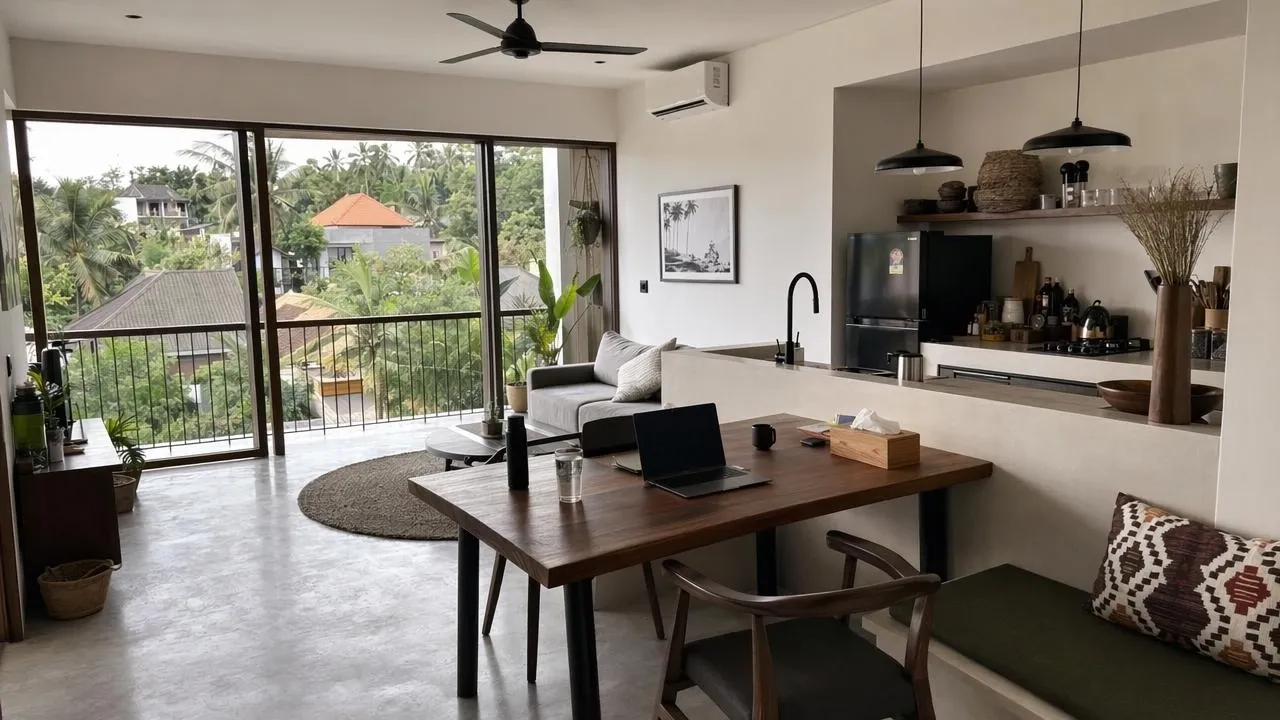
Housing at this level can be very pleasant. While villa rents range enormously, $3,000 a month leaves a substantial allocation for accommodation that can secure an attractive villa — often with a pool, in a desirable area — that would cost multiples of the price in a Western city or a more expensive Asian hub. Housing is the largest and most variable cost, and how much of the budget it consumes depends heavily on location and style, but at the $3,000 level a single person or couple can live somewhere genuinely nice without exhausting the budget, which is central to Bali's appeal.
Food and daily life are inexpensive. Local food is cheap and excellent, everyday transport (particularly by scooter) costs little, and the general price level for daily living is low by Western standards. This means that after housing, a good portion of the $3,000 remains for the things that make life enjoyable — dining out, including at good Western-style restaurants and cafés, leisure activities, wellness, socialising, and the experiences that define the Bali lifestyle. A single person or couple can eat well, go out, enjoy the island, and still live within the budget comfortably, which is precisely why $3,000 has become a byword for a good life in Bali.
The honest summary is that, for one or two people, $3,000 a month in Bali genuinely delivers a comfortable, appealing lifestyle well above what the same figure would buy in most Western or expensive-Asian locations. The reputation is earned at this level. The important qualifications — for families, for schooling, for healthcare and the irregular costs — come not from the everyday lifestyle the budget comfortably supports, but from the significant costs the headline figure quietly omits, which is where a realistic picture must turn next.
Where the Budget Goes: A Monthly Breakdown
To see what $3,000 covers, it helps to break a comfortable single-or-couple budget into its components. The figures below are indicative and in US dollars; actual costs vary considerably by lifestyle, location, and choices, and should be treated as a realistic illustration rather than precise amounts.
Monthly Expense (one or two people) | Approx. Cost (USD) |
Villa rent (attractive, desirable area) | $900–1,500 |
Utilities, internet, and services | $150–300 |
Food (mix of local and Western) | $400–700 |
Transport (scooter, occasional car/driver) | $50–150 |
Leisure, dining out, wellness, social | $400–700 |
Coworking / miscellaneous | $100–250 |
Indicative monthly total | $2,000–3,600 |
The breakdown shows why $3,000 is comfortable for one or two people: the essential costs — housing, utilities, food, and transport — can be covered well within the budget, leaving a meaningful allocation for the leisure and lifestyle spending that makes Bali attractive. Even at the higher end of the ranges, a couple can construct a full and comfortable life around the $3,000 figure, and at the lower end there is genuine room to spare, which is why many find they can live well and still save on this budget.
The table also illustrates the biggest variable: housing. The gap between a modest but pleasant villa and a premium one is the single largest swing in the budget, and it is where an individual's choices most affect whether $3,000 feels generous or merely adequate. Someone prioritising an impressive villa will consume more of the budget on housing and have less for lifestyle; someone content with a simpler place will have more for everything else. The budget is therefore flexible, and $3,000 can be allocated toward housing, lifestyle, or savings according to preference — for one or two people. The picture changes fundamentally, however, once the costs the table does not include enter the frame.
What $3,000 Does Not Cover
The headline budget's real limitations lie in the significant costs it quietly omits, and these are what catch newcomers out and what a genuinely honest account must emphasise.
The first and largest is international schooling. For families with children, private international school fees in Bali can be substantial — in many cases exceeding the entire $3,000 monthly budget per child. A family assuming that $3,000 which is comfortable for a couple will accommodate children in international school is in for a shock, because schooling alone can double, triple, or more the required budget for a family. This single omission transforms the affordability picture for families, and it is the clearest example of how the $3,000 figure, true for one or two, misleads for a household with children.
The second is healthcare. Quality healthcare in Bali generally means private treatment, and serious medical needs may require treatment elsewhere, so comprehensive health insurance is essential rather than optional. The headline lifestyle budget often ignores this, but it is a real and non-trivial recurring cost, and going without adequate insurance is a serious risk given that quality care must be paid for privately. A realistic budget must include health insurance as a genuine line, not an afterthought.
The third category is visas and irregular costs. Maintaining legal status in Bali involves visa arrangements that carry their own costs and periodic requirements, and expat life involves irregular but real expenses — flights home or for visa purposes, periodic larger purchases, and the general lumpy costs that a smooth monthly figure hides. These do not appear in a tidy monthly budget but are genuinely part of the cost of living in Bali, and they add up over a year. The fourth is the risk of lifestyle inflation: Bali offers abundant premium options — luxury villas, high-end dining, extensive wellness and leisure spending — and it is easy to spend far more than the local cost base implies, so the $3,000 that suffices for a comfortable life can be exceeded readily by someone who embraces the island's premium end.
Together, these omissions — schooling, healthcare, visas and irregular costs, and the temptation of lifestyle inflation — are what the honest account must add to the appealing headline. For one or two people living within their means and handling healthcare and visas sensibly, $3,000 genuinely delivers a comfortable Bali life. For a family, for anyone ignoring insurance, or for someone drawn into premium spending, the real cost is considerably higher, and the headline figure becomes misleading precisely by leaving these out.
Who $3,000 Works For — and Who Needs More
Bringing the honest picture together, whether $3,000 a month works in Bali depends heavily on who is asking, and the answer divides sharply by circumstance.
For the single remote worker or the couple without children, $3,000 genuinely works and works well. This is the profile for whom Bali's affordable reputation is entirely accurate: such a person or couple can secure a nice villa, eat well, enjoy the island's lifestyle, handle their visa and insurance sensibly, and often still save, all within or around the $3,000 figure. For this group — which is much of Bali's remote-work and digital-nomad population — the budget delivers exactly the comfortable, appealing life the reputation promises, and Bali is a genuinely affordable and attractive base.
For families with children, $3,000 does not realistically work if international schooling is required, and the honest figure is considerably higher. Once school fees — potentially exceeding the entire budget per child — are added to family-sized housing and the higher living costs of a household, the required budget rises well beyond $3,000, often to a multiple of it. A family can still live well in Bali, but not on $3,000 if the children are in international school; they need a substantially larger budget, and pretending otherwise sets up a serious miscalculation. Families should build their budget from the schooling cost upward, rather than assuming the couple's figure extends to them.
For everyone, the budget must genuinely include the omitted costs — healthcare insurance, visa arrangements, and a realistic allowance for irregular expenses — and resist lifestyle inflation, or the real cost will exceed the headline. Even a single person or couple who ignores insurance, underestimates visa and irregular costs, or is drawn into premium spending will find $3,000 insufficient, not because Bali is expensive but because the headline figure assumed sensible handling of exactly these things. The budget works when it is genuinely complete and lived within; it fails when the omitted costs are ignored. The practical conclusion is that $3,000 is a real and generous figure for one or two disciplined people, an incomplete one for families and the careless, and always a figure that must include what the headline leaves out.
Strategic Considerations
Several principles should guide anyone budgeting for Bali.
Distinguish Your Profile Honestly
Whether $3,000 works depends decisively on whether you are single or a couple without children, for whom it genuinely suffices, or a family with children in international school, for whom it does not. Identify your profile honestly, because the same figure that is generous for one is seriously inadequate for the other.
Budget Schooling From the Top
For families, build the budget starting from international school fees, which can exceed the entire $3,000 per child, rather than assuming the couple's figure extends to a family. Schooling is the single cost that most transforms the family budget, so it should anchor the calculation, not be added as an afterthought.
Include the Omitted Costs
Ensure your real budget includes healthcare insurance, visa arrangements, and a genuine allowance for irregular costs such as flights and periodic expenses, which the headline monthly figure omits. A complete budget that includes these is the only honest basis for assessing affordability.
Guard Against Lifestyle Inflation
Because Bali offers abundant premium options, guard against lifestyle inflation that can push spending well beyond the local cost base. The $3,000 figure assumes reasonable choices; embracing the island's premium end can multiply the cost, so conscious spending discipline preserves the affordability that drew you there.
Risks and Considerations
The risk inventory for budgeting Bali expat life includes:
- Family miscalculation: Assuming a couple's $3,000 budget extends to a family with children in international school is the central error, as schooling alone can exceed the whole budget per child.
- Ignoring healthcare insurance: Quality care in Bali is private, and going without comprehensive insurance is a serious financial and personal risk that the headline budget often omits.
- Overlooking visas and irregular costs: Visa arrangements, flights, and periodic expenses are real costs that a smooth monthly figure hides and that add up over a year.
- Lifestyle inflation: Bali's premium options make it easy to spend far beyond the local cost base, so the comfortable $3,000 can be exceeded readily without discipline.
- Housing-cost variability: Villa rents range enormously, and an expensive choice can consume much of the budget, leaving less for everything else, so housing choices materially affect the outcome.
- Assuming stability of costs: Prices, exchange factors, and visa rules change, so a budget should be treated as needing periodic review rather than fixed indefinitely.
- Underestimating setup costs: Establishing a household in Bali involves initial setup costs beyond the ongoing monthly figure, which should be planned for separately.
- Currency and figure verification: Costs are incurred locally and figures here are presented in US dollars for clarity; actual amounts vary and should be confirmed against current local conditions.
WorldPath View
The honest answer to what $3,000 a month gets you in Bali is that it depends on profile: for a single remote worker or a couple without children, it genuinely delivers a comfortable, appealing lifestyle — a nice villa, good food, a full social and leisure life, and often room to save — which is the truth behind Bali's affordable reputation. For a family with children in international school, it falls well short, because schooling alone can exceed the entire budget per child, and the real figure is considerably higher.
For anyone considering Bali in 2026, three principles should guide the budgeting. First, distinguish your profile honestly, because $3,000 is generous for one or two but seriously inadequate for a family with children in international school, and conflating the two is the central budgeting error. Second, include the costs the headline omits — international schooling for families, healthcare insurance for everyone, visa arrangements, and a genuine allowance for irregular expenses — since a budget that ignores these understates the real cost regardless of profile. Third, guard against lifestyle inflation, because Bali's abundant premium options make it easy to spend well beyond the local cost base, and the $3,000 figure assumes reasonable, disciplined choices.
The deeper truth is that Bali's affordability is real but conditional. For the disciplined single person or couple who handles healthcare and visas sensibly and resists premium excess, $3,000 a month buys a genuinely enviable life, and the island deserves its reputation. For families, and for anyone who ignores the omitted costs or succumbs to lifestyle inflation, the headline figure misleads, and the real cost is meaningfully higher. The figure is a useful starting point, not a complete answer — generous for the right profile living sensibly, incomplete for everyone once the honest full picture, including what it does not cover, is drawn.


