
Key Takeaways
- An established Caribbean CBI programme: Antigua & Barbuda offers a well-known route to citizenship by investment with strong visa-free travel
- Multiple investment routes: The programme typically offers options including a donation to a national fund and real estate investment, among others
- Family inclusion is generous: The programme is notably family-friendly, allowing a family to gain citizenship on one application, often at attractive relative cost
- Costs are meaningful but competitive: Investment thresholds are significant but competitive with other Caribbean programmes, especially for families
- The passport offers strong mobility: Antigua & Barbuda's passport carries visa-free or visa-on-arrival access to many destinations
- Living there is a separate question: Holding the passport and living on the island are different things, and island life has its own realities
- Most holders don't relocate: Many obtain the citizenship for mobility and optionality rather than to live there full-time
- Verify current costs and rules: CBI costs, options, and requirements change, so the current programme terms should be confirmed directly
The Programme and Its Costs
Antigua & Barbuda operates one of the Caribbean's established citizenship-by-investment programmes, offering qualifying applicants and their families citizenship in exchange for a qualifying investment, with the resulting passport providing strong international mobility. As one of the longer-running and better-known Caribbean CBI programmes, it is a mainstream option, competing with the others on cost, family terms, processing, and passport strength.
The programme typically offers several investment routes, allowing applicants to choose the option that best suits them. These commonly include a donation to a national development fund — a non-refundable contribution to the government, usually the most straightforward and, for many, the entry-level route — and real estate investment in approved developments, which involves purchasing qualifying property, typically with a minimum holding period, and can suit those who prefer an asset to a donation. Other routes have featured in the programme over time as well. Each route has its own cost structure, and the choice between them depends on the applicant's preferences, family size, and whether they prefer a lower-cost donation or an asset-based investment.
Route | Nature | Broadly Suits |
National fund donation | Non-refundable government contribution | Most applicants; often lowest entry cost |
Real estate investment | Purchase of approved property, held for a minimum period | Those preferring an asset to a donation |
Other routes | Have featured over time (e.g. enterprise/university options) | Specific circumstances; verify availability |
The costs are meaningful but competitive within the Caribbean CBI market. Investment thresholds run to figures in the range of roughly a couple of hundred thousand US dollars and up for the donation route depending on family size, with real estate routes typically requiring a higher qualifying investment, plus government fees, due-diligence fees, and processing costs on top. These figures are significant but broadly competitive with, and in some configurations among the more affordable of, the Caribbean programmes, particularly for families. Because the specific thresholds, fees, and options change over time — Caribbean CBI pricing has shifted in recent years — the current costs should be verified directly for the specific route and family composition, in US dollars for clear comparison, rather than relied on from general figures.
The programme also typically involves conditions beyond the investment, including due diligence, application requirements, and, in some cases, a minimal physical-presence or visit requirement over a period. These conditions should be understood, particularly any residency or visit obligation, though Caribbean CBI programmes are generally known for light presence requirements. Verifying the current full cost, the conditions, and any presence requirement for the specific route is the essential first step in assessing the programme.
Family Options
One of the programme's notable strengths is its family-friendly approach, and for family-motivated applicants — a large share of CBI buyers — the family options are often the decisive attraction.
The programme is designed to allow a family to gain citizenship together on a single application, including the main applicant, their spouse, and dependent children, and often extending to other dependants such as dependent parents or grandparents and, in some configurations, siblings, subject to the programme's dependency criteria. This family inclusion means that rather than each family member pursuing citizenship separately, a family can obtain it together through one application, which is both more convenient and, on a per-person basis, often more cost-effective than individual applications would be.
The family-friendliness is reinforced by the cost structure, which is often configured to make including family attractive. The programme has historically been positioned to appeal to families, with terms that make adding a spouse and children relatively cost-effective, so that a family application can offer good value per person compared with the single-applicant cost. This makes Antigua & Barbuda particularly attractive to families seeking to secure second citizenship for the whole household in one step, and it is a large part of the programme's appeal to the family-motivated applicants who make up much of the market.
The dependency criteria — who can be included and up to what age or on what conditions — follow the programme's rules, which, as with other CBI programmes, define dependent children by age and often continued-dependency or student status, and set conditions for including other relatives. Families with older children or wishing to include extended relatives should verify the specific current dependency criteria to confirm who can be included and on what terms. But the broad picture is that Antigua & Barbuda is a notably family-friendly programme, well-suited to securing citizenship for a whole family, which for many applicants is precisely the point.
For families thinking long-term, the citizenship obtained is durable and, importantly, can generally be passed to future generations under citizenship-by-descent principles, extending the benefit beyond the included family members to their own future children. This generational dimension adds to the family appeal, making the citizenship not just a benefit for the current family but potentially a lasting family asset, subject to the country's descent rules. For the family-motivated applicant, this combination of generous current inclusion and future transmissibility is a significant part of what makes the programme attractive.
The Passport and Why People Obtain It
The Antigua & Barbuda passport is the core deliverable of the programme, and understanding its value — and why most people obtain the citizenship — clarifies what the programme actually provides.
The passport offers strong international mobility, carrying visa-free or visa-on-arrival access to a substantial number of destinations, including many important ones for business and travel. This mobility is the primary practical value of the citizenship for most holders: a travel document that significantly expands where they can go without the friction of obtaining visas, which is especially valuable for those whose original passport offers weaker access. The strength of the visa-free access is a key selling point of the programme and a major reason applicants choose it, though the exact access varies over time and should be checked currently.
Beyond mobility, the citizenship offers the broader benefits that motivate CBI generally: optionality and security through a second citizenship, a hedge against uncertainty in one's home country, potential tax and business planning flexibility depending on individual circumstances, and the ability to pass citizenship to future generations. For internationally mobile individuals and families, these benefits — a genuine second citizenship with strong mobility, obtained relatively quickly and without the need to relocate — are the core value proposition, and they explain why the programme attracts applicants from around the world.
Crucially, most people obtain Antigua & Barbuda citizenship for these benefits — mobility, optionality, security — rather than to actually live on the island. The programme's light presence requirements and the nature of its appeal mean that the typical holder gains the citizenship as a mobility and optionality asset while continuing to live elsewhere, visiting rarely if at all beyond any minimal requirement. This is entirely normal and legitimate for Caribbean CBI: the citizenship is valued as a travel document and a hedge, not necessarily as a home. Understanding this distinguishes the passport benefit — which most holders use — from island life, which most do not experience full-time.
What It's Really Like to Live on the Island
For the minority who do consider actually living in Antigua & Barbuda, or spending significant time there, the reality of island life is a distinct and important consideration that the CBI marketing tends to skip, and it involves genuine appeal alongside genuine trade-offs.
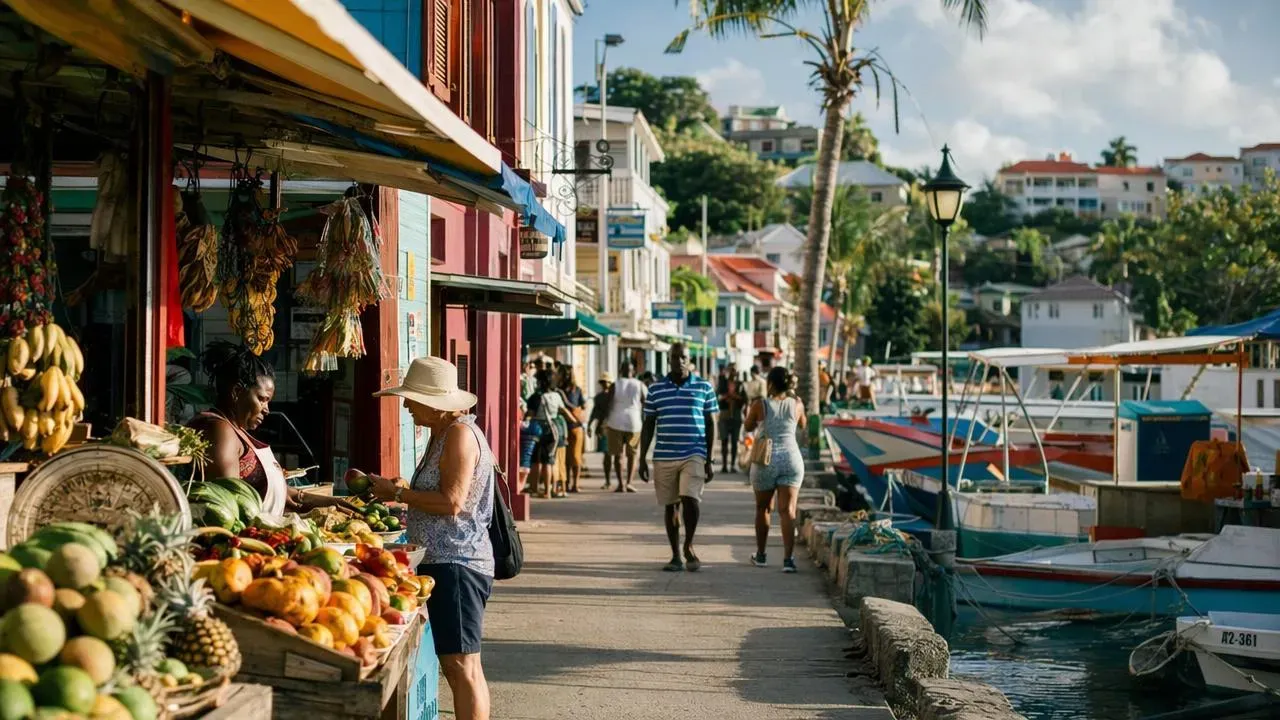
The appeal of island life is real. Antigua & Barbuda offers a beautiful Caribbean setting — famous beaches, a warm tropical climate year-round, a relaxed pace of life, natural beauty, and the appeal of island living that draws people to the Caribbean generally. For those who genuinely want a tropical, relaxed, beautiful environment and can embrace island life, it offers a genuinely attractive lifestyle, and some CBI holders and other expats do choose to spend significant time or live there, drawn by exactly this. The beauty and the climate are not marketing exaggerations but genuine attractions.
The trade-offs of island life are equally real and should be understood by anyone considering actually living there. A small Caribbean island nation has the characteristics that implies: it is small, with limited size and amenities compared with a major country or city; the cost of living, particularly for imported goods and Western-standard amenities, can be surprisingly high, since much is imported; infrastructure, services, and healthcare are those of a small island nation, with serious medical needs sometimes requiring travel elsewhere; connectivity, while reasonable for a Caribbean island, is more limited than a major hub; and the pace and scale of life, while appealing to some, can feel isolating or limiting to others over time, particularly those used to the amenities and connectivity of larger places. Island life suits some wonderfully and others poorly.
This is why the distinction between holding the passport and living on the island matters so much. The great majority of CBI holders obtain the citizenship for mobility and optionality and continue living elsewhere, for whom island life is largely irrelevant. The minority genuinely considering living there must weigh the real appeal of the Caribbean setting against the real limitations of small-island life — the cost of imported goods, the limited amenities and services, the healthcare and connectivity constraints, and the question of whether the relaxed, small-scale island life suits them over the long term rather than as a holiday. Honest assessment of one's own preferences against these realities, ideally after spending genuine time on the island, is essential for anyone contemplating actually living there.
Strategic Considerations
Several principles should guide anyone considering Antigua & Barbuda CBI.
Clarify Your Actual Purpose
Establish whether you seek the citizenship for mobility and optionality — like most applicants — or genuinely intend to live on the island, since this determines what matters most. Mobility seekers should focus on the passport, cost, and family terms; would-be residents must weigh island life centrally.
Compare Routes and Full Family-Inclusive Cost
The programme offers multiple routes (typically a fund donation and real estate, among others) at different costs, and its family terms are a key strength. Compare the routes and assess the full family-inclusive cost for your family composition, in US dollars, since the family configuration and route choice drive the real cost.
Weigh the Family and Generational Benefit
Antigua & Barbuda is notably family-friendly, allowing a family to gain citizenship on one application, often cost-effectively, with the citizenship transmissible to future generations. For family-motivated applicants, weigh this generous inclusion and generational transmissibility, which are among the programme's main attractions.
Assess Island Life Firsthand If Relocating
If you genuinely intend to live on the island, assess island life realistically and firsthand before committing, weighing the beautiful Caribbean setting against the real limitations of small-island life — cost of imported goods, limited amenities, healthcare, and connectivity. The holiday experience differs from permanent residence.
Risks and Considerations
The risk inventory for Antigua & Barbuda CBI includes:
- Cost and rule changes: CBI costs, options, and requirements change, and Caribbean pricing has shifted in recent years, so relying on outdated figures rather than verifying current terms is a real risk.
- Confusing passport with residence: Holding the citizenship and living on the island are different things, and assuming the programme is a route to a desirable life on the island without assessing island life is a misjudgment for would-be residents.
- Island-life realities: For those who do relocate, small-island life carries real limitations — high cost of imported goods, limited amenities, healthcare, and connectivity — that should be assessed firsthand.
- Dependency-criteria specifics: Family inclusion follows dependency criteria that have conditions, and assuming particular relatives or older children qualify without confirming is a risk.
- Visa-free access changes: The passport's visa-free access varies over time and can change, so it should be checked currently rather than assumed from general claims.
- Due diligence and conditions: The programme involves due diligence and conditions, including any minimal presence requirement, that must be met, and misunderstanding them can complicate an application.
- Programme and reputational factors: Caribbean CBI programmes operate under external scrutiny that can affect their terms and passport value over time, warranting a current view.
- Currency and figure verification: Costs are set in various terms and presented here in US dollars for clarity; specific current figures should be confirmed directly, as they change.
WorldPath View
Antigua & Barbuda offers an established Caribbean CBI route to a second citizenship with strong visa-free mobility, competitive costs, and notably generous family inclusion — a genuinely attractive proposition for the mobility-and-optionality-seeking families and individuals who make up most of the market. The programme's multiple investment routes, family-friendly terms, and transmissible citizenship are real strengths, and for those seeking a second passport without relocating, it is a mainstream and credible option.
For those considering it in 2026, three principles should guide the approach. First, clarify your actual purpose, since most applicants seek mobility and optionality and will not live on the island, for whom the passport, cost, and family terms matter most — while the minority genuinely intending to relocate must weigh island life centrally. Second, compare the investment routes and assess the full family-inclusive cost for your family, taking advantage of the programme's generous family terms and the citizenship's generational transmissibility. Third, if you do intend to live there, assess island life realistically and firsthand, weighing the beautiful Caribbean setting against the genuine limitations of small-island life before committing to relocation.
The deeper point is that Antigua & Barbuda CBI is really two propositions, and clarity about which one is pursuing is essential. As a mobility-and-optionality asset — the reason most obtain it — it is a competitive, family-friendly Caribbean programme delivering a strong passport without the need to relocate, and it serves that purpose well. As a route to actually living on a beautiful Caribbean island, it is a different proposition entirely, appealing to those who genuinely want small-island life but carrying real trade-offs that should be assessed firsthand. Matching one's genuine purpose to the programme, and verifying the current costs, routes, and terms, is the key to a sound decision — and for most, the passport, not the island, is the point.


