
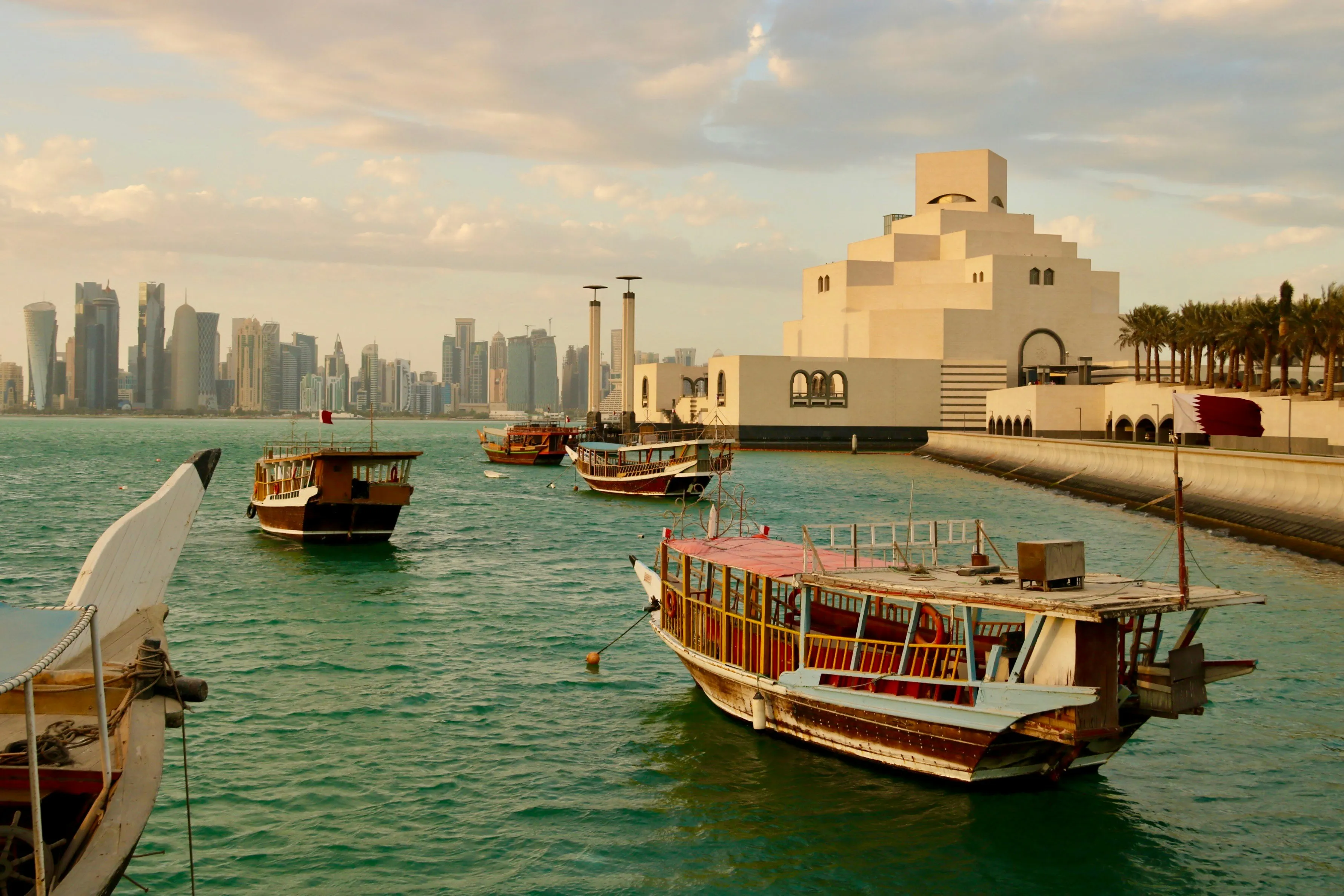
The UAE offers the most mature ecosystem with tiered entry points starting at AED 500,000 for a five-year Green Visa. Saudi Arabia's Premium Residency programme provides permanent, sponsor-free status but demands SAR 7 million in capital and the creation of 10 jobs under its investor track. Qatar, the newest entrant to broaden its framework, now offers a five-year entrepreneur visa announced at Web Summit Qatar 2026, alongside property-linked residency from USD 200,000. Each programme serves a different business profile — and choosing the wrong one can cost years and significant capital.
Metric | 🇦🇪 UAE | 🇸🇦 Saudi Arabia | 🇶🇦 Qatar |
Entry-Level Investment | AED 12,500–500,000 (USD 3,400–136,000) | SAR 400,000 (USD 107,000) entrepreneur track | QAR 250,000 (USD 68,500) Mustaqel visa |
Top-Tier Investment | AED 2,000,000 (USD 545,000) Golden Visa | SAR 7,000,000 (USD 1.87M) investor track | QAR 3,650,000 (USD 1M) permanent residency |
Corporate Tax Rate | 9% above AED 375K; 0% in qualifying free zones | 20% on foreign share; 0% for RHQ programme | 10% flat on foreign share |
Personal Income Tax | 0% | 0% | 0% |
Processing Time | 48 hours – 3 weeks | 1–3 months | 2–8 weeks |
UAE Investor Visas: The Tiered Ecosystem
The UAE operates the most granular investor-visa system in the Gulf. As of January 2026, the government's 'Residency 2.0' framework is fully operational, with 98% of the application process digitised through the ICP and GDRFA portals. Three primary tiers serve different business scales.
The 2-Year Investor Visa
This entry-level permit targets founders of small businesses and early-stage ventures. The minimum investment ranges from AED 12,500 to AED 25,500 depending on the free zone or mainland jurisdiction. It is renewable biennially and allows family sponsorship.
However, from 1 January 2026, renewal now requires demonstrable business substance — active financial records, a valid Ejari lease under the company's trade licence, and a minimum corporate bank balance of AED 50,000. Inactive or paper-only company structures will no longer pass compliance checks, and a maximum of two Partner Visas is permitted per company.
The 5-Year Green Visa
Designed for mid-scale investors and entrepreneurs, the Green Visa requires a minimum capital commitment of AED 500,000 (approximately USD 136,000). It is self-sponsored, meaning no local partner or employer is needed. Holders may live and work across all seven emirates.
The 10-Year Golden Visa
The Golden Visa sits at the top of the UAE's hierarchy. It requires a minimum investment of AED 2,000,000(approximately USD 545,000) via property purchase, a UAE bank deposit, a local investment fund, or equity in a UAE company. Qualifying property can be mortgaged, provided the paid-up portion meets the AED 2 million threshold. Off-plan properties from approved developers are also eligible.
Key advantages:
- 10-year renewable residency with extended absence permitted
- Unlimited family sponsorship including spouse, children, and parents
- No local sponsor required; full banking and business access
- Self-sponsorship and complete independence from local partners
UAE Tax Environment
The UAE levies a 9% corporate income tax on profits exceeding AED 375,000, introduced in June 2023. Profits below that threshold are taxed at 0%. There is no personal income tax. Free zone entities performing qualifying activities may access a 0% corporate tax rate, subject to meeting substance requirements. The UAE has also adopted the OECD Pillar Two Domestic Minimum Top-Up Tax (DMTT) at 15% for large multinationals. VAT is applied at 5%.
Saudi Arabia: Premium Residency and the MISA Route
Saudi Arabia's investor residency framework operates on two parallel tracks: the Ministry of Investment (MISA) investment licence and the Premium Residency programme. Both have been expanded significantly under Vision 2030.
MISA Investment Licence
The most common route for foreign investors establishing an operating business. After receiving a MISA licence and completing company registration, the investor obtains a work visa and Iqama residency permit tied to the licenced entity. This route carries ongoing obligations: maintaining minimum capital, meeting Saudisation workforce requirements (Nitaqat), filing annual returns, and demonstrating genuine commercial activity.
The corporate tax rate for foreign-owned entities is 20% on net adjusted profits, administered by the Zakat, Tax, and Customs Authority (ZATCA). Saudi and GCC nationals pay Zakat at 2.5% on net worth instead of CIT.
Premium Residency — Investor Track
The Premium Residency programme — often called the 'Saudi Green Card' — offers permanent, sponsor-free residency. The investor track requires:
- Minimum capital investment of SAR 7 million (approximately USD 1.87 million) through a MISA-licenced entity
- Creation of 10 full-time jobs within the first two years
- One-time residency fee of SAR 4,000
Key advantages:
- Permanent residency with no renewal cycle
- Freedom to own residential and commercial property
- Family sponsorship for spouse, children under 25, and parents
- Exemption from expatriate dependent fees
- Ability to work in the private sector and switch employers
- Priority airport lanes alongside Saudi citizens
Alternative Premium Residency Tiers
Beyond the investor track, Saudi Arabia offers several additional pathways:
Pathway | Cost | Duration | Key Requirement |
Direct-Payment Permanent | SAR 800,000 (USD 213,000) one-time | Permanent | Financial capacity, age 21+ |
Annual Renewable | SAR 100,000/year (USD 27,000) | 1 year, renewable | Age 21+, clean record |
Real Estate | SAR 4M+ property in Riyadh/Jeddah | Permanent | No job-creation mandate |
Entrepreneur (Cat. 1) | SAR 400,000 (20% share) | 5 years, renewable once | MISA entrepreneur licence |
Saudi Tax Environment
Saudi Arabia imposes a 20% corporate income tax on the foreign-owned share of business profits. There is no personal income tax on salary or employment income. VAT is levied at 15%. Companies qualifying under the Regional Headquarters (RHQ) Programme may access a 0% corporate tax rate for a renewable period of 30 years. Special Economic Zones offer additional reduced rates. ZATCA has signalled continued alignment with the OECD Pillar Two global minimum tax framework at 15% for multinationals with consolidated revenues exceeding EUR 750 million.
Qatar: A Broadening Framework
Qatar has historically maintained a narrower investor-visa system compared to the UAE and Saudi Arabia. That is changing. In February 2026, at Web Summit Qatar, the government launched two new residency categories specifically targeting entrepreneurs and senior executives. Combined with the existing property-linked residency programme, Qatar now offers multiple pathways for foreign business operators.
Property-Linked Residency
Foreign nationals who purchase real estate worth at least QAR 728,000 (approximately USD 200,000) in designated freehold zones — including The Pearl-Qatar, West Bay Lagoon, Lusail, and Al Dafna — receive a renewable one-year residence permit.
A higher investment of QAR 3.65 million (approximately USD 1 million) qualifies for permanent residency, subject to annual government quotas. Permanent residents gain access to public healthcare, education, and visa-free movement across GCC states. A minimum physical presence of 90 days per year is required.
Entrepreneur Residency Visa (New – 2026)
Announced at Web Summit Qatar 2026, this five-year self-sponsored visa targets founders and innovators establishing or expanding businesses in Qatar. Key requirements:
- Endorsement from a recognised Qatari business incubator (QSTP, QFH, or QBIC)
- Minimum bank balance of QAR 36,500 (approximately USD 10,000) maintained over three months
- Government fee of QAR 5,000 (approximately USD 1,374)
Holders gain access to business support programmes, incubator networks, and streamlined licensing pathways.
Executive Residency Visa (New – 2026)
Also launched at Web Summit Qatar 2026, this visa targets senior professionals in C-suite and director-level positions. Requirements include:
- Five years of experience in senior executive management
- Valid local employment contract with qualifying employer types (listed companies, banks, regulated financial institutions, government-adjacent consulting firms)
- Minimum monthly salary of QAR 50,000 (USD 13,700) for C-suite; QAR 80,000 (USD 22,000) for executive directors
Mustaqel Visa
Launched in February 2024, the Mustaqel Visa provides a five-year, employer-independent residence for entrepreneurs with a minimum project value of QAR 250,000 (approximately USD 68,500), backed by an approved incubator. It also covers talented professionals in fields such as IT, healthcare, finance, and scientific research.
Qatar Tax Environment
Qatar applies a flat 10% corporate income tax on the foreign-owned share of profits. Companies wholly owned by Qatari or GCC nationals are exempt. There is no personal income tax, no wealth tax, and no VAT — although implementation at 5% remains under consideration. Qatar has adopted the OECD Pillar Two DMTT for qualifying multinationals. The country maintains over 80 double taxation agreements. Excise taxes apply to tobacco and energy drinks at 100%, and carbonated drinks at 50%.
Head-to-Head Comparison
The following table compares the three programmes across ten dimensions relevant to enterprise operators and SME founders.
Dimension | 🇦🇪 UAE | 🇸🇦 Saudi Arabia | 🇶🇦 Qatar |
Entry-Level Investment | AED 12,500–500,000 (USD 3,400–136,000) | SAR 400,000 (USD 107,000) entrepreneur track | QAR 728,000 (USD 200,000) property; QAR 250,000 (USD 68,500) Mustaqel |
Top-Tier Investment | AED 2,000,000 (USD 545,000) Golden Visa | SAR 7,000,000 (USD 1.87M) investor track | QAR 3,650,000 (USD 1M) permanent residency |
Visa Duration | 2 / 5 / 10 years (renewable) | Permanent (investor); 5-year (entrepreneur) | 1-year (property); 5-year (entrepreneur / Mustaqel); permanent (USD 1M+) |
Corporate Tax | 9% above AED 375K; 0% in qualifying free zones | 20% on foreign share; 0% for RHQ programme | 10% flat on foreign share; 0% for Qatari/GCC-owned |
Personal Income Tax | 0% | 0% | 0% |
VAT | 5% | 15% | Not yet implemented (5% proposed) |
Sponsor Required | No (Green / Golden Visa) | No (Premium Residency) | No (Mustaqel / Entrepreneur visa) |
Family Sponsorship | Spouse, children, parents | Spouse, children <25, parents | Spouse, dependent children |
Job-Creation Mandate | None for visa; required for some licences | 10 jobs in 2 years (investor track) | None for property/entrepreneur visa |
Processing Time | 48 hours – 3 weeks (digital) | 1–3 months | 10–15 working days (initial); 4–8 weeks (long-term) |
Strategic Considerations by Business Profile
For SMEs and Early-Stage Founders
The UAE remains the path of least resistance. A free zone licence can be secured with minimal share capital, and the 2-year investor visa starts from under USD 7,000 in total setup costs. However, the January 2026 renewal rules now require genuine business activity — a corporate bank balance of AED 50,000, an active trade licence, and a valid office lease. Dormant shell structures will no longer pass compliance checks.
Qatar’s new entrepreneur visa and Mustaqel programme offer an alternative with lower capital entry points (USD 10,000–68,500), but the ecosystem is still maturing and incubator endorsement is mandatory.
For Mid-Market Companies Seeking Regional HQ Status
Saudi Arabia’s RHQ Programme is a compelling proposition: a 0% corporate tax rate for 30 years for companies that relocate their regional headquarters to the Kingdom. The programme has a de facto enforcement mechanism — companies without Saudi-based regional HQs risk exclusion from government procurement contracts.
The trade-off is a 20% headline CIT on standard operations, higher than both the UAE (9%) and Qatar (10%). The UAE’s DIFC and ADGM remain strong alternatives, particularly for financial services, with established common-law legal frameworks.
For Capital-Intensive Investors
Investors deploying USD 1 million or more have options in all three jurisdictions. Qatar’s permanent residency at the USD 1 million threshold is the lowest of the three for that status level. Saudi Arabia’s investor track demands nearly double (USD 1.87 million) but delivers permanent residency with full economic rights and no renewal cycle. The UAE’s Golden Visa at USD 545,000 is the most cost-effective for long-term residency without the permanence label.
Key Risks and Compliance Notes
- UAE: Stricter renewal compliance from January 2026. Inactive or shell companies face visa cancellation. Partner visas capped at two per company. Must maintain AED 50,000 corporate bank balance.
- Saudi Arabia: The 10-job mandate on the investor track is enforceable and audited. Saudisation requirements (Nitaqat) apply after three years. Corporate tax at 20% is significantly higher than peers.
- Qatar: Permanent residency is subject to annual government quotas. Applicants for permanent status may need to demonstrate basic Arabic proficiency. The free zone ecosystem (QFC, QSTP) is smaller than the UAE’s.
- All three jurisdictions: OECD Pillar Two global minimum tax (15%) applies to multinationals with consolidated revenues above EUR 750 million. Each country has adopted a DMTT mechanism.
WorldPath View
The Gulf’s investor-visa landscape in 2026 is the most competitive it has ever been. Each programme has a clear centre of gravity:
The UAE is best suited for speed, flexibility, and businesses that need immediate market access with minimal capital. It is the default choice for SMEs, digital-first companies, and founders who value ecosystem maturity over incentive scale.
Saudi Arabia is the long-play for companies prepared to commit capital and headcount in exchange for permanent status and access to the largest consumer market in the GCC (population 32+ million). The RHQ tax incentive is unmatched, but the compliance bar is high.
Qatar is the strategic middle ground — lower corporate tax than Saudi Arabia, a property-linked permanent residency at USD 1 million, and a newly expanding entrepreneur ecosystem. It is most compelling for investors who want a GCC base with moderate capital outlay and the lowest corporate tax rate among the three.
No single programme is universally optimal. The right decision depends on capital availability, operational scale, target market, and the acceptable compliance burden. Businesses planning regional expansion may benefit from holding residency in more than one jurisdiction — a strategy that all three countries now formally permit.


